Radar check
What we found when we opened it. Every bar is one fact, with its date.
Last code pushed 15 Jun 2026, 4 months before this check.
No releases published on GitHub; the code date above is the one to trust.
Public since March 2023, a little over 3 years.
789 stars and 154 forks.
0 commits and 2 new issues in the last 90 days.
40 contributors. No pull requests merged in 90 days; changes go in directly.
A security policy says how to report a problem. 3 published security advisories.
How the bars are scored
- Alive. Days since the last code push: a week or less 100, a month 90, three months 70, six months 50, a year 30, eighteen months 15, older 0.
- Releases. Age of the latest GitHub release, on a similar scale; no bar when the project publishes no releases.
- Maturity. Age of the project: eight years 100, five 90, three 70, two 55, one 40, six months 25, younger 10.
- Adoption. Stars on a log scale: 100,000 stars is 100, 10,000 is 80, 1,000 is 60, 100 is 40.
- Activity. Commits in the last 90 days: 300 or more 100, 100 85, 30 65, 10 45, any 25.
- Community. People who have contributed: 100 or more 100, 30 80, 10 60, 5 40, 2 25, one 10.
- Security. A published security policy 80, none 40; published advisories are listed, not scored.
Checked by Repo Radar on 28 Oct 2026 from the repository on GitHub.
In simple English
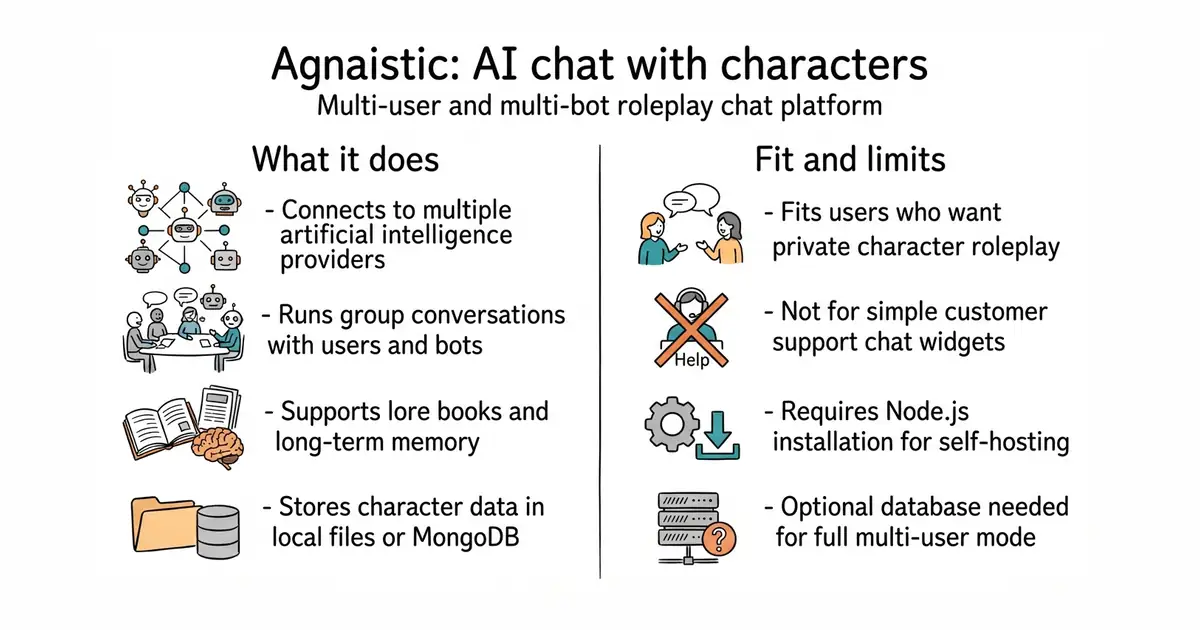
This program lets you chat with fictional characters using artificial intelligence. You can talk to multiple bots at once in group chats. It connects to many different language model providers so you choose which service runs the brain. You can run it on your own computer or server to keep your chats private. It costs whatever you spend on the artificial intelligence services you plug into it.
What it is
Agnaistic is a multi-user and multi-bot web chat application designed for roleplay with fictional characters. It supports several different artificial intelligence backends, lore books, and group chats.
What it is good for
Anyone who wants to host a private roleplaying chat server for themselves or friends without relying on hosted web services that might change their rules.
Summary (Key Points)from the README
Key features
- Group conversations: Multiple users can chat with multiple bots in the same conversation.
- Many AI services: Supports Kobold, Novel, AI Horde, Goose, OpenAI, Claude, Replicate, OpenRouter and Mancer.
- Persona formats: Reads W++, Square bracket format (SBF), Boostyle and plain text personas.
- Multi-tenancy: Includes user authentication, per-user service and settings choices, and per-user generation presets.
- Subscriptions: Built-in subscription support.
- Memory and lore: Memory and Lore books add context to conversations.
- Character generation: Creates characters with AI.
- Image generation: Generates images through third-party services.
- Optional pipeline features: Adds long-term memory and embedding of Wikipedia articles and PDFs.
- Self-hosting overrides: A `settings.json` file at the root applies application-wide changes, such as a default memory book or extra end tokens via `baseEndTokens`.
Ways to install
| Platform or method | What it needs | Effort |
|---|---|---|
| NPM global package | Node.js and npm; `agnai` then runs the app. Files are stored in `HOME_FOLDER/.agnai`. | Low: one global install and one command |
| Manual from source | Node.js, git or the zip download, `npm run deps` (pnpm v8), and optionally MongoDB | Medium: several build and start steps |
| Docker with MongoDB | Docker and the repository's `self-host.docker-compose.yml` | Low to medium: clone, then one compose command |
| Docker without MongoDB | Docker only; the app is served on port 3001 | Low: one `docker run` command |
Important
- MongoDB is optional: Without it, Agnaistic runs in "Guest Only" or `anonymous-only` mode.
- Anonymous data is browser-bound: Anonymous users' data lives in browser local storage. It cannot be shared across devices or browsers, and clearing browser data or cookies deletes it.
- Redis is used for websockets: The README lists Redis for distributed websocket messaging, but it does not say whether a single-user setup needs it.
- Pipeline features need extra setup: `npm run model` installs Poetry into a virtual environment for the Python pipeline service, and the README mentions `--pipeline` only for the NPM package.
- Settings need a restart: Changes to `settings.json` take effect only after restarting Agnai.
- Dependencies must be refreshed: The README says to run `npm run deps` after every update.
Written by an AI model from the project’s README; not part of the review, and it can be wrong.
- Supports many popular artificial intelligence providers and local backends.
- Allows group conversations with multiple users and multiple bots.
- Can run without a database in a guest-only mode for quick testing.
- Requires Node.js and some command-line setup to run locally.
- MongoDB and Redis are needed for full multi-user persistence.
- AGPL-3.0 licence (a legal agreement that requires you to share your source code if you modify this program and host it for others).
SillyTavern
MongoDB
- SillyTavern/SillyTavern35k stars
A popular frontend for connecting to large language models and character chats with extensive extensions.

- vllm-project/vllm96k stars
A serving engine that makes one graphics card answer many requests at once.
- infiniflow/ragflow93k stars
A question-answering system built on a document collection, with the sources shown beside every answer.
- basicmachines-co/basic-memory4.3k stars
Gives an AI assistant a memory that is stored as plain text files you can read.
npm install agnai -g
agnai