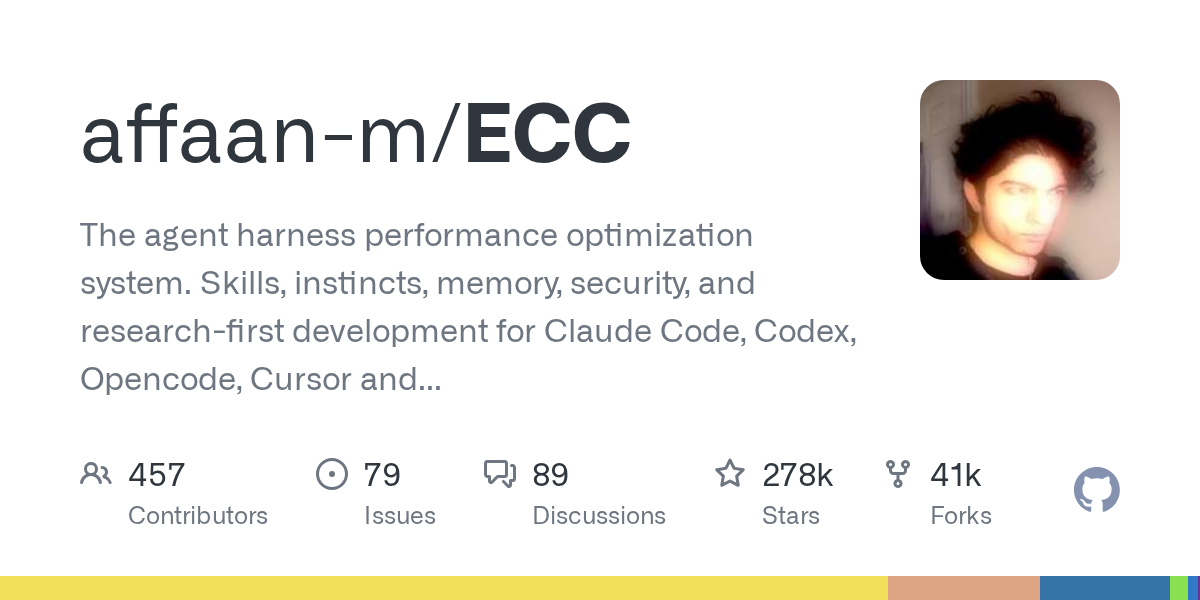
276,800 on the page against 276,183 on ungh; the larger taken stars · MIT, read from /blob/main/LICENSE, plain and unmodified, 'Copyright (c) 2026 Affaan Mustafa'. No second licence file in the root tree, although the README advertises a paid tier for private repositories at $19 per seat per month. · v2.2.3, the release page reading '01 Oct 23:00' with no year and settled as 2026-10-01 by the npm registry, which dates ecc-universal 2.2.3 to 2026-10-02T01:56:16Z, about three hours after the GitHub release; the README's own 'Current release: 2.2.3 (2026-10-01)' agrees. ungh's release cache stops at v2.2.1 and knows neither 2.2.2 nor 2.2.3. · Track this in Scout
A large installable bundle of agents, skills, rules and memory files for coding assistants, with a scanner that audits the settings it installs.
▶Repo detailsthe review · specs · pros & cons · install
What it does
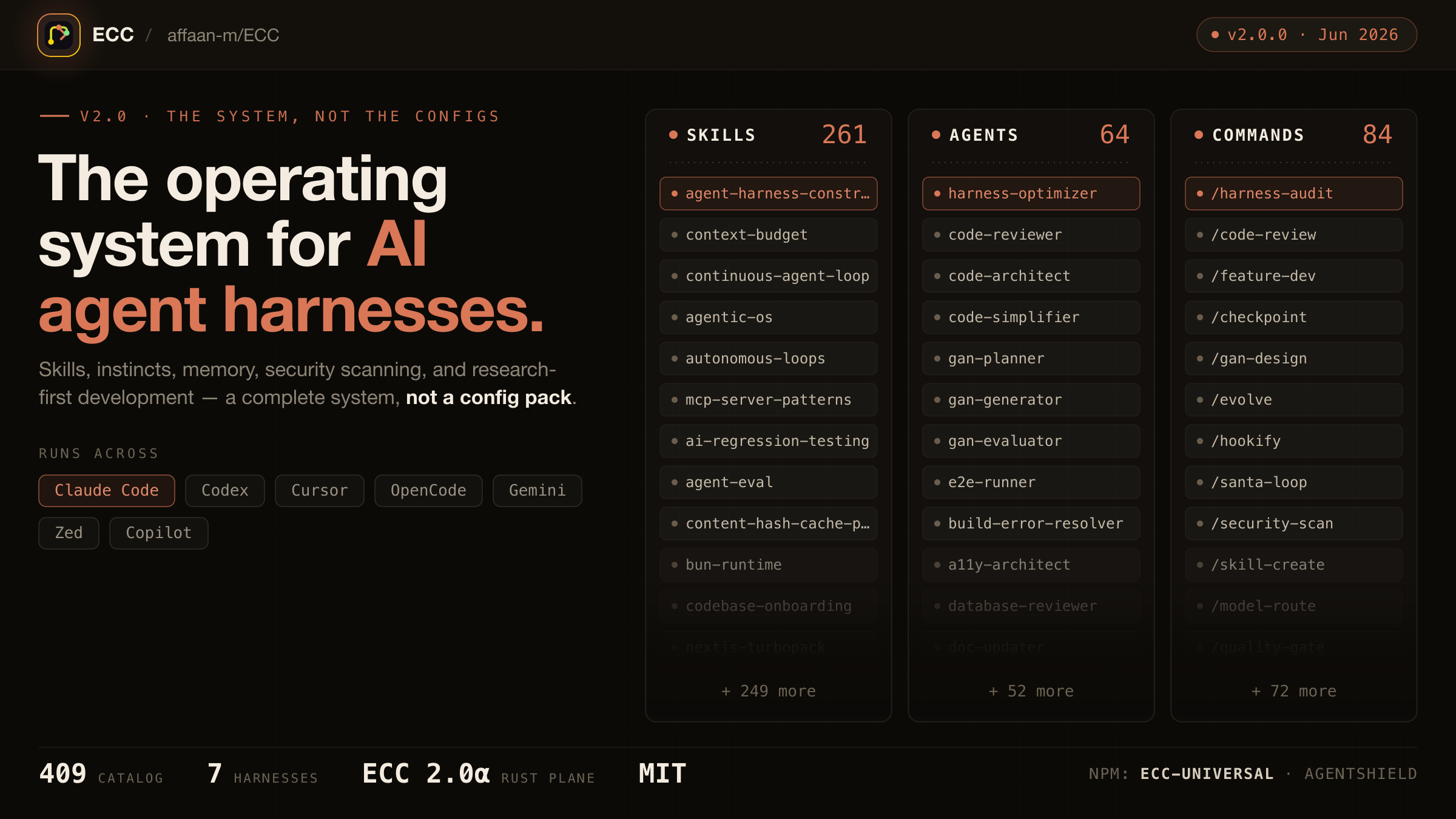
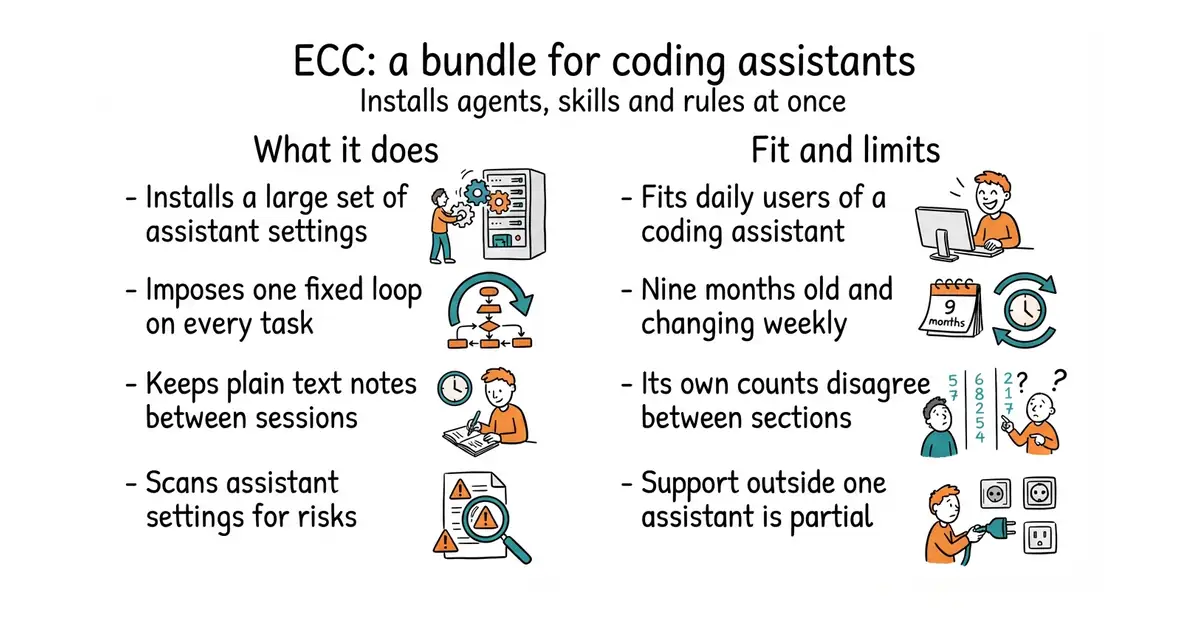
It installs a set of configuration files for coding assistants — Claude Code first, and several others partially. Those files impose a fixed loop on the assistant: plan, test, implement, review, verify, remember, improve. Hooks fire when the assistant uses a tool, and session summaries are written out afterwards. A memory store keeps plain Markdown notes in .ecc/memory/ next to a project and in ~/.ecc/memory/ for everything. A separate piece called AgentShield reads an assistant's own configuration — prompts, hooks, connected servers, permissions, stored secrets — and reports what looks risky. Its own tables claim 68 agents, 293 skills and 94 older command shims. What it does not do is give every assistant the same features: Claude Code is the reference, and the others are explicitly partial. It also says plainly that pinning a version "is not a security audit".
Why it matters
Who it suits. Anyone who already works with a coding assistant every day and has started writing their own instruction files, and who would rather adopt a large tested set than build one slowly. It is also worth a look for the AgentShield part alone, if you want something to read your assistant's settings and tell you what is exposed. Skip it if you use an assistant occasionally; several hundred instructions is a lot of behaviour to inherit for light use.
Verdict. This is the most-starred project in the edition by a wide margin and the youngest, and those two facts together are the reason to be careful rather than the reason to install. 276,000 stars collected since January is a measure of attention, not of whether the instructions suit the work you do. Read the agents and skills you are enabling before you enable them, start with the minimal profile, and treat the memory store as notes rather than rules. Its own documentation disagrees with itself about how many agents and skills there are — one section says 68 and 293, another says 67 and 281 — which is a small thing that tells you how fast it is moving.
- One command installs the whole set, and an uninstall removes only the files it recorded putting there.
- AgentShield is useful on its own: it reads prompts, hooks, permissions and secrets and reports the risks.
- Memory is plain Markdown in a folder you can read and edit, not a database.
- Nine months old, moving fast, and its own README contradicts itself on basic counts.
- Support outside Claude Code is partial: no hook execution on one assistant, no hooks or runtime agents on another, and documented defects on native Windows.
- A paid tier exists for private repositories, so expect the free and paid lines to keep moving.
- hesreallyhim/awesome-claude-code
A curated list of the same kind of resources rather than an installable bundle, at 55,492 stars, with code on 12 October 2026.
Track this in Scout - davila7/claude-code-templates
A command-line tool for configuring and watching the same assistant, at 32,335 stars, narrower and easier to read end to end.
Track this in Scout - SuperClaude-Org/SuperClaude_Framework
The same idea as a framework of commands and personas, at 23,910 stars, older and slower-moving.
Track this in Scout
npx ecc-universal@2.2.3 setup