Radar check
What we found when we opened it. Every bar is one fact, with its date.
Last code pushed 26 Oct 2026, the same day before this check.
Latest release v0.17.3 on 24 Oct 2026.
Public since March 2021, a little over 5 years.
422 stars and 47 forks.
45 commits and 4 new issues in the last 90 days.
27 contributors. 17 pull requests merged in 90 days.
No security policy file says how to report a problem. No published security advisories.
How the bars are scored
- Alive. Days since the last code push: a week or less 100, a month 90, three months 70, six months 50, a year 30, eighteen months 15, older 0.
- Releases. Age of the latest GitHub release, on a similar scale; no bar when the project publishes no releases.
- Maturity. Age of the project: eight years 100, five 90, three 70, two 55, one 40, six months 25, younger 10.
- Adoption. Stars on a log scale: 100,000 stars is 100, 10,000 is 80, 1,000 is 60, 100 is 40.
- Activity. Commits in the last 90 days: 300 or more 100, 100 85, 30 65, 10 45, any 25.
- Community. People who have contributed: 100 or more 100, 30 80, 10 60, 5 40, 2 25, one 10.
- Security. A published security policy 80, none 40; published advisories are listed, not scored.
Checked by Repo Radar on 26 Oct 2026 from the repository on GitHub.
In simple English
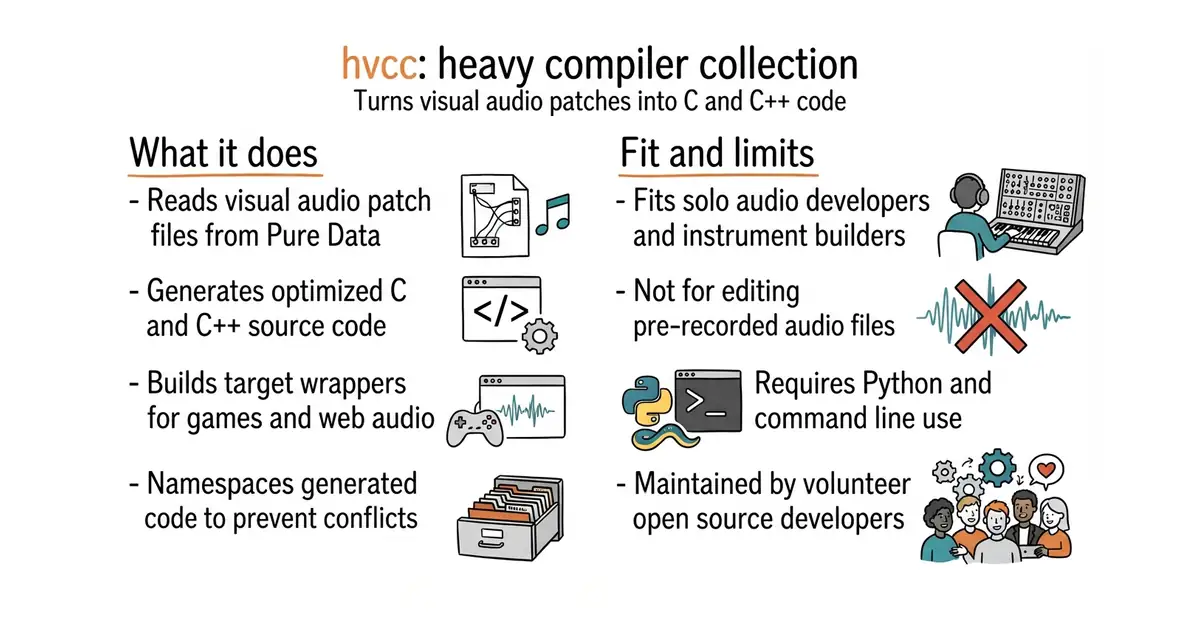
You draw your audio programs using visual boxes and lines in a program called Pure Data. This tool reads those visual files and turns them into plain C or C++ code. That code runs fast on small microchips, inside video game engines, or as plugins for your digital audio workstation. It costs nothing to use, but you need some command-line experience to run the compiler. The project is maintained by volunteers and funded by grants.
What it is
A Python-based compiler that converts visual dataflow audio patches into optimized C and C++ code and framework wrappers. It supports modern Python releases and offers generators for targets like Unity, Wwise, and WebAssembly.
What it is good for
Solo audio developers and instrument designers who want to prototype sound effects visually in Pure Data and export them to high-performance C code without hand-writing low-level audio algorithms.
- Turns visual audio patches into high-performance C and C++ code.
- Includes built-in generators for game engines, web plugins, and audio frameworks.
- Maintains compatibility with standard Pure Data vanilla objects.
- Requires comfort with the command line to invoke compilation flags.
- Dependent on external Python libraries and specific package versions.
- Some advanced Pure Data objects are not supported by the translator.
manual hand-coding of audio digital signal processing algorithms in C or C++
Pure Data for visual patch design
- pure-data/pure-data2.1k stars
The visual programming environment that provides the original design interface for audio patches.
- plugdata-team/plugdata2.4k stars
A modern interface for Pure Data that integrates this compilation toolchain directly into a desktop app.


- spotify/pedalboard6.4k stars
Applies audio effects to recordings from Python, including studio plug-ins, without calling another program.
- iver56/audiomentations2.3k stars
Spoils sound recordings on purpose, 39 ways, so a model trained on them copes with real rooms.
- shaka-project/shaka-packager2.6k stars
Cuts a video file into the pieces and index files that a browser needs in order to stream it.
pip3 install hvcc