Radar check
What we found when we opened it. Every bar is one fact, with its date.
Last code pushed 25 Mar 2026, 7 months before this check.
Latest release v4.8.1 on 11 Feb 2026.
Public since January 2017, a little over 9 years.
2,994 stars and 263 forks.
0 commits and 11 new issues in the last 90 days.
40 contributors. No pull requests merged in 90 days; changes go in directly.
No security policy file says how to report a problem. No published security advisories.
How the bars are scored
- Alive. Days since the last code push: a week or less 100, a month 90, three months 70, six months 50, a year 30, eighteen months 15, older 0.
- Releases. Age of the latest GitHub release, on a similar scale; no bar when the project publishes no releases.
- Maturity. Age of the project: eight years 100, five 90, three 70, two 55, one 40, six months 25, younger 10.
- Adoption. Stars on a log scale: 100,000 stars is 100, 10,000 is 80, 1,000 is 60, 100 is 40.
- Activity. Commits in the last 90 days: 300 or more 100, 100 85, 30 65, 10 45, any 25.
- Community. People who have contributed: 100 or more 100, 30 80, 10 60, 5 40, 2 25, one 10.
- Security. A published security policy 80, none 40; published advisories are listed, not scored.
Checked by Repo Radar on 26 Oct 2026 from the repository on GitHub.
In simple English
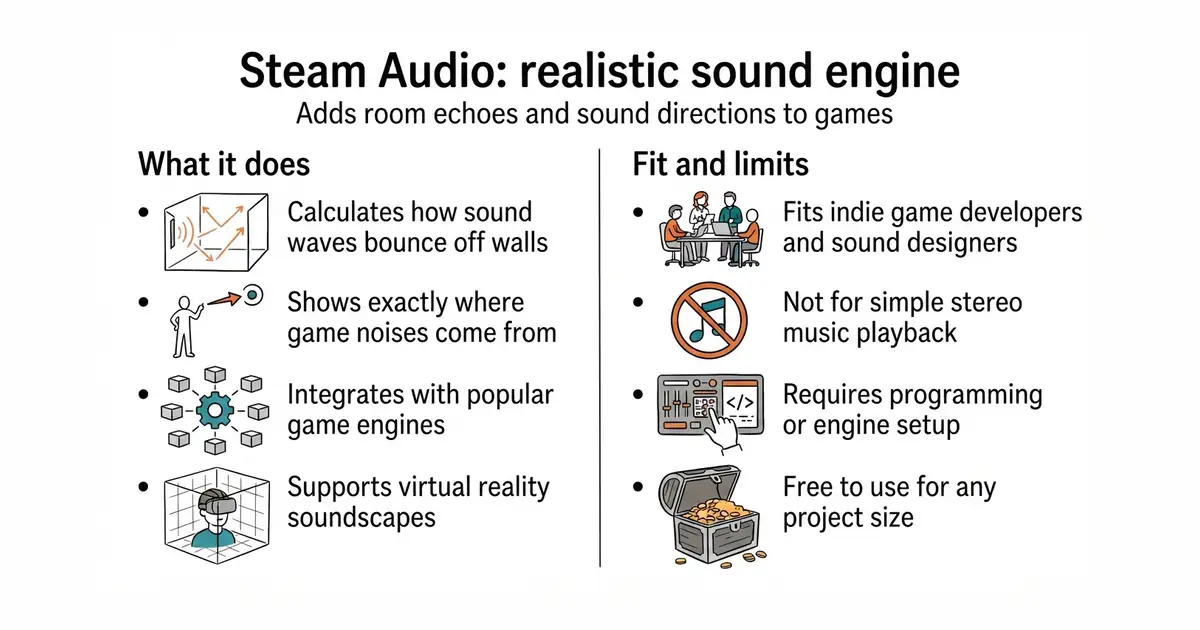
This tool makes sounds feel like they bounce off walls in a real room. It helps players know where noises come from in a game world. You can add it to game engines like Unity or Unreal. It is free to use and comes from Valve Corporation. You need some programming knowledge to set it up.
What it is
Steam Audio is a software library (a collection of pre-written code that helps programmers add specific features without starting from scratch) for 3D spatial sound. It calculates how sound waves move around corners and reflect off surfaces.
What it is good for
Solo game developers who want professional sound effects without buying expensive audio software. It works well for virtual reality projects where sound direction helps players feel immersed.
- Makes game sounds bounce off walls realistically.
- Works across multiple popular game engines.
- Free to use under an open-source licence.
- Requires C++ knowledge or game engine integration skills.
- Needs careful testing to avoid performance drops.
- Documentation can be hard for beginners to follow.
Basic stereo panning and manual volume fading
Unity
- spotify/pedalboard6.4k stars
Applies audio effects to recordings from Python, including studio plug-ins, without calling another program.
- iver56/audiomentations2.3k stars
Spoils sound recordings on purpose, 39 ways, so a model trained on them copes with real rooms.
- shaka-project/shaka-packager2.6k stars
Cuts a video file into the pieces and index files that a browser needs in order to stream it.
Download the software development kit directly from the Steam Audio website and import it into your game engine project.