5.5k stars · GPL-3.0 · v1.8.0 (2026-09-04) · Track this in Rising ↗
Fast local neural speech on plain CPU — the licensed replacement for edge-tts's grey area.
Radar check
What we found when we opened it. Every bar is one fact, with its date.
Last code pushed 25 Oct 2026, 2 days before this check.
Latest release v1.8.0 on 4 Sep 2026.
Public since March 2025, a little over 1 year.
5,995 stars and 585 forks.
63 commits and 29 new issues in the last 90 days.
21 contributors. 28 pull requests merged in 90 days.
No security policy file says how to report a problem. No published security advisories.
How the bars are scored
- Alive. Days since the last code push: a week or less 100, a month 90, three months 70, six months 50, a year 30, eighteen months 15, older 0.
- Releases. Age of the latest GitHub release, on a similar scale; no bar when the project publishes no releases.
- Maturity. Age of the project: eight years 100, five 90, three 70, two 55, one 40, six months 25, younger 10.
- Adoption. Stars on a log scale: 100,000 stars is 100, 10,000 is 80, 1,000 is 60, 100 is 40.
- Activity. Commits in the last 90 days: 300 or more 100, 100 85, 30 65, 10 45, any 25.
- Community. People who have contributed: 100 or more 100, 30 80, 10 60, 5 40, 2 25, one 10.
- Security. A published security policy 80, none 40; published advisories are listed, not scored.
Checked by Repo Radar on 25 Oct 2026 from the repository on GitHub. Covered in Edition 13.
▶Repo detailsthe review · specs · pros & cons · install
What it does
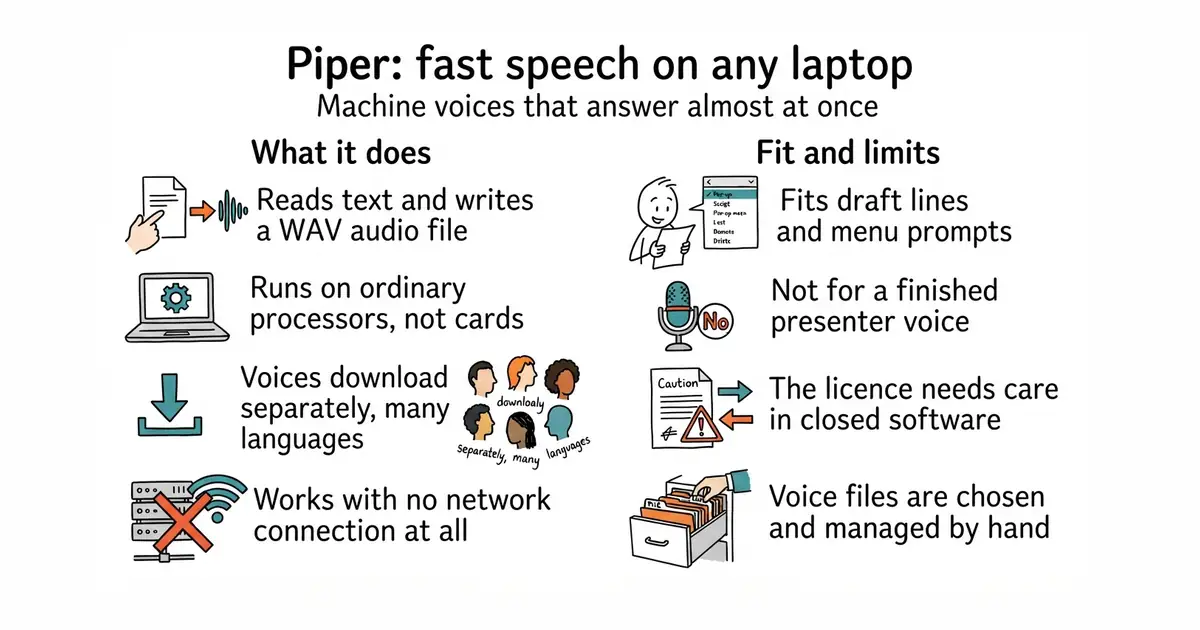
It is a small speech program built for ordinary processors rather than graphics cards. It reads text and writes a WAV audio file, and it is fast enough to use while writing. Voices are separate downloads, and there are many of them across dozens of languages. It is the speech engine behind several home-automation projects, and it is maintained by the Open Home Foundation. Version 1.8.0 was released on 4 September 2026, and code was still being pushed in October 2026. It can be used as a command or as a Python library. It does not copy a voice from a sample, and it will not pass for a person.
Why it matters
Who it suits. It suits anyone who needs speech as a working tool rather than a finished product: hearing how a line sounds before recording it, generating menu prompts, reading chapter titles, or adding speech to a program that must work offline. It also suits anyone uneasy about sending scripts to an outside service. Skip it if the voice is the product, because listeners will hear a machine.
Verdict. Install it, because it costs ten minutes and removes a whole class of waiting. The useful habit is to draft with this and record the final take with a person or with #1. The licence deserves attention: GPL-3.0-or-later means run it as a separate program, and take advice before building it into something sold as closed software. It covers the same ground as edge-tts (Ed. 3 #3), with the difference that this one has a licence anyone can read and does not depend on a private service staying open.
Summary (Key Points)from the README
Key features
- Local neural speech: Runs as a fast, local neural text-to-speech engine, with no cloud service mentioned.
- Built-in phonemization: Embeds espeak-ng to convert text to phonemes before synthesis.
- Command-line interface: Offers a CLI for generating speech from the terminal.
- Web server: Includes a web server option for serving speech over HTTP.
- Python and C/C++ APIs: Provides a Python API and a C/C++ API (libpiper) for embedding in applications.
- Voice training and manual builds: Documents how to train new voices and how to build the project manually.
- Other language bindings: Lists a Java binding (Piper JNI) for languages other than Python and C/C++.
- Real-world adoption: Named users include Home Assistant, NVDA (NonVisual Desktop Access), Open Voice Operating System and LocalAI.
Important
- Maintainer search: The Open Home Foundation is looking for maintainers for Piper, so ongoing upkeep is not assured. Interested people are asked to contact voice@openhomefoundation.org.
- Incomplete install section: The README's "Install with:" line has no command after it, so the install steps must come from elsewhere, such as the linked building or CLI docs.
- Limited bindings: Beyond Python and C/C++, the README lists only one binding, Java (Piper JNI).
- Dependency on espeak-ng: Phonemization depends on the embedded espeak-ng engine, which the README links but does not describe further.
- No performance figures: The README calls the engine fast but gives no speed, size or resource numbers.
Written by an AI model from the project’s README; not part of the review, and it can be wrong.
- Fast on a normal processor and fully offline, so drafts cost nothing and reveal nothing.
- Many languages, with several voices each, including good Russian ones.
- Released steadily, with a clear maintainer behind it.
- It sounds like a machine. No setting changes that.
- GPL-3.0-or-later, which needs thought before it goes near a closed commercial product.
- Voice files are downloaded and managed by hand, and picking a good one takes some listening.
python3 -m venv venv
source venv/bin/activate
pip install piper-tts
python3 -m piper.download_voices en_US-lessac-medium
echo "This is a draft of the opening line." | piper -m en_US-lessac-medium -f draft.wav