2.8k stars · GPL-2.0 | [musicpd.org](https://www.musicpd.org/) · no GitHub releases at all — a determination, not a gap, confirmed 20 October 2026 by opening /releases/latest. The project's own site lists 0.24.16, posted 17 October 2026. · Track this in Scout
A background music player with no interface of its own, controlled over a network by separate client programs.
▶Repo detailsthe review · specs · pros & cons · install
What it does
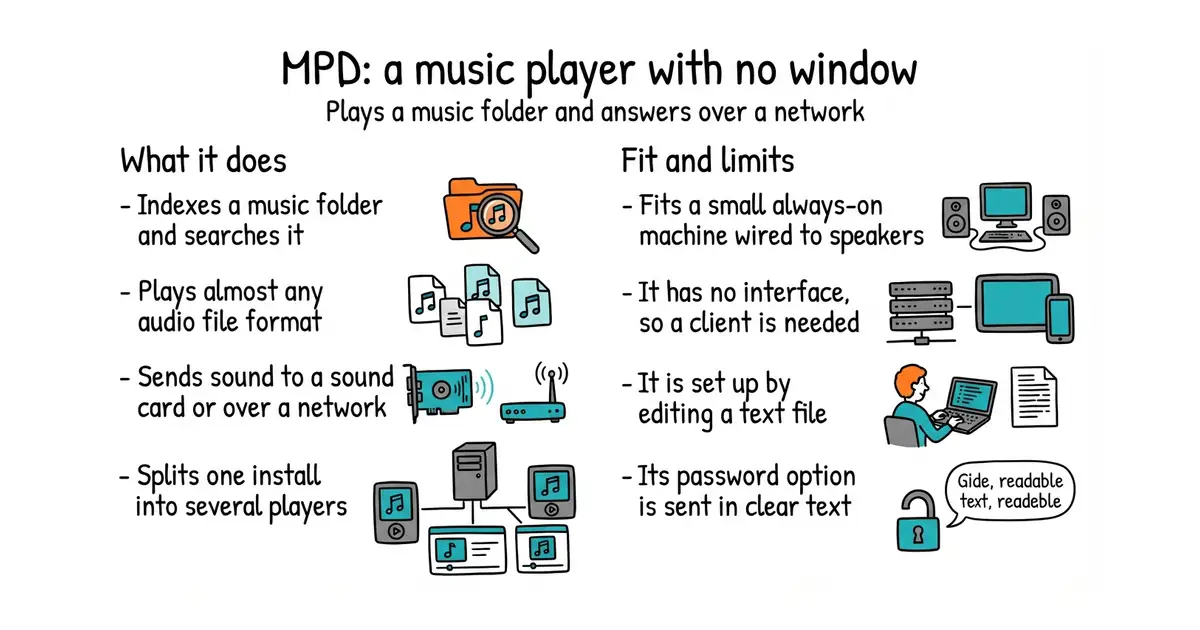
MPD is a daemon, which means a program that runs with no window and waits for instructions. It builds an index of a music folder and answers searches against it, and that folder can sit on the same machine or on a remote server reached through its NFS or SMB storage plugins, with several storages combined if needed. Clients connect over its own network protocol, on port 6600 by default, and mpc is the simple command-line client. Settings live in one file, mpd.conf, with separate blocks for the database, decoders, audio outputs, filters, listeners and permissions, cross-fading, volume levelling, the state file and Zeroconf announcement on the local network. Partitions split one installation into several independent players, each with its own queue and its own outputs, all sharing a single index. Output plugins cover ALSA, PulseAudio, PipeWire, JACK, Core Audio and others, plus httpd and shout, which send the audio over the network instead of to a sound card. Decoders cover FLAC, Vorbis, Opus, MP3, DSD and, through FFmpeg, nearly everything else. The documentation states the boundary plainly: MPD is "a remote-controlled music player, not a music distribution system", so the sound plays where the server is and not where the listener is.
Why it matters
Who it suits. Anyone with a small always-on computer, a sound card and a music collection stored as files. A single-board computer in a cupboard wired to an amplifier is the usual arrangement, and MPD will run in that shape for years without attention. It also suits people who want the player to be scriptable, because everything it does is reachable over a documented protocol. Skip it if the music comes from a streaming subscription. Skip it too if an icon to double-click is what is wanted, because there is no interface here at all, only a protocol and other people's clients.
Verdict. Worth an hour, and remarkable value for a project with 2,799 stars. Currency is not in doubt: 19,739 commits, and code pushed today, 20 October 2026. The project publishes no releases on GitHub at all, so versions are announced on its own site, where 0.24.16 is dated 17 October 2026 and seven earlier versions landed during this year. The documentation is unusually honest, and the list of things the project will not promise is longer than most projects' feature lists, which is a good sign. Three practical warnings. The documentation says the versions in Debian and Ubuntu stable releases are usually too old for the project to support, so expect to build from source if a bug turns up. The password option is sent in clear text, so port 6600 should stay on a trusted network. And bit-perfect output, meaning the audio reaching the sound card unchanged, is attempted by default but is lost as soon as software volume, volume levelling or a forced audio format is switched on. Pair it with snapcast/snapcast below for the same music in more than one room.
- Very light and very stable: no window, a documented protocol, and 19,739 commits behind it.
- Plays almost any format and sends sound to almost any output, including over the network through
httpdorshout. - Partitions give several independent players from one installation and one music index.
- No interface of its own. A client has to be chosen and installed, and the good ones come from other people.
- Set up by editing
mpd.conf, with blocks and plugin names to learn before the first note plays. - The built-in password option is clear text over the wire, and the project says distribution packages are usually too old for it to support.
- mopidy/mopidy
The same idea in Python, speaking the same protocol so the same clients work, with extensions for streaming sources.
Track this in Scout  navidrome/navidrome
A different answer: a web and mobile music server that streams a collection to the listener rather than playing it where the server is.
Track this in Scout beetbox/beets
Not a player but the thing to run before one: it tidies and tags a music library so the index is worth searching.
Track this in Scout
sudo apt install mpd mpc
sudo nano /etc/mpd.conf        # set music_directory and one audio_output block
sudo systemctl enable --now mpd
mpc update                      # build the index
mpc listall | head              # check it found the files
mpc add / && mpc play