Radar check
What we found when we opened it. Every bar is one fact, with its date.
Last code pushed 26 Oct 2026, one day before this check.
Latest release v2.72.0 on 1 Oct 2026.
Public since October 2025, about 1 year.
54,990 stars and 4,848 forks.
103 commits and 25 new issues in the last 90 days.
58 contributors. 20 pull requests merged in 90 days.
A security policy says how to report a problem. No published security advisories.
How the bars are scored
- Alive. Days since the last code push: a week or less 100, a month 90, three months 70, six months 50, a year 30, eighteen months 15, older 0.
- Releases. Age of the latest GitHub release, on a similar scale; no bar when the project publishes no releases.
- Maturity. Age of the project: eight years 100, five 90, three 70, two 55, one 40, six months 25, younger 10.
- Adoption. Stars on a log scale: 100,000 stars is 100, 10,000 is 80, 1,000 is 60, 100 is 40.
- Activity. Commits in the last 90 days: 300 or more 100, 100 85, 30 65, 10 45, any 25.
- Community. People who have contributed: 100 or more 100, 30 80, 10 60, 5 40, 2 25, one 10.
- Security. A published security policy 80, none 40; published advisories are listed, not scored.
Checked by Repo Radar on 28 Oct 2026 from the repository on GitHub.
In simple English
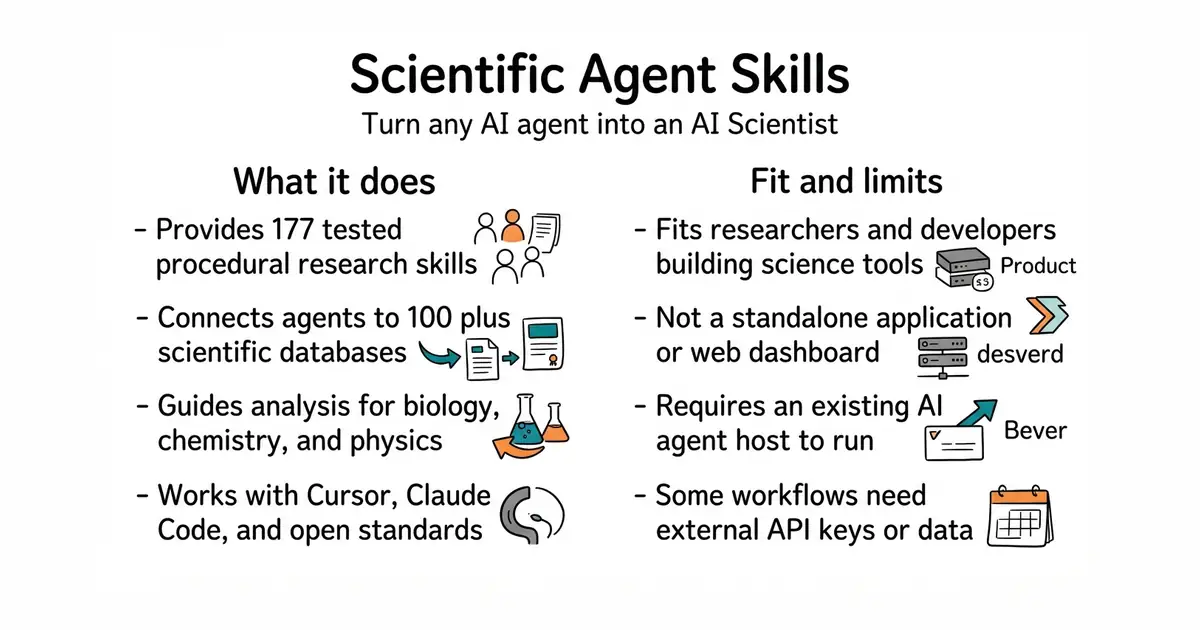
This repository gives your coding assistant specialized knowledge for biology, chemistry, physics, and medicine. It teaches the AI how to work with 100 scientific databases and 70 popular research packages. Instead of writing code from scratch, your agent follows tested workflows for tasks like analyzing gene sequences or simulating chemical structures. You can install it on your computer for free and use it with your own API keys. It requires some technical comfort to set up and run correctly.
What it is
A comprehensive collection of 177 procedural skills and documentation files that guide AI coding agents through complex scientific data analysis. It follows the open Agent Skills standard and integrates with tools like Cursor, Claude Code, and Codex.
What it is good for
Researchers and developers who want their AI assistant to reliably perform bioinformatics, cheminformatics, and data analysis tasks without making basic mistakes.
Summary (Key Points)from the README
Key features
- Broad skill catalog: 177 skills cover biology, chemistry, medicine, physics, engineering, Earth science, data analysis, and scientific communication.
- Database access: The Database Lookup skill documents 80 databases with public, registered, or licensed access, including endpoint selection, pagination, and provenance.
- Package guidance: More than 70 version-aware skills cover packages such as RDKit, Scanpy, PyTorch Lightning, scikit-learn, pymatgen, and Qiskit.
- Platform integrations: 9 skills cover Benchling, DNAnexus, LatchBio, OMERO, Protocols.io, Open Notebook, Ginkgo Cloud Lab, LabArchives, and Opentrons.
- Clinical and regulatory support: Skills cover PK/PD modelling (NCA, population PK, bioequivalence, first-in-human dose) and draft preparation for ISO and ICH/USP/CLSI frameworks.
- Open standards: The collection follows the Agent Skills standard and ships as an Agent Plugins package with `plugin.json` and `skills/`.
- Testing: Skills with bundled `scripts/` have test suites under `tests/<skill-name>/`, and pull requests run repository-wide structural checks.
- Security scanning: Every skill is scanned with the Cisco AI Defense Skill Scanner. Scans run weekly, with a full rescan at least every 30 days, and results are published in `docs/security-report.md`.
Ways to install
| Platform or method | What it needs | Effort |
|---|---|---|
| npx (supported Agent Skills hosts) | npx and a supported host such as Claude Code, Codex, Gemini CLI, Cursor, or Google Antigravity | Low |
| GitHub CLI (`gh skill`) | GitHub CLI v2.90.0 or later; supports version pinning and updates | Low |
| Agent Plugins (Cursor, Codex, other plugin clients) | A local checkout, a symlink into the Cursor plugins directory, or the Codex plugin install | Medium |
| Manual git clone | git and a host that scans `~/.agents/skills/` or `.agents/skills/` | Low |
| Hermes skill tap | A Hermes version that supports skill taps | Low |
Important
- Dependencies are separate: Installing the skill files does not install their packages, system tools, credentials, or network access. Follow each skill's `compatibility` field.
- Environment conflicts: Some skills need different Python versions or incompatible pins, so use a separate environment for each workflow. `uv sync` only installs the repository's development tools.
- Prerequisites: Repository tooling needs Python 3.13+ and uv. Windows is supported only through WSL2.
- Code execution risk: Skills can run code, install packages, make network requests, and modify files. Read each `SKILL.md` and scan third-party skills before installing.
- Community skills: Many community contributions may not have been reviewed as thoroughly as K-Dense-authored ones. The maintainers recommend installing only the skills you need.
- Research-only scope: Clinical, healthcare, animal welfare, and regulatory skills are aids for research or draft preparation. They do not support patient-specific diagnosis, treatment, or certification decisions.
- Removed document skills: The `docx`, `pdf`, `pptx`, and `xlsx` skills are no longer bundled. Install them from Anthropic's repository if needed.
- Uneven validation: Local tests, live-service checks, and illustrative examples have different coverage. Verify skills in your target environment.
- NemoClaw networking: Under NemoClaw's default-deny networking, skills that need network access only work after the operator approves the relevant domains.
Written by an AI model from the project’s README; not part of the review, and it can be wrong.
- Provides 177 validated skills covering major scientific domains.
- Includes guidance for over 100 databases and specialized Python packages.
- Compatible with multiple popular AI coding assistants and open standards.
- Requires Python and package management tools to run dependencies.
- Some advanced scientific workflows need external API keys or heavy computation.
- Local security review is recommended since skills can execute code.
manual API research and writing custom integration scripts for scientific data
Cursor
- anthropics/skills184k stars
Anthropic's official collection of agent skills for document processing and general tasks.

- vllm-project/vllm96k stars
A serving engine that makes one graphics card answer many requests at once.
- infiniflow/ragflow93k stars
A question-answering system built on a document collection, with the sources shown beside every answer.
- basicmachines-co/basic-memory4.3k stars
Gives an AI assistant a memory that is stored as plain text files you can read.
npx skills add K-Dense-AI/scientific-agent-skills