15.3k stars · AGPL-3.0 · v8.2.4 (2026-08-04) · Track this in Rising ↗
Self-hosted video with an ActivityPub feed — the copy of your tutorials whose delivery you control.
Radar check
What we found when we opened it. Every bar is one fact, with its date.
Last code pushed 16 Oct 2026, 11 days before this check.
Latest release v8.3.1 on 28 Sep 2026.
Public since October 2015, a little over 10 years.
15,362 stars and 1,848 forks.
413 commits and 68 new issues in the last 90 days.
850 contributors. 22 pull requests merged in 90 days.
A security policy says how to report a problem. 11 published security advisories.
How the bars are scored
- Alive. Days since the last code push: a week or less 100, a month 90, three months 70, six months 50, a year 30, eighteen months 15, older 0.
- Releases. Age of the latest GitHub release, on a similar scale; no bar when the project publishes no releases.
- Maturity. Age of the project: eight years 100, five 90, three 70, two 55, one 40, six months 25, younger 10.
- Adoption. Stars on a log scale: 100,000 stars is 100, 10,000 is 80, 1,000 is 60, 100 is 40.
- Activity. Commits in the last 90 days: 300 or more 100, 100 85, 30 65, 10 45, any 25.
- Community. People who have contributed: 100 or more 100, 30 80, 10 60, 5 40, 2 25, one 10.
- Security. A published security policy 80, none 40; published advisories are listed, not scored.
Checked by Repo Radar on 25 Oct 2026 from the repository on GitHub. Covered in Edition 13.
▶Repo detailsthe review · specs · pros & cons · install
What it does
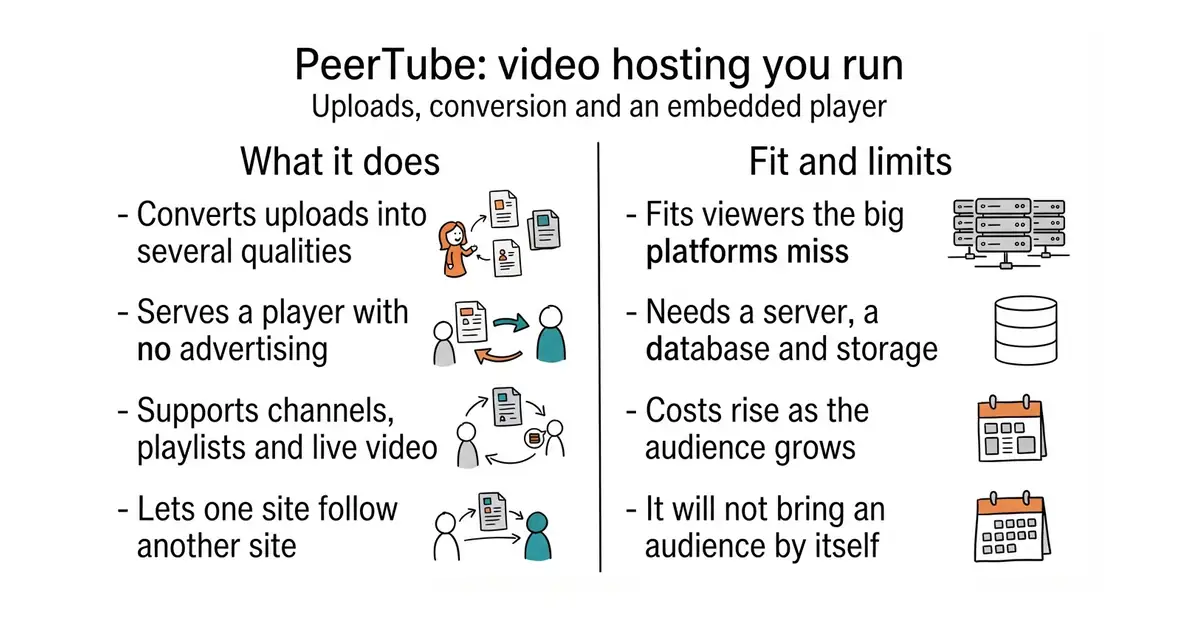
It is a complete video platform: upload, convert, store, and an embeddable player. It converts uploads into several qualities, or accepts files already converted elsewhere. It supports live streaming, playlists, channels, subscriptions and comments. Servers can follow each other, so videos from one site appear in another's listings, and it publishes feeds that other software can read. It is released steadily, with version 8.3.1 dated 28 September 2026. It is a service, not a program: it needs Node.js, PostgreSQL, Redis and real storage, and it does not bring an audience with it.
Why it matters
Who it suits. It suits anyone whose viewers are partly unreachable on the large platforms, and anyone who embeds video on a commercial page where suggested videos at the end are unwelcome. It suits organisations with a reason to hold their own copies. Skip it if the goal is reach, because that still lives on the large platforms, and skip it if there is no appetite for running a service.
Verdict. A real commitment rather than an afternoon, and worth it only for one of the narrow reasons above. Convert video on a desktop machine and upload the finished files, because conversion will overwhelm a small server. Storage and bandwidth are the first cost in this edition that grows with success, so plan for it. owncast/owncast is much lighter if the need is live streaming, and mediacms-io/mediacms is lighter if it is a private library.
Summary (Key Points)from the README
Key features
- Live streaming: Upload videos to stream anywhere, or start livestreams from your favorite client and host permanent streams.
- Fediverse discovery: Videos added with a description and tags can be found across the whole video fediverse, not only on your instance, and you can embed a player on other websites.
- Following without an account: Follow channels from Mastodon, Pleroma and other Fediverse software, or via RSS, without needing an account on the instance hosting the video.
- Customizable interface: Users and administrators can change colors, choose whether an instance lists its videos, and use alternative clients instead of the default web client.
- Peer-to-peer sharing: Visitors use P2P with WebRTC to share the load, and instances cache each other's videos so small instances can reach a wider audience.
- Support button: Creators can show a message linking to donation accounts or other destinations, as an alternative to pay-per-view and advertising.
- Public API documentation: A REST API has an OpenAPI 3.0.0 schema and a spec explorer, and ActivityPub is documented separately.
- Non-programmer contributions: You can help by giving feedback, reporting bugs, translating, or writing documentation.
Ways to install
| Platform or method | What it needs | Effort |
|---|---|---|
| Production guide (recommended for installing or upgrading) | Hardware requirements are covered in the FAQ under "Should I have a big server to run PeerTube?" | Not stated in the README |
| Community packages (various platforms, including YunoHost and Docker) | Depends on the specific package; the README does not list requirements | Not stated in the README |
Important
- Hardware: Check the FAQ on server size before setting up an instance; the README does not give specific requirements itself.
- Pre-release builds: The demonstration instances labeled Nightly and RC are not the stable release.
- Public discoverability: Videos are discoverable across the wider fediverse, not only on your own instance.
- Community packages: Their platform coverage and maintenance are not detailed in the README, so verify each one before relying on it.
- License: The code is licensed under AGPL v3 or later, so redistribution and modification are governed by those terms.
Written by an AI model from the project’s README; not part of the review, and it can be wrong.
- Full control of the player and the embed: no advertising, no suggested videos, no outside tracking.
- Publishes feeds, so other tools can react when something is posted.
- Actively released, with a long history and a clear licence.
- A real service to run: Node.js, PostgreSQL, Redis, storage, and video conversion that needs headroom.
- Storage and bandwidth costs rise as the audience grows.
- AGPL-3.0 licence, and the network of servers will not deliver an audience to a new site.
The embed then replaces lite-youtube-embed (Ed.
Follow the official guide at https://docs.joinpeertube.org, which uses Docker Compose, a way to run several linked services from one file.