Radar check
What we found when we opened it. Every bar is one fact, with its date.
Last code pushed 26 Oct 2026, the same day before this check.
Latest release v7.50.0 on 20 Oct 2026.
Public since March 2026, 7 months.
193 stars and 32 forks.
485 commits and 18 new issues in the last 90 days.
10 contributors. 446 pull requests merged in 90 days.
No security policy file says how to report a problem. No published security advisories.
How the bars are scored
- Alive. Days since the last code push: a week or less 100, a month 90, three months 70, six months 50, a year 30, eighteen months 15, older 0.
- Releases. Age of the latest GitHub release, on a similar scale; no bar when the project publishes no releases.
- Maturity. Age of the project: eight years 100, five 90, three 70, two 55, one 40, six months 25, younger 10.
- Adoption. Stars on a log scale: 100,000 stars is 100, 10,000 is 80, 1,000 is 60, 100 is 40.
- Activity. Commits in the last 90 days: 300 or more 100, 100 85, 30 65, 10 45, any 25.
- Community. People who have contributed: 100 or more 100, 30 80, 10 60, 5 40, 2 25, one 10.
- Security. A published security policy 80, none 40; published advisories are listed, not scored.
Checked by Repo Radar on 26 Oct 2026 from the repository on GitHub.
In simple English
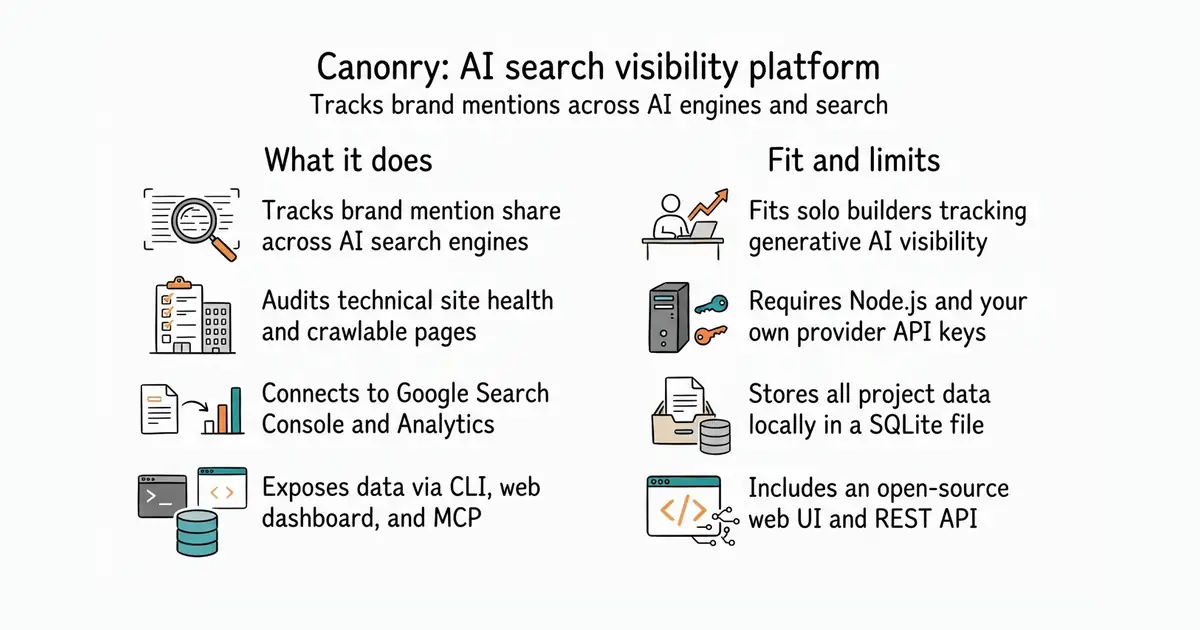
Canonry is a dashboard and command-line tool that checks how AI models talk about your website. It tracks whether chatbots recommend your business or your competitors when users ask questions. You run it on your own computer or server using your own database. It connects to search consoles, website analytics, and AI model keys that you provide. You pay only for the AI queries and third-party data services you use.
What it is
Canonry is an agent-first optimization platform that measures AI visibility, audits site health, and integrates search data. It stores everything in a local SQLite (a small, self-contained database that lives in a single file on your disk) database and exposes a complete web user interface and command-line interface.
What it is good for
Solo founders and small teams who want to monitor their brand presence across generative search engines, track technical site health, and let coding assistants query their SEO data.
- Tracks brand mentions and citations across multiple AI engines and model providers.
- Includes a complete web dashboard alongside command-line and agent integrations.
- Self-hosted with local data storage using SQLite, keeping your site metrics private.
- Requires specific Node.js version ranges, which can break if your system runtime is outdated.
- Needs your own API keys for AI models and external data providers like DataForSEO, which incurs ongoing third-party costs.
- Requires compiling native database modules during installation, which can fail without C++ build tools.
Manual brand checks across ChatGPT and Perplexity
DataForSEO
- firecrawl/firecrawl195k stars
Extracts clean markdown and structured data from websites for AI applications.


- GoogleChrome/lighthouse-ci7.1k stars
Runs the standard page audit on every code change and fails the change if the page got slower.
- harlan-zw/nuxt-seo1.5k stars
Seven search-engine and answer-engine modules for Nuxt sites, installed as one package.
- Swetrix/swetrix1.2k stars
Website analytics with no cookies, plus performance monitoring and error tracking, which you can host yourself.
npm install -g @canonry/canonry
cnry bootstrap
cnry serve