
Edition No. 31 · 25 Sep 2026
Twelve repositories for guarding a server, reading a PDF and tidying a folder
Twelve areas, one repository each, and a prose linter whose GitHub page now says it is only a copy.
proselint is a well-known tool that reads your writing and points out weak habits. Its GitHub page still exists, and the project has changed its own description on that page to three words plus a title: "[Mirror] A linter for prose." The website link in the sidebar no longer points at a documentation site. It points at Codeberg, a different, smaller code-hosting site run by a non-profit in Germany. That is entry 6, and it is the fifth project this report has found moving its development off GitHub in September.
The rest of the edition is a program that turns a PDF into clean text, a way to deploy applications on your own server, a security tool that shares blocked addresses with everybody else running it, and two very small command-line tools that each save a repeated minute.
We aim for twelve every day. Some candidates fall out while we check them — those are listed at the end, with the reason.
If you only do three things
- nickgerace/gfold (#8) — two minutes, and it changes nothing. It looks at a folder full of code projects and prints one line for each: which branch it is on, and whether there is work in it that has not been saved or sent anywhere. A forgotten unsaved change is the cheapest kind of loss to prevent.
- pvolok/dekit (#7) — five minutes. It runs several long-running commands at once and gives each one its own panel, so a website, a background worker and a database log stop fighting over one screen.
- opendatalab/MinerU (#3) — half an hour, on files that already exist, if the machine has memory to spare. It turns a folder of PDFs into clean Markdown text, keeping headings, tables and reading order, so the contents become searchable instead of being pictures of words.
Every link in one place
| # | Repository | What it does | Stars | Licence | Project site |
|---|---|---|---|---|---|
| 1 | crowdsecurity/crowdsec | Blocks attackers, using a shared list | 14,962 | MIT | crowdsec.net |
| 2 | Dokploy/dokploy | Deploys applications on your own server | 36,992 | Apache-2.0 + a paid part | dokploy.com |
| 3 | opendatalab/MinerU | PDFs into clean Markdown text | 77,975 | MinerU Open Source License | opendatalab.github.io/MinerU |
| 4 | AykutSarac/jsoncrack.com | Draws a data file as a picture | 44,269 | Apache-2.0 | jsoncrack.com |
| 5 | markmap/markmap | A bullet list becomes a mind map | 13,106 | MIT | markmap.js.org |
| 6 | amperser/proselint | Points out weak writing habits | 4,575 | BSD-3-Clause | codeberg.org/amperser/proselint |
| 7 | pvolok/dekit | Several commands, one screen 💎 | 2,726 | MIT | github.com/pvolok/dekit |
| 8 | nickgerace/gfold | The state of every project folder 💎 | 401 | Apache-2.0 | crates.io/crates/gfold |
| 9 | tfeldmann/organize | Files sorted by rules you write | 3,103 | MIT | organize.readthedocs.io |
| 10 | Zulko/moviepy | Video edited by a short program | 14,917 | MIT | zulko.github.io/moviepy |
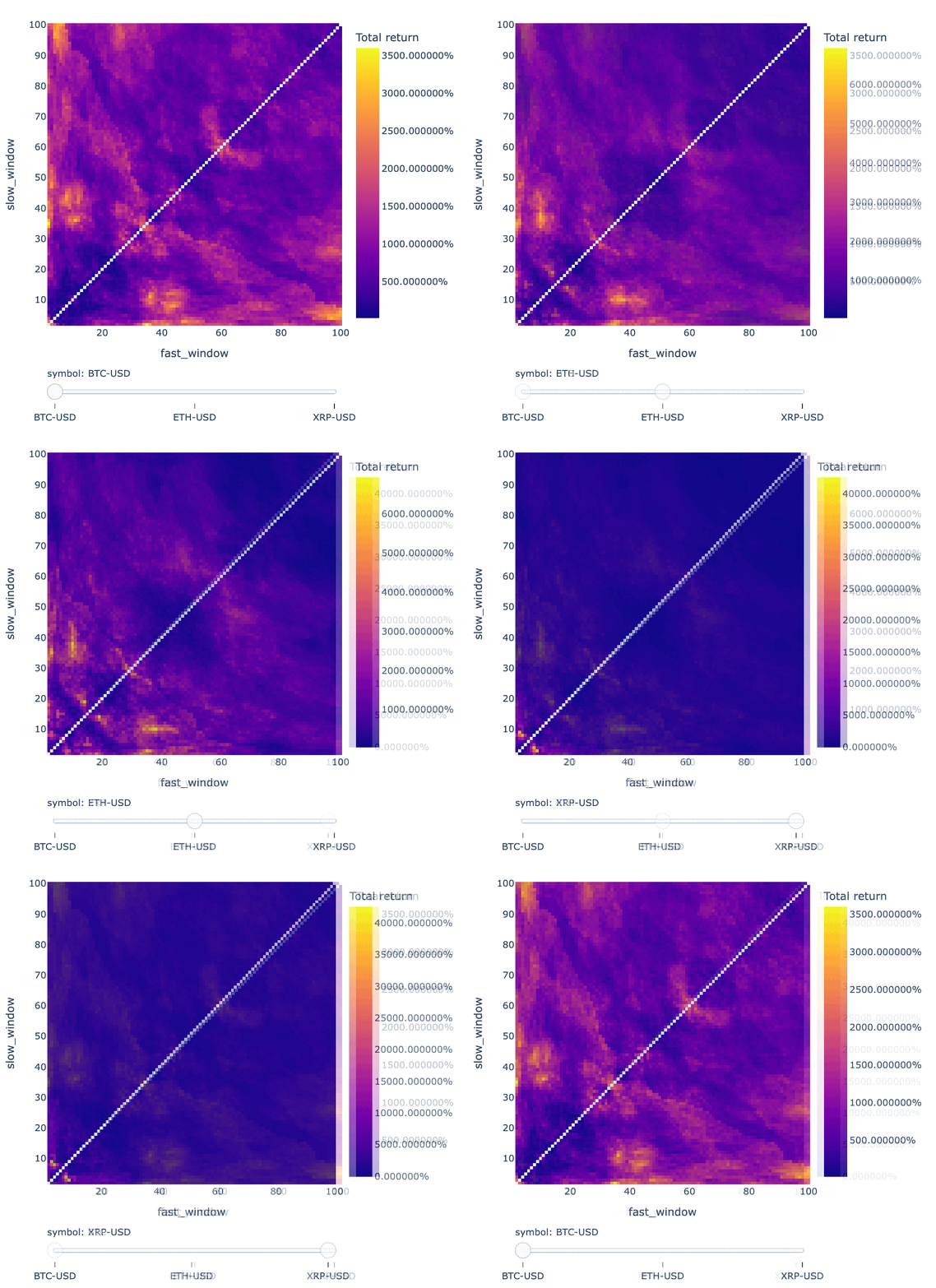
| 11 | polakowo/vectorbt | Tests thousands of trading rules at once | 9,180 | Apache-2.0 + Commons Clause | vectorbt.dev |
| 12 | amicalhq/refref | A referral programme you run yourself 💎 | 222 | AGPL-3.0 | refref.ai |
A fifth project has moved off GitHub to Codeberg
Twelve repositories, checked and reviewed. Every version verified against the GitHub API and dated.

14,962 stars · MIT — the LICENSE file was opened directly on 2026-09-25 and is the plain MIT text, 'Copyright (c) 2020-2023 Crowdsec' · v1.8.1 (2026-09-03), read from /releases/latest and confirmed by ungh · Track this in Scout
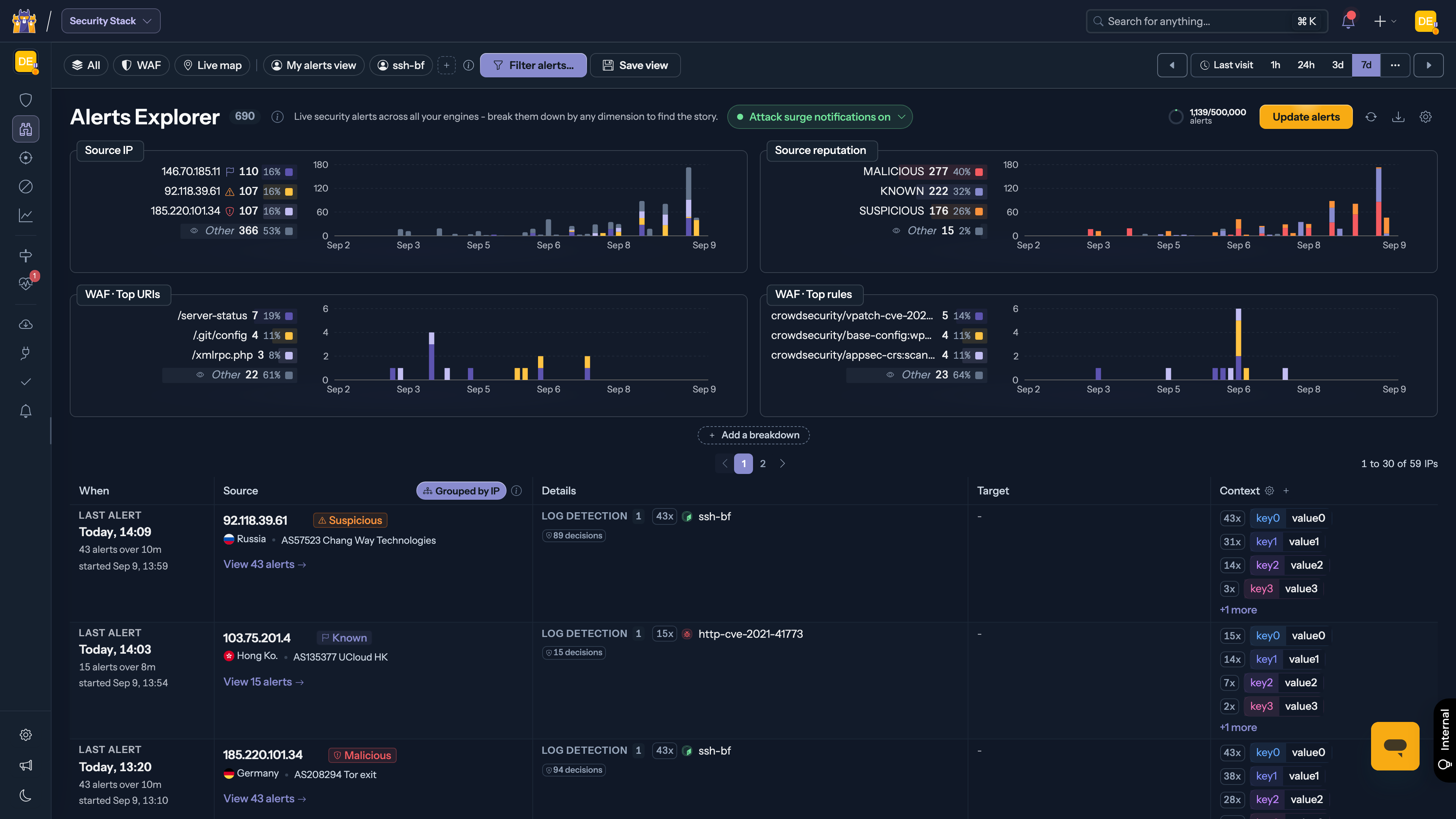
It reads a server's own log files, decides who is attacking, blocks them, and shares what it found with everyone else running it.
▶Repo detailsthe review · specs · pros & cons · install
What it is
CrowdSec is an intrusion detection and prevention system written in Go. It parses logs from a web server, an SSH daemon or a firewall, applies community-written detection rules called scenarios, and hands decisions to separate small programs called bouncers that do the actual blocking.
What it is good for. Any machine with a public address and nobody watching it — a small web server, a mail server, a home machine with a port open. The older answer to this problem blocks an address only after that address has already attacked you. The shared list means an address that attacked somebody else last night is refused here this morning.
- MIT licence, read from the LICENSE file directly. That is about as permissive as a licence gets: use it, change it, ship it, no conditions beyond keeping the notice.
- Blocking is separated from detecting. CrowdSec decides, and a small bouncer for your firewall, web server or CDN carries the decision out. You can change one without touching the other.
- Very actively maintained. Version 1.8.1 was published on 3 September 2026 and code landed on 24 September 2026.
- It is two pieces, not one. Installing the engine gets you decisions and nothing enforced until a bouncer is installed as well. People stop after the first half and think it is not working.
- Sharing is part of the design. The free service expects you to send signals about the attacks you see. What is sent is deliberately narrow, but it is a trade you should decide on knowingly.
- A detection rule that is too eager can lock out a real person, including you. The allow-list for your own addresses is something to set up before, not after.
- fail2ban/fail2ban
18,676 stars, the long-established tool for the same job; it bans on your own logs alone, with no shared list and no separate blocking programs.
Track this in Scout - wazuh/wazuh
16,533 stars, a much larger security platform that collects and correlates events across many machines; heavier to run and aimed at teams with an analyst.
Track this in Scout - OISF/suricata
6,552 stars, inspects network traffic itself rather than log files, which catches different things and costs far more processing.
Track this in Scout
# Debian and Ubuntu
curl -s https://install.crowdsec.net | sudo sh
sudo apt install crowdsec
# then install something that actually blocks — here, for nftables/iptables
sudo apt install crowdsec-firewall-bouncer-iptables
# see what it has decided
sudo cscli decisions list
sudo cscli metrics



36,992 stars · Apache-2.0 for the main tree, PLUS the Dokploy Source Available License (LICENSE_PROPRIETARY.md) covering the /proprietary folder — production use of that folder requires a paid commercial agreement · v0.30.7 (2026-09-18), read from /releases/latest; ungh was stale here and returned v0.29.13 of 2026-07-21 · Track this in Scout
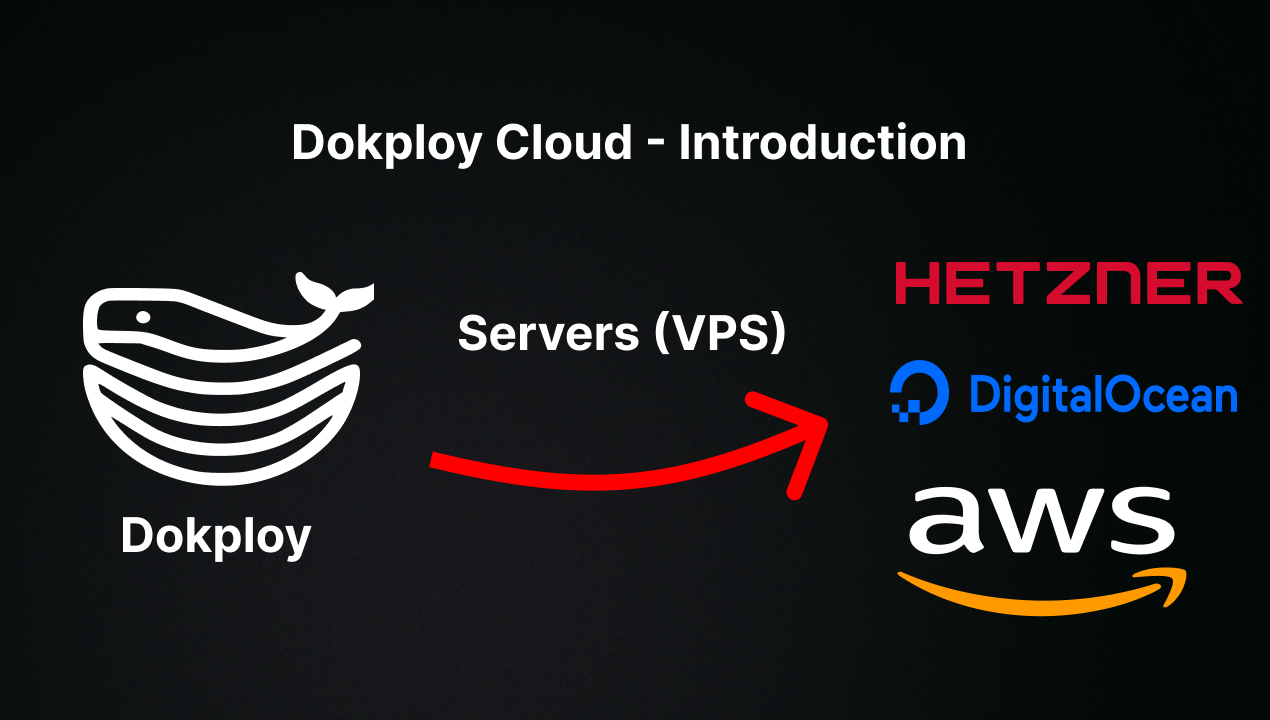
A web screen for your own server that deploys applications and databases the way a hosting company would.
▶Repo detailsthe review · specs · pros & cons · install
What it is
Dokploy is a self-hosted platform-as-a-service. It manages Docker containers (a way to run a program inside its own sealed box, so it cannot break anything else on the machine), sets up reverse proxying and certificates, runs databases such as PostgreSQL and MySQL, and can rebuild an application when a repository changes.
What it is good for. The situation where monthly hosting bills are growing, the applications are small, and one rented server could hold all of them — but nobody wants to hand-write proxy configuration and certificate renewals. It replaces the part of a hosting company that is a control screen, and keeps the machine yours.
- One install covers deployment, databases, backups, certificates and logs, so there is one screen instead of five tools.
- The main codebase is Apache-2.0, a plain permissive licence. Running it on your own machine costs nothing.
- Very widely used for its age. The repository was created in April 2024 and already has 36,992 stars, so answers to ordinary problems are easy to find.
- Part of it is not open source. Beside the Apache-2.0 licence there is a second file, the Dokploy Source Available License, covering the
/proprietaryfolder. Its own words: this code "may only be used in production, if you have agreed to, and are in compliance with, a valid commercial agreement from Dokploy." You may read and test that code; using it for real needs a paid agreement. - The whole point is that everything runs on one machine, which makes that machine a single point of failure. A backup of the server, not only of the databases, is the thing to arrange first.
- The release numbers move fast — v0.30.7 was published on 18 September 2026 — and it is still below version 1.0, so upgrades occasionally change behaviour.
 coollabsio/coolify
61,717 stars, the best-known tool for the same job, with a larger catalogue of one-click services; it is a single licence with no proprietary folder.
Track this in Scout- caprover/caprover
15,129 stars, older and simpler, built on Docker Swarm; fewer features but less to learn.
Track this in Scout - kubero-dev/kubero
4,373 stars, the same idea but on top of Kubernetes, which suits people who already run a cluster and nobody else.
Track this in Scout
# on a fresh Ubuntu or Debian server, as root
curl -sSL https://dokploy.com/install.sh | sh
# it installs Docker if missing, then serves the panel on port 3000
# open http://YOUR-SERVER-ADDRESS:3000 and create the first account immediately

77,975 stars · MinerU Open Source License — Apache 2.0 plus three added conditions, read from the LICENSE file: a separate commercial licence above 100 million monthly active users or 20 million USD monthly revenue, prominent attribution for any online service built on it, and automatic termination if either is breached. NOT plain Apache-2.0. · mineru-4.0.7-released (2026-09-23), read from /releases/latest and confirmed by ungh · Track this in Scout
It converts PDFs into clean Markdown or JSON, keeping headings, tables, equations and reading order.
▶Repo detailsthe review · specs · pros & cons · install
What it is
MinerU is a document extraction pipeline. It works out the layout of each page, reads text that exists only as an image, and rebuilds the document with its headings, tables, formulas and reading order intact. It ships a command, a local web page and a server mode.
What it is good for. Any pile of PDFs somebody needs to search, quote or feed into another program: scanned contracts, research papers, manuals, statements, old invoices. It is unusually strong on documents full of equations and on Chinese-language text, where simpler tools scramble the order.
- It handles the hard cases: multi-column pages, formulas, tables that run across pages, and pages that are nothing but an image.
- Very actively developed. The release tagged
mineru-4.0.7-releasedwas published on 23 September 2026, two days before this edition. - There is more than one way in. A command, a local web page and a server mode mean it fits both a one-off job and a pipeline.
- The licence is not plain Apache-2.0, whatever a summary says. The LICENSE file is the MinerU Open Source License: Apache 2.0 with three additions. A separate commercial licence is required above 100 million monthly active users or 20 million US dollars of monthly revenue. Any online service built on it must state prominently that MinerU is used. Breaking either condition ends the licence automatically. For almost everybody the money thresholds are irrelevant. The attribution requirement is not.
- It is heavy. The project's own requirements ask for at least 16 GB of memory, 32 GB recommended, and about 20 GB of disk for the model files. Check the machine has room before starting.
- It converts and stops. It does not store, index or search the results, so something else has to hold them afterwards.
 docling-project/docling
67,760 stars, covered in Edition 3; it reads Word and PowerPoint files as well and is lighter on memory, at some cost in accuracy on equations.
Track this in Scout datalab-to/marker
39,918 stars, covered in Edition 9; plain Apache-2.0 with no thresholds and no attribution clause, and it is more comfortable on a machine without a graphics card.
Track this in Scout- getomni-ai/zerox
12,259 stars, converts by sending each page to a vision model instead of running local layout models, so it costs money per page; its last code landed on 20 May 2025.
Track this in Scout
python3 -m venv venv
source venv/bin/activate
pip install -U "mineru[core]"
# one file
mineru -p report.pdf -o ./out
# a whole folder
mineru -p ./pdfs -o ./out

44,269 stars · Apache-2.0 — LICENSE.md was opened directly on 2026-09-25 and is the standard text, 'Copyright 2025 Aykut Sarac', with no added condition · v5.0.0 (2026-03-11), read from /releases/latest and confirmed by ungh · Track this in Scout
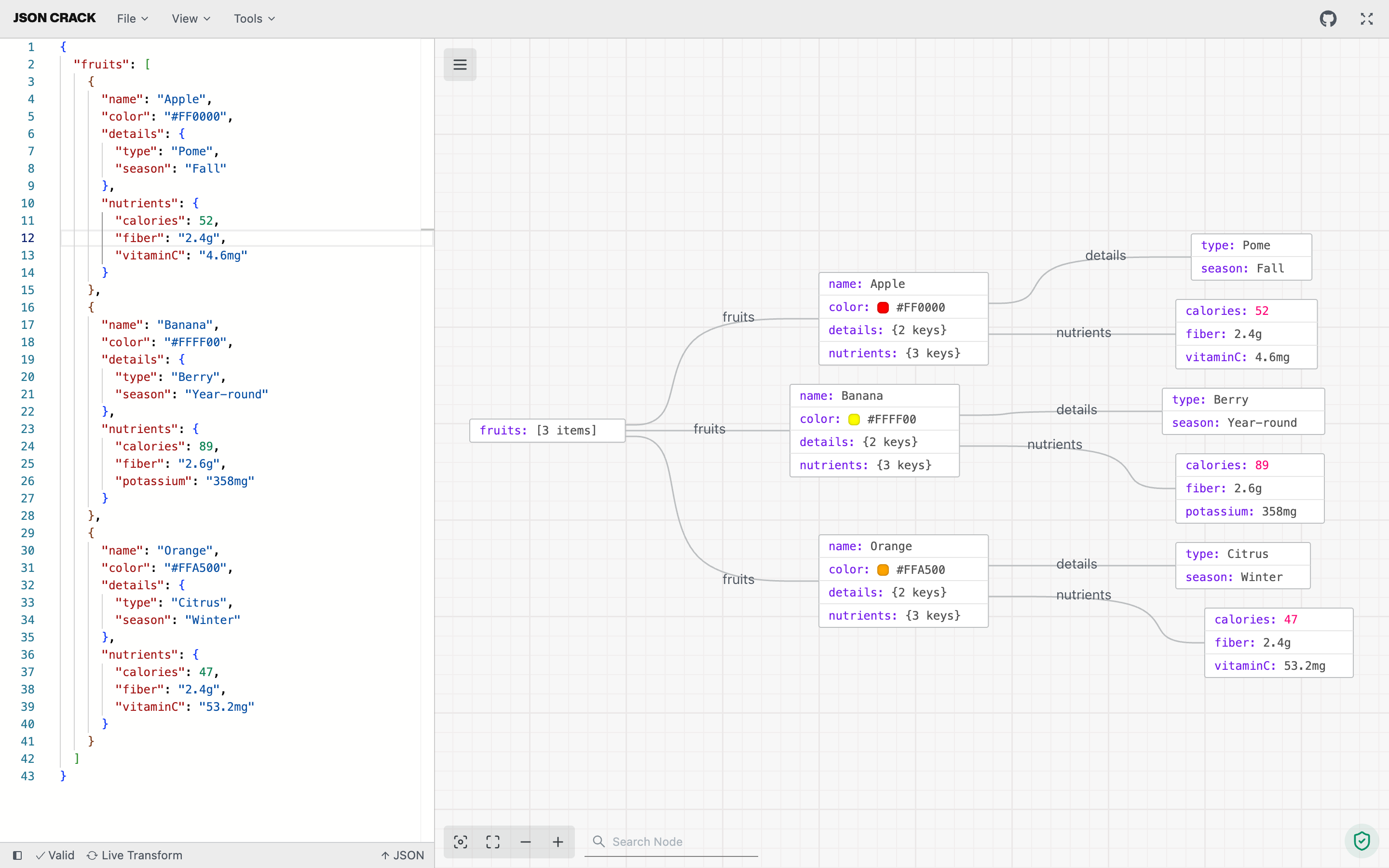
It draws a JSON, YAML, XML or CSV file as a diagram you can zoom around and search.
▶Repo detailsthe review · specs · pros & cons · install
What it is
JSON Crack renders structured data as a node graph in the browser. It handles JSON, YAML, XML, CSV and TOML, offers search across the graph, and can convert between those formats or generate a schema from a sample.
What it is good for. Anybody handed a large configuration file or an unfamiliar API response and asked what is in it. Reading nested data as text means holding the shape in your head; seeing it drawn means not having to.
- Apache-2.0, read from the LICENSE file. Its own words in the README are that all data processing is local and nothing is stored on their servers.
- It reads several formats, so it also works as a converter between them.
- It can be run on your own machine with Docker, which is the answer when the file contains anything you cannot paste into a website.
- Very large files will make a browser struggle. A graph with tens of thousands of nodes is slow to draw whatever machine you are on.
- The last tagged release is v5.0.0 of 11 March 2026, and code last landed on 15 June 2026. It is a stable tool rather than a fast-moving one.
- It shows and it converts. It does not edit a file in place or validate against a schema you supply, so it sits beside your editor rather than replacing it.
- antonmedv/fx
20,641 stars, does the same exploring in a terminal rather than a browser, which suits a server with no screen.
Track this in Scout - jqlang/jq
35,558 stars, the standard command-line tool for pulling values out of JSON; it queries rather than draws, and it has a language to learn.
Track this in Scout - ynqa/jnv
6,117 stars, an interactive terminal filter that shows the result of a jq expression as you type it.
Track this in Scout
# use it with nothing installed
# open https://jsoncrack.com/editor in a browser
# or run it on your own machine
git clone https://github.com/AykutSarac/jsoncrack.com.git
cd jsoncrack.com
docker build -t jsoncrack .
docker run -p 8888:8080 jsoncrack
# then open http://localhost:8888

13.1k stars · MIT · v0.18.0 (2024-12-19) · Track this in Scout
Build mindmaps from plain Markdown — superficially a perfect fit for Grasppy's output format.
▶Repo detailsthe review · specs · pros & cons · install
What it is
markmap is a JavaScript library and command-line tool that reads Markdown headings and nested lists and renders them as an interactive tree. It ships a command that writes a single self-contained HTML file, and plugins exist for common editors.
What it is good for. Anyone whose notes, meeting minutes or project plans are already nested bullets. Turning an outline into a map takes one command, and the map makes the shape of a long document visible in a way scrolling never does.
- The source stays plain Markdown. The map is generated, so the notes remain readable, greppable and easy to keep in version control.
- MIT licence, one of the least demanding there is.
- The output can be one self-contained HTML file, which is easy to email, attach or publish without any server.
- The last tagged release is v0.18.0, dated 19 December 2024, twenty-one months ago, while code last landed on 21 June 2026. The project is alive; it simply does not cut releases often, and the npm packages are what move.
- It draws and does not edit. You cannot drag a branch to a new parent; you change the text and regenerate.
- Very wide maps get cramped fast. Past a few hundred nodes it needs a lot of zooming.
 mermaid-js/mermaid
90,288 stars, draws diagrams from text as well, but flowcharts and sequence diagrams rather than foldable outlines, and GitHub renders it in a page directly.
Track this in Scout jgraph/drawio
8,341 stars, a full drawing editor where you place every box by hand; better for a deliberate diagram, worse for a document that changes weekly.
Track this in Scout- ondras/my-mind
3,367 stars, a browser mind-map editor you draw in directly; its last code landed on 18 June 2024, twenty-seven months ago.
Track this in Scout
# needs Node.js 18 or newer
npx markmap-cli notes.md            # opens a live preview in a browser
npx markmap-cli --no-open -o map.html notes.md   # writes one HTML file


4.6k stars · BSD-3-Clause · v0.16.0 (2025-11-14) · Track this in Scout
The classic prose linter — aggregated advice from well-known editors as a command-line tool.
▶Repo detailsthe review · specs · pros & cons · install
What it is
proselint applies a set of checks drawn from well-known style guides and editors, each one narrow and each one switchable. It reads a text, Markdown or plain file and prints the line, the column and what it objected to.
What it is good for. Anybody who writes documentation, release notes, landing pages or a newsletter without a colleague to read it first. It will not tell you whether an argument works. It will catch the sentence you have written a hundred times without noticing.
- BSD-3-Clause, which asks almost nothing of you.
- Every check can be turned off individually in a small configuration file, so the noisy ones stop being noisy after ten minutes of tuning.
- It runs entirely on your machine. Nothing is uploaded, which matters for anything unpublished.
- Development has moved to Codeberg. The GitHub repository now describes itself as "[Mirror] A linter for prose." and the project link in its sidebar is
codeberg.org/amperser/proselint. Issues and the newest work belong there; GitHub is a copy. - The newest release is v0.16.0, dated 14 November 2025, ten months ago, though code landed on 4 September 2026.
- English only, and the advice is culturally particular. Some rules argue with each other, and a few will be wrong for your voice.
 vale-cli/vale
6,144 stars, the actively developed alternative; it understands Markdown structure properly and lets you write your own house rules, which proselint does not.
Track this in Scout- retextjs/retext
2,435 stars, a JavaScript framework for the same class of checks; its last code landed on 4 February 2025, nineteen months ago.
Track this in Scout - btford/write-good
5,079 stars, a much smaller set of checks in JavaScript; its last code landed on 10 March 2025, eighteen months ago.
Track this in Scout
python3 -m venv venv
source venv/bin/activate
pip install proselint
proselint README.md
proselint --config .proselintrc.json article.md

2,726 stars · MIT · mprocs v0.9.6 (2026-06-06), confirmed by ungh. There is NO dekit release yet; the README says the first one is not available · Track this in Scout
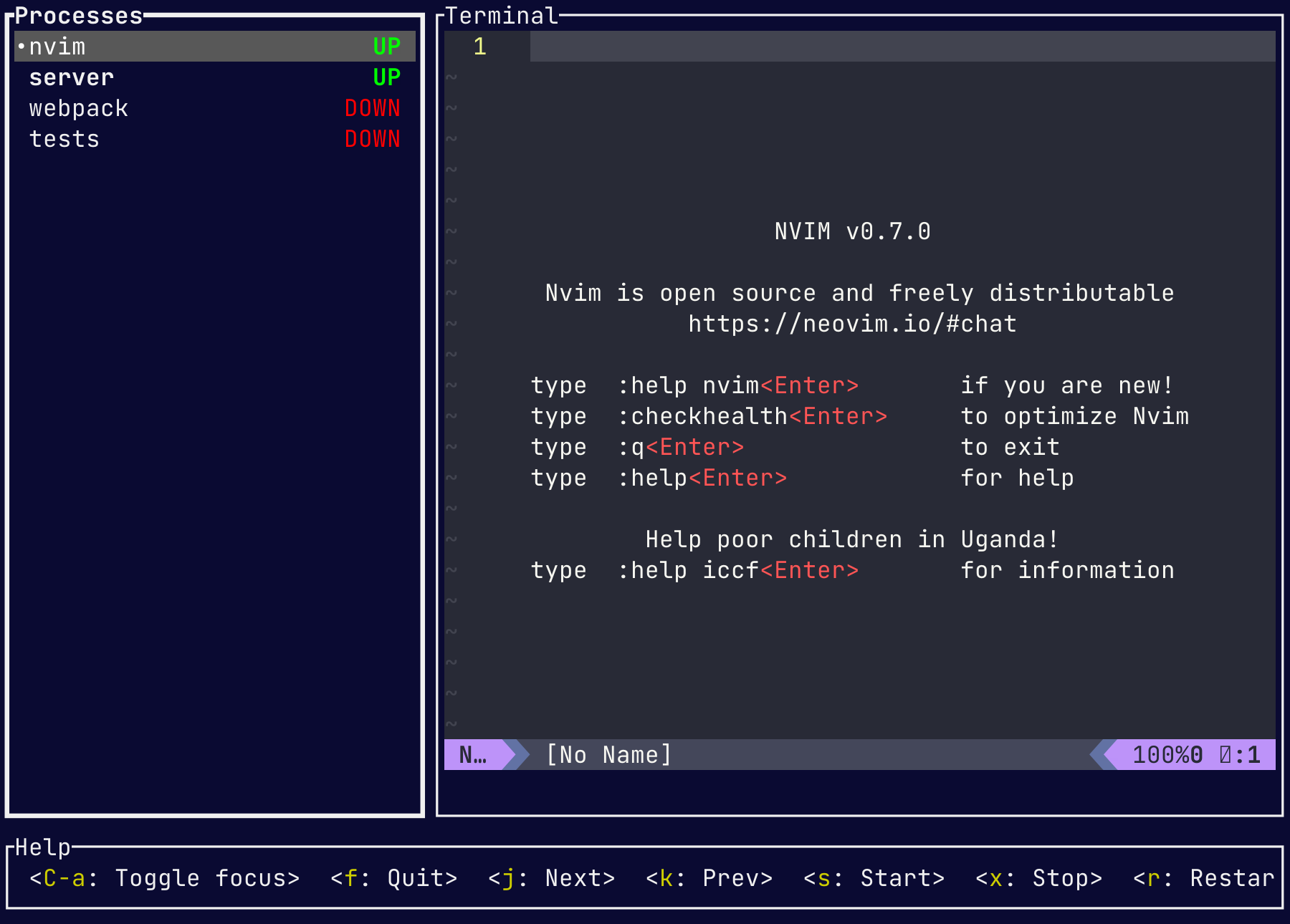
It runs several long-running commands at once, each in its own panel on one screen.
▶Repo detailsthe review · specs · pros & cons · install
What it is
dekit is a terminal program, written in Rust, that starts a list of commands from a small configuration file and shows each one's output in a separate pane. You can restart or stop any one of them without touching the others, and scroll back through what each has printed.
What it is good for. Any project where "start working" means starting a web server, a background worker, a file watcher and a database at the same time. One command replaces four windows, and stopping work is one key instead of four.
- Very small and very fast. One binary, no runtime to install, and it starts instantly.
- MIT licence, and the configuration is a short YAML file that lives with the project, so everyone on it gets the same setup.
- Actively developed: code landed on 24 September 2026, the day before this edition.
- The repository has been renamed.
pvolok/mprocsnow redirects topvolok/dekit, and the README is explicit about what that means: "the first dekit release is not available yet. The CLI, configuration format, and scripting API are still being designed and may change." The last published release is mprocs v0.9.6 of 6 June 2026, and that is still what you install today. - It is a terminal program with no graphical version, so it suits people who already live in a terminal.
- It runs processes and shows their output. It does not restart something that crashes, and it is not a process manager for a server.
- zellij-org/zellij
35,533 stars, a full terminal workspace with panes, tabs and plugins; far more capable and far more to learn.
Track this in Scout - Nukesor/pueue
6,288 stars, queues and manages long-running commands in the background instead of showing them side by side.
Track this in Scout - DarthSim/overmind
3,748 stars, runs the processes listed in a Procfile on top of tmux; its last code landed on 4 April 2025, seventeen months ago.
Track this in Scout
# with cargo (Rust's package manager)
cargo install mprocs
# or on macOS
brew install mprocs
# then write mprocs.yaml in the project root:
# procs:
#   server: { shell: "npm run dev" }
#   worker: { shell: "python worker.py" }
mprocs

401 stars · Apache-2.0 · 2026.9.0 (2026-09-11), read from ungh's releases endpoint; the project uses calendar versioning · Track this in Scout
It prints the state of every code project in a folder, in one screen.
▶Repo detailsthe review · specs · pros & cons · install
What it is
gfold is a command-line tool written in Rust. It walks a directory, finds every Git repository inside it, and reports each one's branch, whether there are uncommitted changes, whether there are untracked files, and where it came from. It only reads.
What it is good for. The situation where work is spread over many small projects and it is no longer obvious which ones are tidy. It is the cheapest possible check before a machine is wiped, handed over or left alone for a month.
- Read-only by design. It cannot change, delete or push anything, so there is nothing to be careful about.
- Fast, because it checks the repositories in parallel. Thirty projects take about a second.
- Apache-2.0, and actively maintained: version 2026.9.0 was published on 11 September 2026.
- 401 stars. That is the smallest project in this edition, and it means very few worked examples and almost nothing written about it elsewhere.
- It reports and stops. It will not commit, push or clean anything up, so acting on what it finds is still manual.
- Git only. A project kept in another version control system is simply not listed, with no warning that it was skipped.
- x-motemen/ghq
3,778 stars, organises where repositories are cloned to rather than reporting on their state; the two work well together.
Track this in Scout - jesseduffield/lazygit
82,669 stars, a full terminal interface for working inside one repository; it does everything gfold refuses to do, one project at a time.
Track this in Scout
# with cargo (Rust's package manager)
cargo install gfold
# or on macOS
brew install gfold
gfold ~/projects
gfold ~/projects --display classic


3,103 stars · MIT · v3.3.0 (2024-11-25), confirmed by ungh; code pushed 2026-08-10 · Track this in Scout
It sorts, renames and moves files according to rules you write in a small text file.
▶Repo detailsthe review · specs · pros & cons · install
What it is
organize is a command-line tool written in Python. Rules are written in a YAML file: each one has locations to look in, filters that decide which files match, and actions such as move, rename, copy or delete. It has a simulation mode that prints every action without carrying any of them out.
What it is good for. Any folder that grows faster than anyone tidies it: a downloads folder, a scanner's output folder, a shared drive where everything lands in the root. It is also the honest answer to a recurring chore that is too small to justify writing a script for.
- The simulation mode means you can see the full list of moves before anything happens, which makes a mistake cheap.
- Filters can read the inside of a file, not only its name — the text of a PDF, the date a photograph was taken, a file's size.
- MIT licence, and code last landed on 10 August 2026.
- The last tagged release is v3.3.0, dated 25 November 2024, twenty-two months ago, while code keeps landing. That is a publishing habit rather than a health problem, but it means the released version is well behind the repository.
- Its actions include deleting and moving files, so a wrong rule is destructive. Run the simulation first, every time.
- 3,103 stars. That is just above the line this report calls a hidden gem, and it still means fewer answers on the internet than a household name would have.
 ayoisaiah/f2
2,432 stars, covered in Edition 30; it renames in place very safely but does not sort files into folders by rules.
Track this in Scout- qarmin/czkawka
32,839 stars, finds duplicates, empty folders and similar images; it cleans rather than files.
Track this in Scout - jhspetersson/fselect
4,467 stars, finds files using SQL-like queries; it answers questions about a folder rather than reorganising it.
Track this in Scout
python3 -m venv venv
source venv/bin/activate
pip install organize-tool
organize new              # writes a starter config file
organize sim              # shows what WOULD happen, changes nothing
organize run              # does it


14.9k stars · MIT · v2.2.1 (2025-05-21) · Track this in Scout
Programmatic video editing in Python — batch intros, burned-in subtitles, format conversion.
▶Repo detailsthe review · specs · pros & cons · install
What it is
MoviePy is a Python library for cutting, joining, compositing and exporting video. It wraps FFmpeg, the standard tool for moving video between formats, and adds text, images, transitions and effects as objects you can put together in code.
What it is good for. Repetitive video work of any kind: putting the same intro on every episode, burning subtitles into a batch of clips, cutting a long recording into sections at known timestamps, or producing five sizes of the same video for five places.
- The edit becomes a file you can keep, read and change, so next month's batch is one command rather than an afternoon.
- MIT licence, and code last landed on 26 August 2026.
- Version 2 is a substantial rewrite, so the current interface is cleaner than the tutorials written for version 1.
- Version 2 changed a lot. Almost every older example on the internet is written for version 1 and will not run without edits.
- It is slow on long videos, because every frame passes through Python. A straight format conversion is faster done with FFmpeg directly.
- The last release is v2.2.1, dated 21 May 2025, sixteen months ago, although code has kept landing since.
 mifi/lossless-cut
43,741 stars, a desktop application for cutting and joining without re-encoding; much faster and much better for one file at a time.
Track this in Scout WyattBlue/auto-editor
5,355 stars, covered in Edition 2; it removes silence and unwanted sections automatically rather than letting you describe an edit.
Track this in Scout- kkroening/ffmpeg-python
11,008 stars, thin Python bindings around FFmpeg; its last code landed on 4 August 2024, twenty-five months ago.
Track this in Scout
python3 -m venv venv
source venv/bin/activate
pip install moviepy
# ffmpeg must also be installed, e.g.
sudo apt install ffmpeg        # Debian/Ubuntu
brew install ffmpeg            # macOS

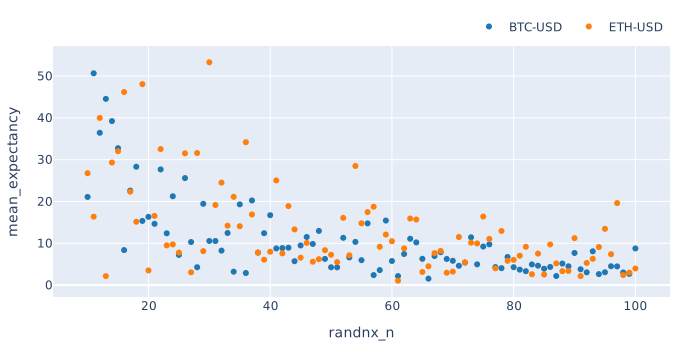
9k stars · Apache-2.0 + Commons Clause · v1.1.0 (2026-07-05) · Track this in Scout
Vectorised backtester — sweeps thousands of parameter combinations at once instead of one at a time.
▶Repo detailsthe review · specs · pros & cons · install
What it is
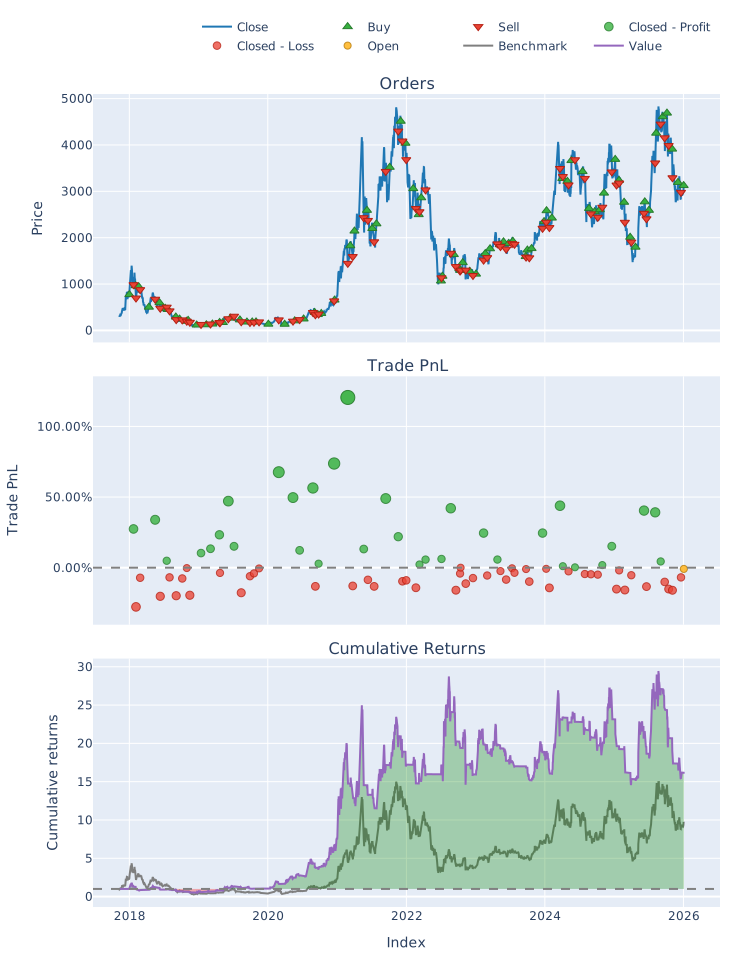
vectorbt is a Python backtesting library built on NumPy and Numba. Instead of stepping through time one bar at a time, it represents a whole grid of parameter combinations as arrays and computes them together, then reports returns, drawdowns and other statistics for every combination.
What it is good for. The situation where a rule looks good on one setting and nobody knows whether the neighbouring settings also work. Seeing the whole grid at once is how you tell a robust rule from one that happened to fit the past.
- Speed is the whole point. Sweeps that take hours in a loop-based backtester finish in seconds.
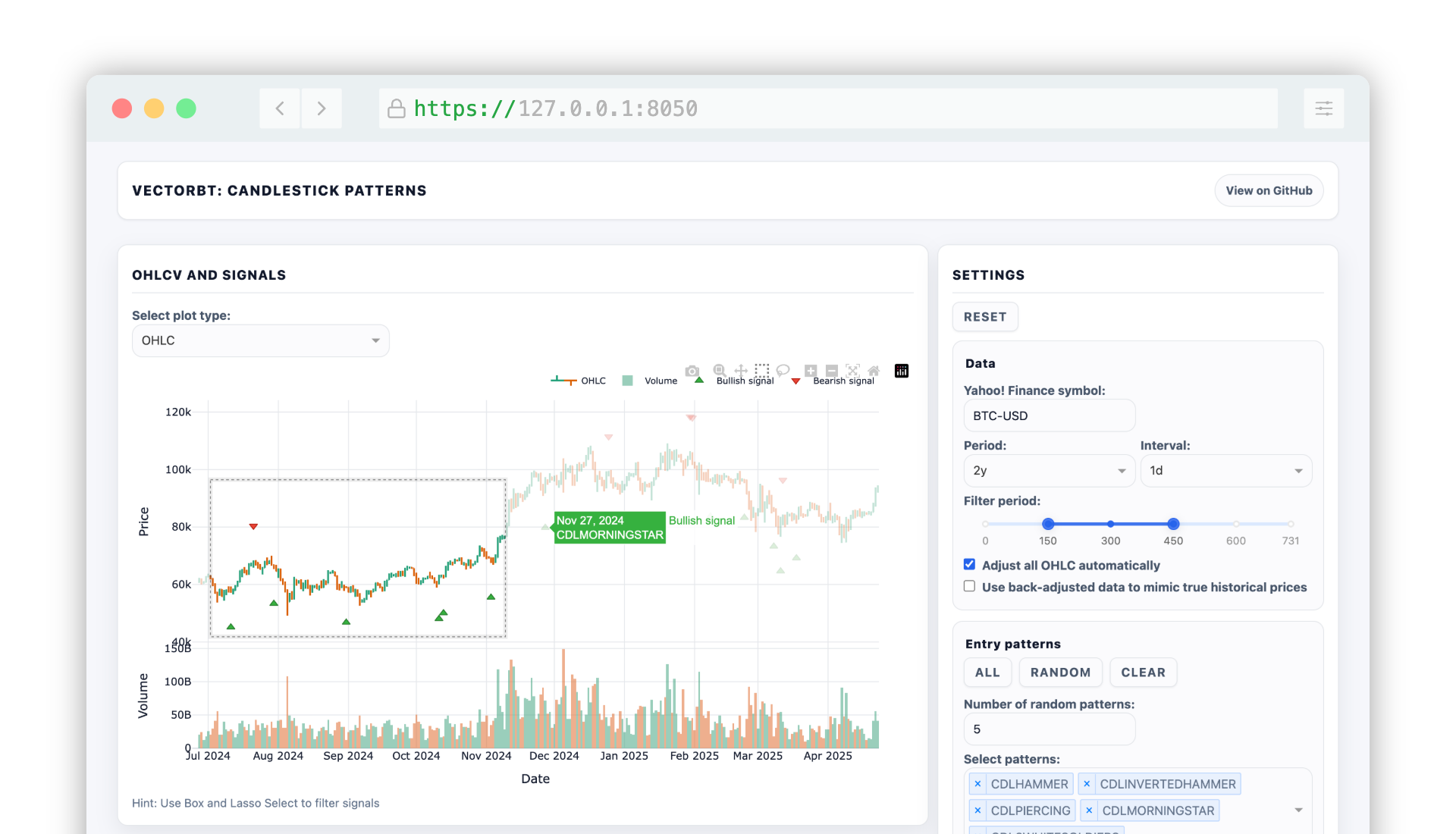
- It produces a large set of portfolio statistics and charts directly, so there is less glue code to write.
- Actively maintained: version 1.1.0 was published on 5 July 2026 and code landed on 17 September 2026.
- The licence is Apache-2.0 plus the Commons Clause, which is not open source. The project states the limit plainly: "you may not sell products or services that are primarily this software." Private research is fine. Building a paid product on it is not, without asking the author.
- Thinking in arrays is a real change of habit. Code that reads naturally in a loop-based backtester has to be rewritten, and the learning curve is steep.
- A backtest is not evidence. It models neither the cost of trading at scale nor your place in the queue, and testing a thousand variations makes it easier, not harder, to find a result that is pure luck.
 kernc/backtesting.py
8,978 stars, much simpler and loop-based; far easier to learn and far slower for large sweeps.
Track this in Scout nautechsystems/nautilus_trader
29,294 stars, a production trading engine in Rust with a Python interface, aimed at running strategies live rather than only testing them.
Track this in Scout- mementum/backtrader
23,319 stars, for years the default answer to this question; its last code landed on 19 August 2024, twenty-five months ago.
Track this in Scout
python3 -m venv venv
source venv/bin/activate
pip install vectorbt
# the paid "PRO" edition is a separate product; the open package is `vectorbt`

216 stars · AGPL-3.0 · no releases; 113 commits · Track this in Scout
Open-source referral and affiliate programmes — attribution, incentives and a partner portal.
▶Repo detailsthe review · specs · pros & cons · install
What it is
RefRef is a self-hosted referral platform written in TypeScript on Next.js and PostgreSQL. It issues referral links, attributes signups and purchases to the person who sent them, calculates rewards under rules you set, and gives partners a portal showing what they have earned.
What it is good for. A small business paying a monthly fee for a referral service, or one that has put off starting a referral programme because the tools are priced for larger companies. Running it yourself also means the customer list stays on your own machine.
- The only open-source project in this category this report has managed to find in thirty-one editions. Everything else here is a paid service.
- Attribution, reward rules, fraud checks and a partner portal are all in the one project, so there is nothing to stitch together.
- Built on ordinary parts — Next.js and PostgreSQL — so anyone who has run a web application can run it.
- 222 stars and no releases at all. There is no version to pin, so an install means choosing a commit and writing it down. Code last landed on 20 March 2026.
- AGPL-3.0. If you change it and offer it to other people over a network, you have to publish your changes. For running it as part of your own business that is usually fine; for embedding it in a product you sell, read the licence first.
- It is young. Expect gaps, expect to read the source, and do not make it the only record of who is owed money.
git clone https://github.com/amicalhq/refref.git
cd refref
# it needs Node.js and a PostgreSQL database
cp .env.example .env          # then set DATABASE_URL and the app URL
npm install
npm run db:push
npm run dev                   # http://localhost:3000


Checked, and left out
These were opened for this edition and did not make it, with the reason.
datalab-to/marker - ALREADY PUBLISHED, Edition 9 #9 on 3 September 2026. Researched and written up in full this morning as entry #3 before the id check against ledger.json caught it. No release since that edition
datalab-to/marker - ALREADY PUBLISHED, Edition 9 #9 on 3 September 2026. Researched and written up in full this morning as entry #3 before the id check against ledger.json caught it. No release since that edition (v2.0.0, 20 July 2026), so no repeat is earned. Replaced by opendatalab/MinerU in the same slot; listed as a comparison under entry #3.
mementum/backtrader - FINISHED. 23,319 stars, last code 19 August 2024, twenty-five months. New to the ledger as not-qualified, found in the comparison list under entry #11. For years the default Python backtesting library.
mementum/backtrader - FINISHED. 23,319 stars, last code 19 August 2024, twenty-five months. New to the ledger as not-qualified, found in the comparison list under entry #11. For years the default Python backtesting library.
kkroening/ffmpeg-python - FINISHED. 11,008 stars, last code 4 August 2024, twenty-five months. New to the ledger as not-qualified, found in the comparison list under entry #10.
kkroening/ffmpeg-python - FINISHED. 11,008 stars, last code 4 August 2024, twenty-five months. New to the ledger as not-qualified, found in the comparison list under entry #10.
btford/write-good - FINISHED. 5,079 stars, last code 10 March 2025, eighteen months. New to the ledger as not-qualified, found in the comparison list under entry #6.
btford/write-good - FINISHED. 5,079 stars, last code 10 March 2025, eighteen months. New to the ledger as not-qualified, found in the comparison list under entry #6.
ondras/my-mind - FINISHED. 3,367 stars, last code 18 June 2024, twenty-seven months. New to the ledger as not-qualified, found in the comparison list under entry #5.
ondras/my-mind - FINISHED. 3,367 stars, last code 18 June 2024, twenty-seven months. New to the ledger as not-qualified, found in the comparison list under entry #5.
retextjs/retext - FINISHED. 2,435 stars, last code 4 February 2025, nineteen months. New to the ledger as not-qualified, found in the comparison list under entry #6.
retextjs/retext - FINISHED. 2,435 stars, last code 4 February 2025, nineteen months. New to the ledger as not-qualified, found in the comparison list under entry #6.
koenbollen/jl - FINISHED. 246 stars, last code 5 April 2024, twenty-nine months. New to the ledger as not-qualified; considered as a small JSON-log viewer and not used.
koenbollen/jl - FINISHED. 246 stars, last code 5 April 2024, twenty-nine months. New to the ledger as not-qualified; considered as a small JSON-log viewer and not used.
formbricks/formbricks - ALIVE. 12,899 stars, code 7 September 2026
formbricks/formbricks - ALIVE. 12,899 stars, code 7 September 2026 (ungh). Self-hosted surveys; stays queued because it overlaps two tools already published and talking-to-customers was covered in Edition 30.
jhspetersson/fselect - ALIVE. 4,467 stars, code 5 September 2026
jhspetersson/fselect - ALIVE. 4,467 stars, code 5 September 2026 (ungh). New to the ledger as queued; listed as a comparison under entry #9.
ynqa/jnv - ALIVE. 6,117 stars, code 24 September 2026
ynqa/jnv - ALIVE. 6,117 stars, code 24 September 2026 (ungh). New to the ledger as queued; listed as a comparison under entry #4.
getomni-ai/zerox - ALIVE BUT QUIET. 12,259 stars, last code 20 May 2025, sixteen months. New to the ledger as queued, explicitly not called dead; listed as a comparison under entry #3.
getomni-ai/zerox - ALIVE BUT QUIET. 12,259 stars, last code 20 May 2025, sixteen months. New to the ledger as queued, explicitly not called dead; listed as a comparison under entry #3.
d3/d3-hierarchy - ALIVE BUT CLOSE TO THE BAR. 1,269 stars, last code 8 April 2025, seventeen and a half months. About two weeks from the eighteen-month line. Already in the ledger as queued; re-check next week.
d3/d3-hierarchy - ALIVE BUT CLOSE TO THE BAR. 1,269 stars, last code 8 April 2025, seventeen and a half months. About two weeks from the eighteen-month line. Already in the ledger as queued; re-check next week.
Coming tomorrow