Overview
Summary
The useful answer before the supporting detail.
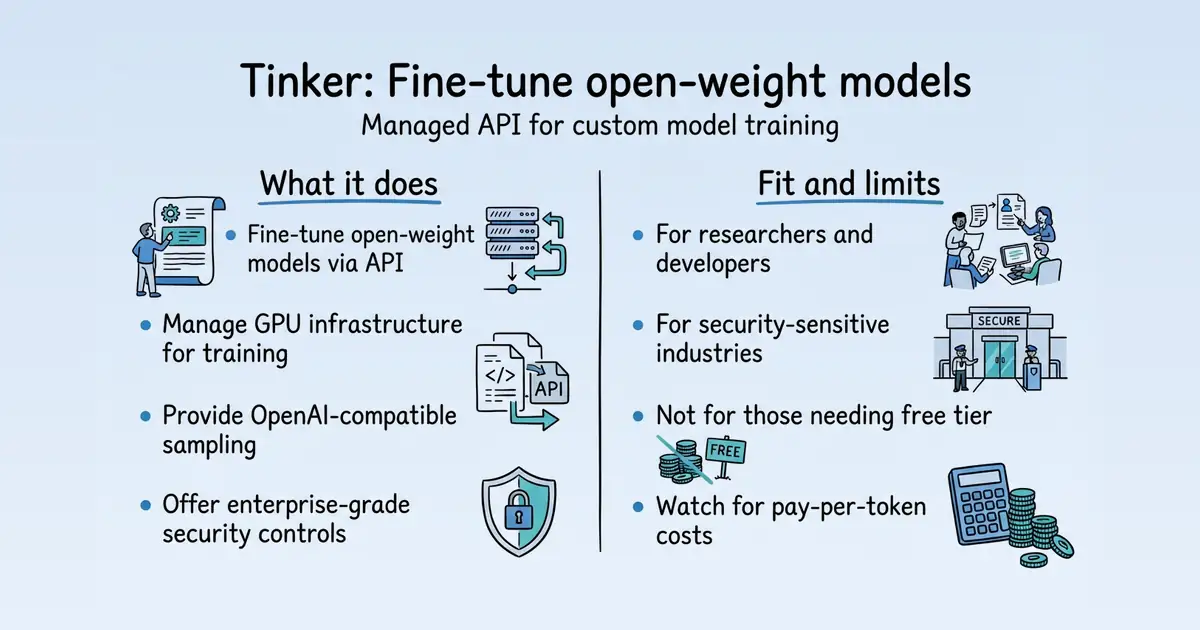
Tinker is a managed API for fine-tuning open-weight models, letting researchers and developers train custom models without managing GPU infrastructure S20 S26. It solves the problem of complex post-training by providing low-level primitives and an open-source cookbook for common methods S26. Its practical value is enabling users to control their data and training loop while accessing scalable infrastructure and pay-per-token pricing S32 S1.
Product identity and positioning
Name, category, positioning, audience, and first-party claims.
- Identity: Tinker is Thinking Machines Lab's API for fine-tuning open-weight models S20.
- Core purpose: It simplifies post-training by handling distributed training complexity while giving users control over algorithms and data S26.
- Intended users: Researchers and developers who want to customize models for their own applications S26.
- Product scope: A managed service running on internal clusters, offering training, checkpoint storage, and sampling S26 S32.
- Positioning: Positioned as frontier-grade infrastructure for training your own models S20.
- Claimed distinction: Provides low-level primitives like forward_backward and sample to express most post-training methods S26.
Use cases and audiences
Who the product serves and the jobs it is designed to handle.
| Audience | Practical use case |
|---|---|
| Researchers | Conduct studies on post-training methods and customize models for new applications S40. |
| Developers | Integrate fine-tuned models into custom workflows and applications via API S32. |
| Security-sensitive industries | Use enterprise controls like SSO and private VPC to fine-tune models with strict data governance S32. |
| Financial analysts | Automate information triage tasks by training models to replicate expert judgment S29. |
Traffic and search
SEO analysis
Collected Oct 22, 2026thinkingmachines.ai: an estimated 330,342 total monthly visits and about 57,021 monthly organic visits across 582 ranking keywords. Scout crawled 15 pages and measured a technical health score of 96/100.
Search summary
The useful answer before the supporting detail.
Connectionism: Research Blog by Thinking Machines Lab. thinkingmachines.ai: an estimated 330,342 total monthly visits and about 57,021 monthly organic visits across 582 ranking keywords. Scout crawled 15 pages and measured a technical health score of 96/100.
- Total traffic (modeled): 330,342 monthly visits across all channels.
- Organic search traffic (estimated): 57,021 monthly visits from search.
- Strongest sampled ranking: inkling at position 1.
- Leading page in the collected evidence: https://thinkingmachines.ai/news/introducing-inkling/.
- Closest measured organic competitor: youtube.com, appearing 2 times in the sampled first-page SERPs.
- Technical crawl: 15 pages, health score 96/100.
Website intelligence — Collected evidence
Company identity and positioning
| Page type | Evidence | Source |
|---|---|---|
| other | Connectionism: Research Blog by Thinking Machines Lab | https://thinkingmachines.ai/ |
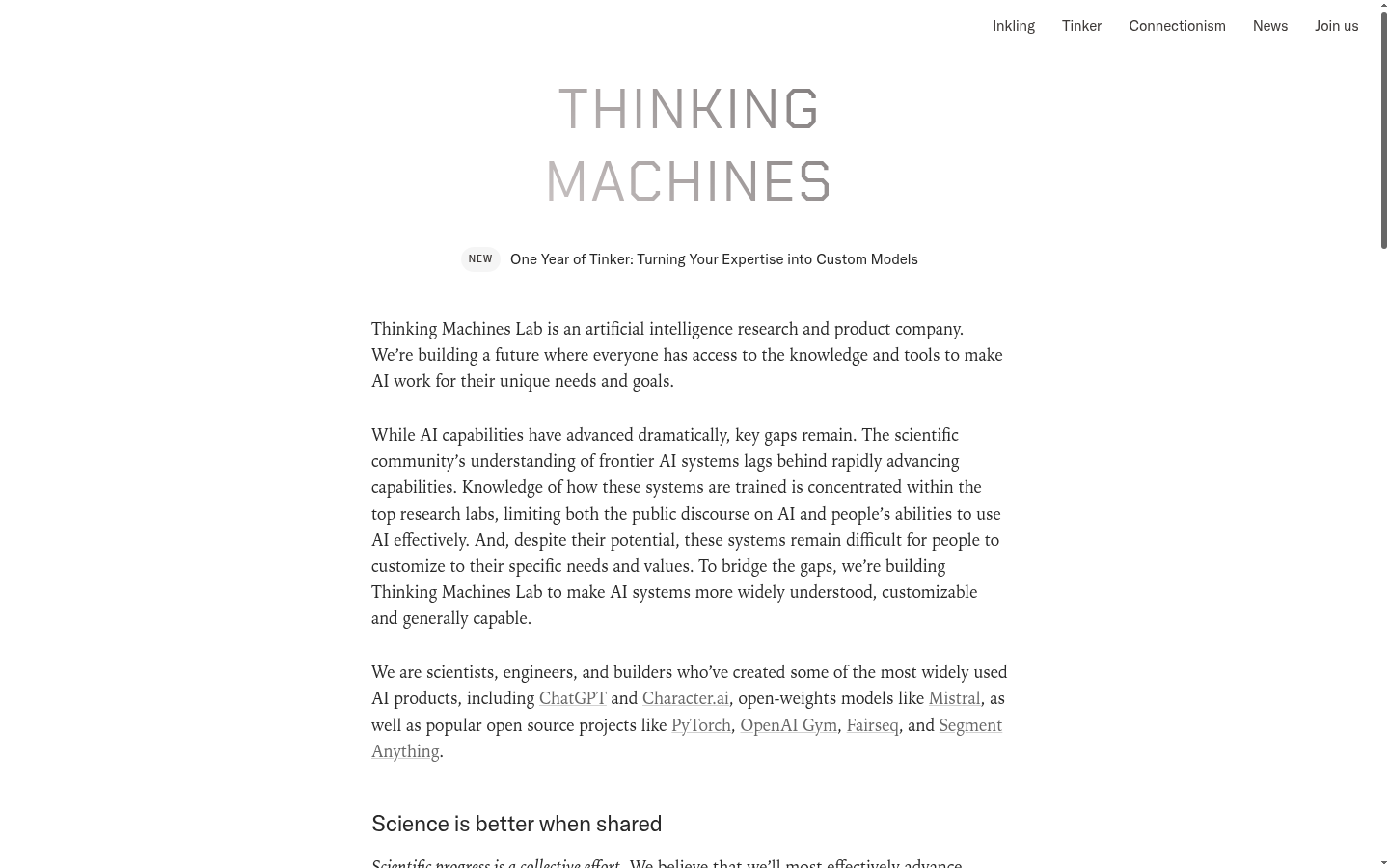
| other | Thinking Machines Lab is an artificial intelligence research and product company. We’re building a future where everyone has access to the knowledge and tools to make AI work for their unique needs and goals. | https://thinkingmachines.ai/ |
| other | While AI capabilities have advanced dramatically, key gaps remain. The scientific community’s understanding of frontier AI systems lags behind rapidly advancing capabilities. Knowledge of how these systems are trained is concentrated within the top research labs, limiting both the public discourse on AI and people’s abilities to use AI effectively. And, despite their potential, these systems remain difficult for people to customize to their specific needs and values. To bridge the gaps, we’re building Thinking Machines Lab to make AI systems more widely understood, customizable and generally capable. | https://thinkingmachines.ai/ |
| other | AI that works for everyone | https://thinkingmachines.ai/ |
| other | More flexible, adaptable, and personalized AI systems. We see enormous potential for AI to help in every field of work. While current systems excel at programming and mathematics, we’re building AI that can adapt to the full spectrum of human expertise and enable a broader spectrum of applications. | https://thinkingmachines.ai/ |
| other | Infrastructure quality as a top priority. Research productivity is paramount and heavily depends on the reliability, efficiency, and ease of use of infrastructure. We aim to build things correctly for the long haul, to maximize both productivity and security, rather than taking shortcuts. | https://thinkingmachines.ai/ |
| other | Empirical and iterative approach to AI safety. The most effective safety measures come from a combination of proactive research and careful real-world testing. We plan to contribute to AI safety by (1) maintaining a high safety bar—preventing misuse of our released models while maximizing users’ freedom, (2) sharing best practices and recipes for how to build safe AI systems with the industry, and (3) accelerating external research on alignment by sharing code, datasets, and model specs. We believe that methods developed for present day systems, such as effective red-teaming and post-deployment monitoring, provide valuable insights that will extend to future, more capable systems. | https://thinkingmachines.ai/ |
| other | We’re building AI systems that push technical boundaries while delivering real value to as many people as possible. Our team combines rigorous engineering with creative exploration, and we’re looking for collaborators to help shape this vision. | https://thinkingmachines.ai/ |
| other | Follow us on X at @thinkymachines for updates or see our open roles. | https://thinkingmachines.ai/ |
Domain performance
Modeled total traffic, six-month trend, engagement, countries, and domain identity.
Total website traffic
| Month | Modeled visits |
|---|---|
| 2026-04 | 303,172 |
| 2026-05 | 582,529 |
| 2026-06 | 375,894 |
| 2026-07 | 1,057,480 |
| 2026-08 | 574,202 |
| 2026-09 | 330,342 |
Top visitor countries
| Country | Name | Traffic share |
|---|---|---|
| US | United States | 57.8% |
| IN | India | 4.9% |
| DE | Germany | 3.7% |
| GB | United Kingdom | 3.3% |
| VN | Vietnam | 2.3% |
Domain identity
| Signal | Value |
|---|---|
| Registered | Jul 9, 2024 |
| Last changed | Aug 12, 2026 |
| Expires | Jul 9, 2030 |
| WHOIS server | whois.nic.ai |
| DNSSEC | — |
| Nameservers | alexa.ns.cloudflare.com, kellen.ns.cloudflare.com |
Website capture
Organic keywords
Top keywords and an independent Google result page.
Top organic keywords
| Keyword | Volume | CPC | Estimated value |
|---|---|---|---|
| thinking machines | 40,350 | $3.51 | $24,940 |
| thinking machines lab | 16,980 | $3.45 | $13,460 |
| inkling | 31,800 | $0.53 | $3,940 |
| tinker | 50,410 | $1.06 | $3,650 |
| thinking machine labs | 4,150 | $4.68 | $2,790 |
Independent Google result page
Query: inkling
| Position | Title | URL | Description |
|---|---|---|---|
| 1 | Inkling | Empower Your Workers | Frontline Employee Training | https://www.inkling.com/ | Inkling provides frontline employee training to help your business confidently serve your customers, your way. |
| 2 | thinkingmachines/Inkling | https://huggingface.co/thinkingmachines/Inkling | Inkling is a general-purpose multimodal model that accepts text, image and audio inputs and generates text outputs. It is intended for use in ... |
| 3 | INKLING Definition & Meaning | https://www.merriam-webster.com/dictionary/inkling | The meaning of INKLING is a slight knowledge or vague notion. inkling has not a drop to do with ink, whether of squid, tattoo, or any other ... |
| 4 | Inkling | https://thinkingmachines.ai/inkling/ | Inkling. Our most capable open model, with native reasoning over text, images, and audio. Parameters: 975B total 41B active; Architecture: Mixture of Experts ... |
| 5 | What Thinking Machines' Inkling Is Really Like, Part I | https://semaphore.substack.com/p/what-thinking-machines-inkling-is | An inkling is the first glimmer of an idea: Inkling describes itself as a tool for extending human capability, not replacing human judgment. It ... |
| 6 | Inklings - Splatoon Wiki - Fandom | https://splatoon.fandom.com/wiki/Inklings | Inklings (インクリング, Inkuringu) are a fictional species of humanoid cephalopods and also the customizable characters that players take control of within ... |
| 7 | Inkling - Your personalised AI tutor | https://myinkling.ai/ | One-to-one tutoring built around each student. Personalised learning, exam-board aligned content and safeguarding designed for schools and families. |
| 8 | Mira Murati on X: "Our first model, Inkling. Trained from ... | https://x.com/miramurati/status/2077455974743593100 | Today, we are introducing Inkling. Inkling reasons efficiently across text, image, and audio modalities. We are making the full weights ... |
| 9 | How Do Inkling Transformations Work? | https://www.youtube.com/watch?v=-oMTHqC5GxI | A professional animator breaks down Splatoon 2's inkling transformations to figure out why these quick, unsettling animations work so well. |
Important pages
Pages earning the most estimated search traffic in the sample.
| URL | Ranking keywords | Estimated traffic | Best position |
|---|---|---|---|
| https://thinkingmachines.ai/news/introducing-inkling/ | 2 | 10,181 | 1 |
| https://thinkingmachines.ai/blog/interaction-models/ | 10 | 930.2 | 1 |
| https://thinkingmachines.ai/ | 3 | 173.3 | 1 |
| https://thinkingmachines.ai/blog/defeating-nondeterminism-in-llm-inference/ | 2 | 100.3 | 1 |
| https://thinkingmachines.ai/blog/lora/ | 1 | 97.3 | 1 |
| https://thinkingmachines.ai/blog/modular-manifolds/ | 1 | 15.2 | 1 |
| https://thinkingmachines.ai/news/putting-task-expertise-into-rl/ | 1 | 9.1 | 1 |
Website intelligence — Collected evidence
Prioritized website intelligence pages
| Type | Page | Words | Change | URL |
|---|---|---|---|---|
| other | Thinking Machines Lab | 699 | new | https://thinkingmachines.ai/ |
| pricing | Tinker Pricing - Thinking Machines Lab | 494 | new | https://thinkingmachines.ai/tinker/pricing/ |
| integrations | Training Data Documentation - Thinking Machines Lab | 450 | new | https://thinkingmachines.ai/training-data-documentation/ |
| changes | News - Thinking Machines Lab | 197 | new | https://thinkingmachines.ai/news/ |
| changes | Announcing Tinker - Thinking Machines Lab | 418 | new | https://thinkingmachines.ai/news/announcing-tinker/ |
| changes | Tinker: Call for Community Projects - Thinking Machines Lab | 1,033 | new | https://thinkingmachines.ai/news/call-for-community-projects/ |
| changes | Introducing Inkling-Small - Thinking Machines Lab | 2,338 | new | https://thinkingmachines.ai/news/inkling-small/ |
| changes | Announcing Interactivity Research Grants - Thinking Machines Lab | 459 | new | https://thinkingmachines.ai/news/interactivity-research-grants/ |
| changes | Inkling: Our Open-Weights Model - Thinking Machines Lab | 4,400 | new | https://thinkingmachines.ai/news/introducing-inkling/ |
| changes | Learning to Replicate Expert Judgment in Financial Tasks - Thinking Machines Lab | 1,946 | new | https://thinkingmachines.ai/news/learning-to-replicate-expert-judgment-in-financial-tasks/ |
| changes | Thinking Machines Lab and NVIDIA Announce Long-Term Gigawatt-Scale Strategic Partnership - Thinking Machines Lab | 298 | new | https://thinkingmachines.ai/news/nvidia-partnership/ |
| changes | One Year of Tinker: Turning Your Expertise into Custom Models - Thinking Machines Lab | 1,953 | new | https://thinkingmachines.ai/news/one-year-of-tinker/ |
Features
No supporting public-page evidence was collected for this category.
Pricing and plans
| Page type | Evidence | Source |
|---|---|---|
| pricing | Pricing that follows your usage | https://thinkingmachines.ai/tinker/pricing/ |
| pricing | $0.10 / GB / month | https://thinkingmachines.ai/tinker/pricing/ |
| pricing | \ | $1.87 \ |
| pricing | \ | $1.87 \ |
| pricing | \ | $0.58 \ |
| pricing | \ | $0.58 \ |
| pricing | \ | $0.57 \ |
| pricing | \ | $0.57 \ |
| pricing | \ | $0.184 \ |
| pricing | \ | $0.184 \ |
| pricing | \ | $1.80 \ |
| pricing | \ | $1.80 \ |
| pricing | \ | $0.195 \ |
| pricing | \ | $3.78 \ |
| pricing | \ | $0.84 \ |
| pricing | \ | $2.205 \ |
| pricing | \ | $2.205 \ |
| pricing | \ | $0.6975 \ |
| pricing | \ | $0.6975 \ |
| pricing | \ | $0.45 \ |
Integrations and supported platforms
| Page type | Evidence | Source |
|---|---|---|
| integrations | THINKING MACHINES | https://thinkingmachines.ai/training-data-documentation/ |
| integrations | Training Data Documentation | https://thinkingmachines.ai/training-data-documentation/ |
| integrations | This document provides information regarding the datasets used by Thinking Machines Lab to develop its generative artificial intelligence systems and services, including its models (collectively “AI services”). This information reflects general practices, not specific to any single model. | https://thinkingmachines.ai/training-data-documentation/ |
| integrations | 1\. Dataset Sources | https://thinkingmachines.ai/training-data-documentation/ |
| integrations | Thinking Machines Lab’s AI services are developed using a variety of data sources, including publicly available data, data provided by partners via access agreements, and internally generated data, including synthetic data. | https://thinkingmachines.ai/training-data-documentation/ |
| integrations | 2\. Intended Purpose | https://thinkingmachines.ai/training-data-documentation/ |
| integrations | Thinking Machines Lab uses the collected data to develop its AI services, which are designed to understand and generate content, which may include text, images, audio, and video. The datasets are selected and curated to enable the AI services to develop broad capabilities, which may include language understanding, reasoning, visual comprehension, and audio and video processing. | https://thinkingmachines.ai/training-data-documentation/ |
| integrations | 3\. Data Types and Amount | https://thinkingmachines.ai/training-data-documentation/ |
| integrations | Thinking Machines Lab’s AI services are developed using datasets containing trillions of tokens. The training data consists of a broad variety of content types, including text, images, audio, and video, drawn from publicly available sources or acquired from third-parties. Thinking Machines Lab also uses synthetically generated data to supplement its training datasets. | https://thinkingmachines.ai/training-data-documentation/ |
| integrations | 4\. Inclusion of Public Domain or IP-protected Data | https://thinkingmachines.ai/training-data-documentation/ |
| integrations | The datasets Thinking Machines Lab uses to develop its AI services includes content that is in the public domain as well as content that may be subject to intellectual property protection. | https://thinkingmachines.ai/training-data-documentation/ |
| integrations | 5\. Data Acquisition | https://thinkingmachines.ai/training-data-documentation/ |
| integrations | Thinking Machines Lab’s services were developed using publicly available content obtained from the open internet and publicly accessible data repositories. Certain datasets were also obtained from third parties. | https://thinkingmachines.ai/training-data-documentation/ |
| integrations | 6\. Inclusion of Personal Information or Aggregate Consumer Information | https://thinkingmachines.ai/training-data-documentation/ |
| integrations | Thinking Machines Lab’s training datasets may contain personal information or aggregate personal information, as defined under applicable laws, such as names or other details that individuals share publicly on the internet or with Thinking Machines Labs. | https://thinkingmachines.ai/training-data-documentation/ |
| integrations | 7\. Cleaning, Processing, and Other Modification to Datasets | https://thinkingmachines.ai/training-data-documentation/ |
| integrations | Thinking Machines Lab takes steps to clean, process, and modify datasets used for its AI services. These processing steps, which vary by data type, may include deduplication and filtering to remove junk or other low-quality data, and are intended to improve the data’s usefulness for model training and support the responsible development of the AI services. | https://thinkingmachines.ai/training-data-documentation/ |
| integrations | 8\. Data Collection and Use Timeline | https://thinkingmachines.ai/training-data-documentation/ |
| integrations | Thinking Machines Lab collects and uses datasets to train and improve its AI services on an ongoing basis. Thinking Machines Lab began collecting and using datasets for model development in 2025. | https://thinkingmachines.ai/training-data-documentation/ |
| integrations | 9\. Use of Synthetic Data | https://thinkingmachines.ai/training-data-documentation/ |
Product and company updates
| Page type | Evidence | Source |
|---|---|---|
| changes | THINKING MACHINES | https://thinkingmachines.ai/news/ |
| changes | One Year of Tinker: Turning Your Expertise into Custom Models | https://thinkingmachines.ai/news/ |
| changes | Oct 15, 2026](/news/one-year-of-tinker/) | https://thinkingmachines.ai/news/ |
| changes | Putting Task Expertise into RL Achieves State-of-the-Art Performance on Text-to-SQL | https://thinkingmachines.ai/news/ |
| changes | Aug 27, 2026](/news/putting-task-expertise-into-rl/) | https://thinkingmachines.ai/news/ |
| changes | Announcing Safety Research Grants | https://thinkingmachines.ai/news/ |
| changes | Aug 24, 2026](/news/safety-research-grants/) | https://thinkingmachines.ai/news/ |
| changes | Introducing Inkling-Small | https://thinkingmachines.ai/news/ |
| changes | Jul 30, 2026](/news/inkling-small/) | https://thinkingmachines.ai/news/ |
| changes | Inkling: Our Open-Weights Model | https://thinkingmachines.ai/news/ |
| changes | Jul 15, 2026](/news/introducing-inkling/) | https://thinkingmachines.ai/news/ |
| changes | Learning to Replicate Expert Judgment in Financial Tasks | https://thinkingmachines.ai/news/ |
| changes | Jun 30, 2026](/news/learning-to-replicate-expert-judgment-in-financial-tasks/) | https://thinkingmachines.ai/news/ |
| changes | Announcing Interactivity Research Grants | https://thinkingmachines.ai/news/ |
| changes | May 19, 2026](/news/interactivity-research-grants/) | https://thinkingmachines.ai/news/ |
| changes | Training LLMs to Predict World Events (Guest Post with Mantic) | https://thinkingmachines.ai/news/ |
Rank tracking
Persistent keyword baselines and position movement.
This analysis created the first position baseline at 2026-10-22T07:15:28.521Z. Movement appears after the next fresh analysis using the same location and language.
Features
Features and capabilities
Core functions and evidence-backed product capabilities.
| Capability | What it does |
|---|---|
| Fine-tuning API | Provides low-level primitives like forward_backward and sample to express custom post-training methods S26. |
| Managed infrastructure | Runs on Thinking Machines' clusters, managing GPUs for sampling and training, and storing checkpoints S26 S32. |
| OpenAI-compatible sampling | Offers an inference interface compatible with the OpenAI API, enabling plug-and-play with OpenAI-compatible platforms S39. |
| Vision input | Supports interleaving image chunks with text for multimodal fine-tuning and inference S39. |
| Enterprise controls | Includes single sign-on, role-based access control, audit-log API, and private VPC connectivity for security-sensitive industries S32. |
| Autoscaling | Shifts capacity between models as demand changes, handling tens of thousands of concurrent requests S32. |
| Tinker Cookbook | Open-source library with modern implementations of post-training methods that run on top of the Tinker API S26. |
Integrations and ecosystem
Connected products, exports, APIs, and workflow compatibility.
| Integration or interface | Type | What it enables |
|---|---|---|
| OpenAI API-compatible sampling | API | Allows sampling from models using OpenAI-compatible scaffolding, enabling integration with any OpenAI-compatible platform S39. |
| Tinker Cookbook | Open-source library | Provides modern implementations of post-training methods that run on top of the Tinker API S26. |
| Tinker Playground | Web interface | Offers a quick chat interface for sampling from checkpoints S32. |
| Audit-log API | API | Enables programmatic access to audit logs for enterprise compliance S32. |
Pricing
Pricing and plans
Published plans, free access, trials, credits, and pricing limitations.
| Plan or offer | Verified price and billing | Included | Limits |
|---|---|---|---|
| Nemotron-3.5-Lightning-30B-A3B | $0.80 / 1M train tokens, pay per token | Sample $0.495 / 1M; prefill $0.184 / 1M | Checkpoint storage $0.10 per GB per month S1 |
| Qwen3.5-4B | $1.34 / 1M train tokens, pay per token | Sample $1.005 / 1M; prefill $0.33 / 1M | Checkpoint storage $0.10 per GB per month S1 |
| AI modelOSS-120B | $2.33 / 1M train tokens, pay per token | Sample $0.84 / 1M; prefill $0.33 / 1M | Checkpoint storage $0.10 per GB per month S1 |
| Qwen3.5-397B-A17B | $12.00 / 1M train tokens, pay per token | Sample $7.50 / 1M; prefill $1.65 / 1M | Checkpoint storage $0.10 per GB per month S1 |
| Kimi-K2.6 | $15.40 / 1M train tokens, pay per token | Sample $5.49 / 1M; prefill $2.205 / 1M | Checkpoint storage $0.10 per GB per month S1 |
Competition
Competitive landscape
Domains competing for the same organic search demand.
Sampled competitors
| Competitor | First-page appearances | Sampled queries | Average position | Queries observed |
|---|---|---|---|---|
| youtube.com | 2 | 2 | 6 | inkling, interaction model |
| inkling.com | 1 | 1 | 1 | inkling |
| linkedin.com | 1 | 1 | 1 | interaction model |
| huggingface.co | 1 | 1 | 2 | inkling |
| alphaxiv.org | 1 | 1 | 2 | interaction model |
| merriam-webster.com | 1 | 1 | 3 | inkling |
| slideshare.net | 1 | 1 | 3 | interaction model |
| semaphore.substack.com | 1 | 1 | 5 | inkling |
| bookdown.org | 1 | 1 | 5 | interaction model |
| splatoon.fandom.com | 1 | 1 | 6 | inkling |
Website intelligence — Collected evidence
Customers, testimonials, and first-party review claims
No supporting public-page evidence was collected for this category.
Independent review sources discovered
No links to supported independent review platforms were discovered on the collected pages.
Backlink profile
Authority and referring-domain signals.
Backlink comparison profile
- Domain rating: 77/100
- Backlinks: 61,147
- Referring domains: 7,223
- Dofollow backlinks: 73.0%
- Dofollow referring domains: 79.0%
Collection decision
The Scout search index remains intentionally excluded from automatic Scout analysis. This Scout traffic model profile costs 5 credits (0.5 cents) and is included in the first comparison run so its usefulness can be judged before the recurring collection is finalized.
AI visibility
Measured ChatGPT and Google AI mentions with cited sources.
AI-assistant referral traffic
- Estimated current generative-AI referral share: 1.4%
| Month | Traffic share | Source |
|---|---|---|
| — | — | All AI assistants |
| — | — | All AI assistants |
Website intelligence — Collected evidence
Site-stated AI capabilities
| Page type | Evidence | Source |
|---|---|---|
| other | Thinking Machines Lab is an artificial intelligence research and product company. We’re building a future where everyone has access to the knowledge and tools to make AI work for their unique needs and goals. | https://thinkingmachines.ai/ |
| other | While AI capabilities have advanced dramatically, key gaps remain. The scientific community’s understanding of frontier AI systems lags behind rapidly advancing capabilities. Knowledge of how these systems are trained is concentrated within the top research labs, limiting both the public discourse on AI and people’s abilities to use AI effectively. And, despite their potential, these systems remain difficult for people to customize to their specific needs and values. To bridge the gaps, we’re building Thinking Machines Lab to make AI systems more widely understood, customizable and generally capable. | https://thinkingmachines.ai/ |
| other | AI that works for everyone | https://thinkingmachines.ai/ |
| other | More flexible, adaptable, and personalized AI systems. We see enormous potential for AI to help in every field of work. While current systems excel at programming and mathematics, we’re building AI that can adapt to the full spectrum of human expertise and enable a broader spectrum of applications. | https://thinkingmachines.ai/ |
| other | Empirical and iterative approach to AI safety. The most effective safety measures come from a combination of proactive research and careful real-world testing. We plan to contribute to AI safety by (1) maintaining a high safety bar—preventing misuse of our released models while maximizing users’ freedom, (2) sharing best practices and recipes for how to build safe AI systems with the industry, and (3) accelerating external research on alignment by sharing code, datasets, and model specs. We believe that methods developed for present day systems, such as effective red-teaming and post-deployment monitoring, provide valuable insights that will extend to future, more capable systems. | https://thinkingmachines.ai/ |
| other | We’re building AI systems that push technical boundaries while delivering real value to as many people as possible. Our team combines rigorous engineering with creative exploration, and we’re looking for collaborators to help shape this vision. | https://thinkingmachines.ai/ |
| pricing | Pricing documentation | https://thinkingmachines.ai/tinker/pricing/ |
| integrations | This document provides information regarding the datasets used by Thinking Machines Lab to develop its generative artificial intelligence systems and services, including its models (collectively “AI services”). This information reflects general practices, not specific to any single model. | https://thinkingmachines.ai/training-data-documentation/ |
| integrations | Thinking Machines Lab’s AI services are developed using a variety of data sources, including publicly available data, data provided by partners via access agreements, and internally generated data, including synthetic data. | https://thinkingmachines.ai/training-data-documentation/ |
| integrations | Thinking Machines Lab uses the collected data to develop its AI services, which are designed to understand and generate content, which may include text, images, audio, and video. The datasets are selected and curated to enable the AI services to develop broad capabilities, which may include language understanding, reasoning, visual comprehension, and audio and video processing. | https://thinkingmachines.ai/training-data-documentation/ |
| integrations | Thinking Machines Lab’s AI services are developed using datasets containing trillions of tokens. The training data consists of a broad variety of content types, including text, images, audio, and video, drawn from publicly available sources or acquired from third-parties. Thinking Machines Lab also uses synthetically generated data to supplement its training datasets. | https://thinkingmachines.ai/training-data-documentation/ |
| integrations | The datasets Thinking Machines Lab uses to develop its AI services includes content that is in the public domain as well as content that may be subject to intellectual property protection. | https://thinkingmachines.ai/training-data-documentation/ |
| integrations | Thinking Machines Lab takes steps to clean, process, and modify datasets used for its AI services. These processing steps, which vary by data type, may include deduplication and filtering to remove junk or other low-quality data, and are intended to improve the data’s usefulness for model training and support the responsible development of the AI services. | https://thinkingmachines.ai/training-data-documentation/ |
| integrations | Thinking Machines Lab collects and uses datasets to train and improve its AI services on an ongoing basis. Thinking Machines Lab began collecting and using datasets for model development in 2025. | https://thinkingmachines.ai/training-data-documentation/ |
| integrations | Thinking Machines Lab generates and uses synthetic data in the development of its AI services. | https://thinkingmachines.ai/training-data-documentation/ |
| changes | Today, we are launching Tinker, a flexible API for fine-tuning language models. It empowers researchers and hackers to experiment with models by giving them control over the algorithms and data while we handle the complexity of distributed training. Tinker advances our mission of enabling more people to do research on cutting-edge models and customize them to their needs. | https://thinkingmachines.ai/news/announcing-tinker/ |
| changes | Redwood Research used Tinker to RL Qwen3-32B on difficult AI control tasks | https://thinkingmachines.ai/news/announcing-tinker/ |
| changes | Tinker is now in private beta for researchers and developers. You can sign up for the Tinker waitlist here. We will be onboarding users to the platform starting today. | https://thinkingmachines.ai/news/announcing-tinker/ |
| changes | We launched Tinker to enable builders and researchers to train models their own way, whether they’re conducting studies or customizing models for new applications. We plan to publish regular roundups of the coolest projects from the Tinker community, and we invite you to submit what you’ve been Tinkering on to be featured on our blog. | https://thinkingmachines.ai/news/call-for-community-projects/ |
| changes | We’re interested in featuring ML research projects, AI-enabled research in other domains, custom models, and other contributions. Some examples: | https://thinkingmachines.ai/news/call-for-community-projects/ |
These are first-party product claims, not independent measurements of AI-search visibility.
Marketing opportunities
Actions calculated directly from the collected evidence.
| Opportunity | Recommended action | Evidence |
|---|---|---|
| Competitor gap | Review the sampled queries where youtube.com appears. | 2 first-page appearances across inkling, interaction model |
Website intelligence — Collected evidence
Website evidence gaps
- features: no usable public page was collected; verify whether the site publishes this evidence.
- customers: no usable public page was collected; verify whether the site publishes this evidence.
- reviews: no usable public page was collected; verify whether the site publishes this evidence.
- identity: no usable public page was collected; verify whether the site publishes this evidence.
- technical: no usable public page was collected; verify whether the site publishes this evidence.
Trust and proof
Customers, proof, and reviews
Published proof, customer signals, and review evidence.
Independent reviews
| Platform | Page | How it was found | Note |
|---|---|---|---|
| eesel AI Blog | Inkling review: is Thinking Machines' open model worth it? / eesel AI | Grounded web search | Inkling review: is Thinking Machines' open model worth it? / eesel AI ... The Hacker News launch thread (1,214 points, ~292 comments) is the clearest read on reception. The mood was enthusiastic but measured, and the excitement was less about scores and more about who shipped it: ... That framing got pushback (people named Mistral, Cohere's North, Gemma), but the underlying "a credible Western open-weights option was overdue" sentiment ran through the whole thread. There was also a healthy "how |
Customer proof
No named customers, testimonials, or customer case studies were found.
Independent mentions
- Tinker: Thinking Machines Lab Thoughts / Hacker News — *Tinker Fine-Tuning Experience - Key Takeaways:* ... - *Flexible API*: Python-based API enabled custom GRPO implementation with full control over reward functions and training loops without framework constraints - *Managed Infrastructure*: Abstracted distributed GPU training complexity—no need to handle NCCL configs, gradient synchronization, or multi-node debugging - *LoRA Support*: Made fine-tuning 30B parameter Qwen model feasible by reducing trainable parameters significantly; converged in 5
- Thinking Machines Lab / Hacker News — Thinking Machines Lab (thinkingmachines.ai) 30 points by Philpax on Feb 18, 2025 / hide / past / favorite / 4 comments ... Machine was a very interesting architecture, for its time. Plus it looked cool---the CM-2, with all its blinkenlights, is
- Thinking Machines Lab — Thinking Machines Lab is an artificial intelligence research and product company. We’re building a future where everyone has access to the knowledge and tools to make AI work for their unique needs and goals.
- Does Thinking Machines Lab write with AI? — HN AI Detector — Salah Adawi — 4 articles analyzed on the Hacker News front page. # Reliably human. 4 articles on the Hacker News front page. Pangram has scored Thinking’s articles from the Hacker News front page. They average 0% AI, well below the human threshold.
- I wasn't referring to Murati (although she seems capable). / Hacker News — has no idea on how to go on alignment, as you can see here, during this ... min rambling into nothing, on the subject. At correct time stamp: https://youtu.be/Wo95ob_s_NI?t=1040 What is in contrast to the published vision of Thinking Machines Lab.
- Thinking Machines Launches Inkling Open-Weights Model — Speka / Speka — The clearest independent signal of how much attention this launch is getting comes from Hacker News (https://news.ycombinator.com/item?id= ... crossed 255 points shortly after posting. On a forum where most launch posts fade quickly, that level of
- Thinking Machines says its mission is to build AI that people and organizations can shape and make their own, and that “extends human will and judgment” / TEXXR — > thinking machines is actually such a funny company the dashboard is slow enough to be unusable but you can now train a model by dropping the api key and telling fable to train one so it doesn't matter it's literally train models by api, but more flexible than what oai has had - @nicbstme
External links were grounded in one live web search. Search snippets are leads, not independently scraped page content; rejected links remain available in Review evidence.
Company, security, and trust
Ownership, policies, security signals, and public trust evidence.
| Signal | Finding | Source |
|---|---|---|
| Company and ownership | “AI is the most powerful knowledge discovery instrument in human history,” said Jensen Huang, founder and CEO of NVIDIA. “Thinking Machines has brought together a world-class team to advance the frontier of AI. We are th | source |
| Contact and support | If you’re an organization interested in using Tinker, please contact us here. | source |
| Legal and privacy | See how to apply for proposal requirements, selection criteria, timeline, and complete terms of service for the grant program. | source |
| Security and compliance | Custom models draw strong interest from security-sensitive industries, and their requirements set a high bar. We met it with enterprise-grade controls. Organizations divided into projects with data and training access ga | source |
| Uptime and status page | Not published on the collected pages. | — |
| Domain registered | 2024-07-09 | — |
| Domain expires | 2030-07-09 | — |
Not found on the collected pages: uptime and status page. This only means Scout did not find it on the pages it read; it says nothing about the company itself.
Documentation and product updates
Help resources, product guidance, and visible changes over time.
| Resource or update | Type | What is available | Date or freshness |
|---|---|---|---|
| Training Data Documentation - Thinking Machines Lab | Documentation | Training Data Documentation This document provides information regarding the datasets used by Thinking Machines Lab to develop its generative artificial intelligence systems and services, including its models (collectively “AI services”). This information reflects general practices, not specific to any single model. 1. Dataset Sources Thinking Machines Lab’s AI services are developed using a variety of data sources, including publicly available data, data provided by partners via access agreements, and internally generated data, including synthetic data. (source) | Not dated |
| Inkling: Our Open-Weights Model - Thinking Machines Lab | Product update | Product update is publicly available. (source) | Not dated |
Not found in the collected public sources: public roadmap, changelog or release notes, status page, separate help center or knowledge base.
Technical
Technical and delivery signals
Delivery model, platforms, API, data ownership, reliability claims and release activity.
| Signal | Finding | Source |
|---|---|---|
| Delivery model (cloud, self-hosted, desktop, browser extension) | Managed service running on Thinking Machines' internal clusters and training infrastructure S26. | S26 |
| Platforms and apps | Accessible via web API and Tinker Playground chat interface S32. | S32 |
| API and extensibility (API, SDK, webhooks, MCP, plugins) | Provides low-level API primitives like forward_backward and sample, plus an OpenAI-compatible sampling interface S26 S39. | S26 S39 |
| Data ownership and export | Customer data and training loop stay under customer control; checkpoints can be sampled from S32. | S32 |
| Performance and reliability claims | Autoscaling handles tens of thousands of concurrent requests without queueing S32. | S32 |
| Release activity | Tinker launched in private beta, then general availability with vision input; ongoing improvements shipped over a year S26 S39 S32. | S26 S39 S32 |
Measured infrastructure
Domain, certificate, and hosting signals, measured directly.
| Signal | Finding |
|---|---|
| Domain registered | 2024-07-09 — MarkMonitor Inc. |
| Domain expires | 2030-07-09 |
| TLS certificate | Google Trust Services, valid, expires 2026-11-29 |
| Security headers | X-Content-Type-Options, Referrer-Policy |
| Headers not served | HSTS, CSP, X-Frame-Options |
| Server header | cloudflare |
| Mail handled by | aspmx.l.google.com, alt1.aspmx.l.google.com |
| Nameservers | kellen.ns.cloudflare.com, alexa.ns.cloudflare.com |
Not measurable: wayback: rate limited by archive.org, ladder stopped after 1 probe(s). A gap here means the lookup was unavailable, not that the finding is negative.
Technical site audit
A bounded multi-page crawl with page-level issues and URLs.
Scout — Bounded technical crawl
- Pages crawled: 15 of 15 maximum
- Technical health: 96/100
- Critical issues: 0
- Warnings: 10
- Notices: 6
Issues
| Severity | Issue | Value | Affected URL |
|---|---|---|---|
| warning | Page should have one primary H1 | 0 | https://thinkingmachines.ai/ |
| notice | Images are missing alt text | 90 | https://thinkingmachines.ai/tinker/ |
| notice | Low visible word count | 139 | https://thinkingmachines.ai/blog/ |
| notice | Meta description length should be reviewed | 31 | https://thinkingmachines.ai/news/ |
| warning | Title length should be reviewed | 85 | https://thinkingmachines.ai/news/one-year-of-tinker/ |
| warning | Title length should be reviewed | 89 | https://thinkingmachines.ai/blog/interaction-models/ |
| notice | Meta description length should be reviewed | 749 | https://thinkingmachines.ai/legal/terms/ |
| warning | Page should have one primary H1 | 20 | https://thinkingmachines.ai/legal/terms/ |
| notice | Meta description length should be reviewed | 684 | https://thinkingmachines.ai/legal/privacy/ |
| warning | Page should have one primary H1 | 13 | https://thinkingmachines.ai/legal/privacy/ |
| warning | Title length should be reviewed | 67 | https://thinkingmachines.ai/security/disclosure-policy/ |
| notice | Meta description length should be reviewed | 452 | https://thinkingmachines.ai/security/disclosure-policy/ |
| warning | Page should have one primary H1 | 9 | https://thinkingmachines.ai/model-card/inkling/ |
| warning | Page should have one primary H1 | 9 | https://thinkingmachines.ai/model-card/inkling-small/ |
| warning | Duplicate meta description in audit sample | 2 | https://thinkingmachines.ai/ |
| warning | Duplicate meta description in audit sample | 2 | https://thinkingmachines.ai/blog/ |
Crawled pages
| Status | Title | H1s | Words | Response | URL |
|---|---|---|---|---|---|
| 200 | Thinking Machines Lab | 0 | 722 | 70 ms | https://thinkingmachines.ai/ |
| 200 | Inkling - Thinking Machines Lab | 1 | 404 | 100 ms | https://thinkingmachines.ai/inkling/ |
| 200 | Tinker - Thinking Machines Lab | 1 | 4833 | 110 ms | https://thinkingmachines.ai/tinker/ |
| 200 | Connectionism - Thinking Machines Lab | 1 | 139 | 96 ms | https://thinkingmachines.ai/blog/ |
| 200 | News - Thinking Machines Lab | 1 | 176 | 24 ms | https://thinkingmachines.ai/news/ |
| 200 | One Year of Tinker: Turning Your Expertise into Custom Models - Thinking Machines Lab | 1 | 1960 | 59 ms | https://thinkingmachines.ai/news/one-year-of-tinker/ |
| 200 | Inkling: Our Open-Weights Model - Thinking Machines Lab | 1 | 5671 | 74 ms | https://thinkingmachines.ai/news/introducing-inkling/ |
| 200 | Introducing Inkling-Small - Thinking Machines Lab | 1 | 2960 | 83 ms | https://thinkingmachines.ai/news/inkling-small/ |
| 200 | Interaction Models: A Scalable Approach to Human-AI Collaboration - Thinking Machines Lab | 1 | 4035 | 46 ms | https://thinkingmachines.ai/blog/interaction-models/ |
| 200 | The Future Worth Building Is Human - Thinking Machines Lab | 1 | 2160 | 62 ms | https://thinkingmachines.ai/blog/the-future-worth-building-is-human/ |
| 200 | Service Terms of Use - Thinking Machines Lab | 20 | 9245 | 98 ms | https://thinkingmachines.ai/legal/terms/ |
| 200 | Privacy notice - Thinking Machines Lab | 13 | 1899 | 108 ms | https://thinkingmachines.ai/legal/privacy/ |
| 200 | Coordinated Vulnerability Disclosure Policy - Thinking Machines Lab | 1 | 748 | 102 ms | https://thinkingmachines.ai/security/disclosure-policy/ |
| 200 | Inkling Model Card - Thinking Machines Lab | 9 | 1511 | 55 ms | https://thinkingmachines.ai/model-card/inkling/ |
| 200 | Inkling-Small Model Card - Thinking Machines Lab | 9 | 1613 | 93 ms | https://thinkingmachines.ai/model-card/inkling-small/ |
This is a bounded Scout crawl. Core Web Vitals and Lighthouse scores are not claimed unless a dedicated performance audit is connected.
Search Console and Analytics
First-party search and behavioral data connection state.
Modeled acquisition channels
| Channel | Estimated share |
|---|---|
| direct | 43.5% |
| search | 38.1% |
| search organic | 37.9% |
| search paid | 0.1% |
| social | 6.6% |
| social organic | 6.6% |
| social paid | 0.0% |
| referrals | 9.2% |
| paid referrals | 0.1% |
| 1.1% | |
| gen ai | 1.4% |
| affiliate | 0.0% |
| other | 0.0% |
First-party connections
| Integration | Status | Data available after connection |
|---|---|---|
| Google Search Console | Not connected | Clicks, impressions, CTR, average position, queries, pages, countries, and devices |
| Google Analytics | Not connected | Organic sessions, engagement, landing pages, conversions, geography, and devices |
No first-party Search Console or Analytics numbers are shown until the site owner authorizes the corresponding Google account. Scout traffic model values above are modeled estimates, not private analytics totals.
Limits and method
Limitations and open questions
Known constraints and missing evidence from the collected pages.
The collected pages do not mention specific competitors. Evidence gaps include lack of independent reviews, detailed customer case studies, and explicit uptime or status page information. Open questions remain about the full feature set of the serverless inference beta and the exact scope of the enterprise plan.
Sources, method, and limitations
Evidence inventory, collection method, provider use, and constraints.
This report is based on 15 collected pages from thinkingmachines.ai, including the Tinker product page, pricing page, training data documentation, and news announcements. Static and browser rendering rendering were used; external proof search was enabled but only verified the existence of linked results. Pricing data was owner-reviewed and read on 2026-10-21. Limitations: no third-party reviews or detailed case studies were collected, and some claims rely on company-authored announcements.
- Official Websitehttps://thinkingmachines.ai/tinker/Verified
- Pricing Pagehttps://thinkingmachines.ai/tinker/pricing/Verified
- Documentationhttps://thinkingmachines.ai/training-data-documentation/Verified
- Official Websitehttps://thinkingmachines.ai/news/Verified
- Official Websitehttps://thinkingmachines.ai/news/announcing-tinker/Verified
- Official Websitehttps://thinkingmachines.ai/news/call-for-community-projects/Verified
- Official Websitehttps://thinkingmachines.ai/news/inkling-small/Verified
- Official Websitehttps://thinkingmachines.ai/news/interactivity-research-grants/Verified
- Official Websitehttps://thinkingmachines.ai/news/introducing-inkling/Verified
- Official Websitehttps://thinkingmachines.ai/news/learning-to-replicate-expert-judgment-in-financial-tasks/Verified
- Official Websitehttps://thinkingmachines.ai/news/nvidia-partnership/Verified
- Official Websitehttps://thinkingmachines.ai/news/one-year-of-tinker/Verified
- Official Websitehttps://thinkingmachines.ai/news/putting-task-expertise-into-rl/Verified
- Official Websitehttps://thinkingmachines.ai/news/safety-research-grants/Verified
- Official Websitehttps://thinkingmachines.ai/news/tinker-general-availability/Verified
- Articlehttps://news.ycombinator.com/item?id=46020291Verified
- Articlehttps://news.ycombinator.com/item?id=43093429Verified
- Review Sitehttps://www.eesel.ai/blog/inkling-reviewVerified
- Articlehttps://thinkingmachines.ai/Verified
- Articlehttps://www.salahadawi.com/hacker-news-ai-detector/authors/thinking-machines-labVerified
- Articlehttps://news.ycombinator.com/item?id=44597822Verified
- Articlehttps://speka.info/blog/thinking-machines-launches-inkling-open-weights-model/Verified
- Articlehttps://texxr.com/1172446/thinking-machines-aims-to-build-shapable-aiVerified