Radar check
What we found when we opened it. Every bar is one fact, with its date.
Last code pushed 19 Oct 2026, 7 days before this check.
Latest release v0.7.0 on 10 Aug 2026.
Public since August 2021, a little over 5 years.
1,262 stars and 179 forks.
161 commits and 18 new issues in the last 90 days.
36 contributors. 29 pull requests merged in 90 days.
No security policy file says how to report a problem. No published security advisories.
How the bars are scored
- Alive. Days since the last code push: a week or less 100, a month 90, three months 70, six months 50, a year 30, eighteen months 15, older 0.
- Releases. Age of the latest GitHub release, on a similar scale; no bar when the project publishes no releases.
- Maturity. Age of the project: eight years 100, five 90, three 70, two 55, one 40, six months 25, younger 10.
- Adoption. Stars on a log scale: 100,000 stars is 100, 10,000 is 80, 1,000 is 60, 100 is 40.
- Activity. Commits in the last 90 days: 300 or more 100, 100 85, 30 65, 10 45, any 25.
- Community. People who have contributed: 100 or more 100, 30 80, 10 60, 5 40, 2 25, one 10.
- Security. A published security policy 80, none 40; published advisories are listed, not scored.
Checked by Repo Radar on 26 Oct 2026 from the repository on GitHub.
In simple English
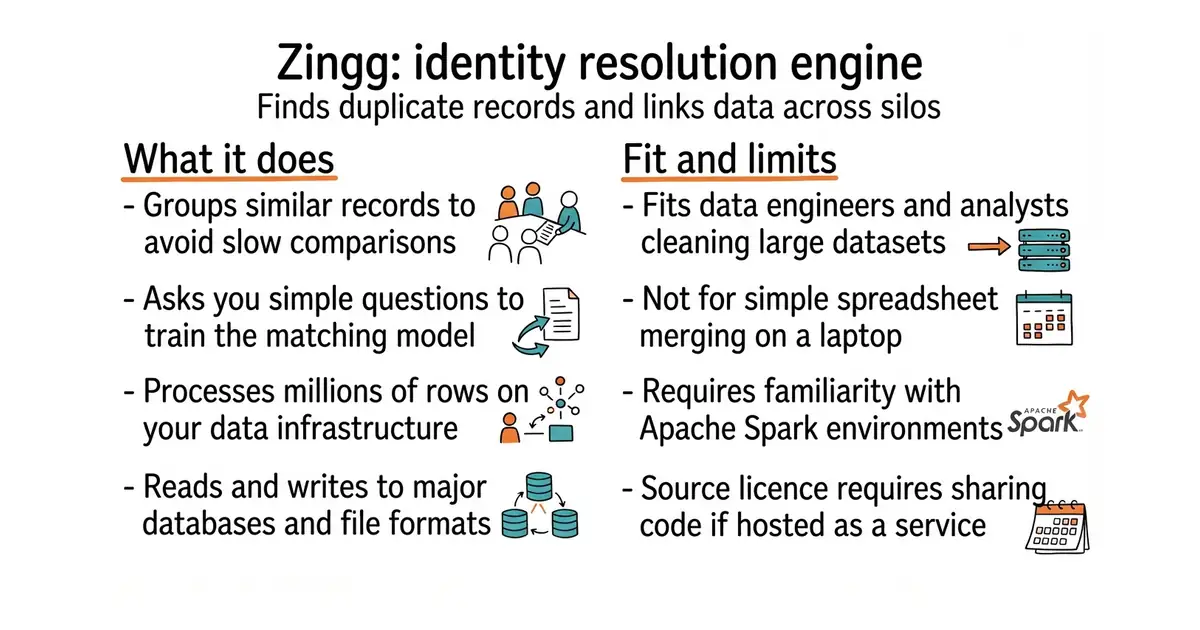
Real world data often has many records for the same person or product spread across different files. These copies have small spelling mistakes and missing parts that make them hard to combine by hand. This tool uses machine learning to match and clean up those records automatically. It asks you a few simple questions on your screen to learn what counts as a match. Then it processes millions of rows on your computer or cloud server.
What it is
Zingg is a machine learning library for entity resolution and master data management that runs on Apache Spark (a fast system for processing large datasets across multiple computers). It clusters similar records together and builds training sets through an interactive command-line interface.
What it is good for
Data engineers and analysts who need to merge duplicate customer lists, clean up product catalogs, or combine company databases after a merger without writing complex fuzzy-matching rules from scratch.
- Interactive training builder asks you to label a few records to teach the matching model.
- Scales to millions of records by grouping similar data before comparing.
- Connects directly to major databases, cloud storage, and file formats like CSV and Parquet.
- Requires Java and Apache Spark knowledge to run and troubleshoot large jobs.
- AGPL-3.0 licence requires you to share your source code if you offer this tool as a paid hosted service over a network.
- Needs careful configuration of memory and hardware resources for large datasets.
Writing complex SQL scripts and manual fuzzy-matching rules for duplicate data.
Apache Spark for running large distributed data processing jobs.
- dedupeio/dedupe4.5k stars
A Python library for accurate and fast deduplication using active learning, though it lacks native distributed processing support.

- tobymao/sqlglot9.7k stars
Reads, rewrites and translates SQL between more than twenty database dialects, without a database.
- patroni/patroni8.8k stars
Watches a group of PostgreSQL copies and promotes a new leader when the leader fails.
- pgEdge/spock758 stars
An add-on that lets several PostgreSQL databases all accept changes and keep each other in step.
docker pull zingg/zingg
docker run -it zingg/zingg bash
./scripts/zingg.sh --phase match --conf examples/febrl/config.json