Radar check
What we found when we opened it. Every bar is one fact, with its date.
Last code pushed 14 Jul 2026, 3 months before this check.
No releases published on GitHub; the code date above is the one to trust.
Public since June 2025, a little over 1 year.
12,647 stars and 941 forks.
0 commits and 7 new issues in the last 90 days.
27 contributors. No pull requests merged in 90 days; changes go in directly.
No security policy file says how to report a problem. No published security advisories.
How the bars are scored
- Alive. Days since the last code push: a week or less 100, a month 90, three months 70, six months 50, a year 30, eighteen months 15, older 0.
- Releases. Age of the latest GitHub release, on a similar scale; no bar when the project publishes no releases.
- Maturity. Age of the project: eight years 100, five 90, three 70, two 55, one 40, six months 25, younger 10.
- Adoption. Stars on a log scale: 100,000 stars is 100, 10,000 is 80, 1,000 is 60, 100 is 40.
- Activity. Commits in the last 90 days: 300 or more 100, 100 85, 30 65, 10 45, any 25.
- Community. People who have contributed: 100 or more 100, 30 80, 10 60, 5 40, 2 25, one 10.
- Security. A published security policy 80, none 40; published advisories are listed, not scored.
Checked by Repo Radar on 26 Oct 2026 from the repository on GitHub.
In simple English
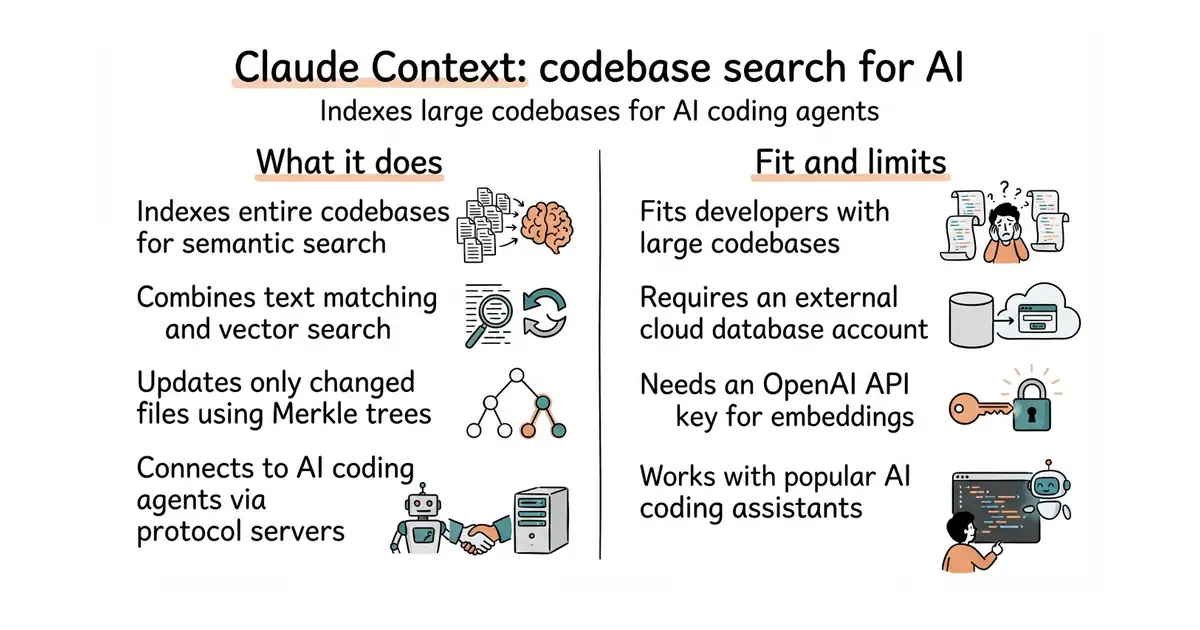
This tool connects an AI coding assistant to your entire project codebase. Instead of loading every file into memory, it indexes your code using semantic search and text matching. When the AI needs to answer a question, it fetches only the relevant parts. This keeps your API costs low and helps the assistant find functions across millions of lines of code. You need a free cloud database account and an OpenAI API key to run it.
What it is
An open-source Model Context Protocol server and core engine that indexes codebases using Abstract Syntax Tree chunking and vector databases. It lets coding assistants search through large projects efficiently using hybrid search.
What it is good for
Solo builders working on large codebases with AI coding agents who want to reduce token costs and improve code retrieval accuracy.
- Reduces token usage by around 40 percent compared to loading whole folders.
- Uses smart code splitting based on syntax trees rather than raw character counts.
- Re-indexes only changed files using Merkle trees to save time.
- Requires an external cloud database and an OpenAI API key which cost money.
- Setup involves editing configuration files for your specific AI client.
- Depends on third-party cloud services for vector storage and embeddings.
manually copying and pasting code files into AI chat windows
Claude Code
- modelcontextprotocol/servers92k stars
Official collection of Model Context Protocol servers for various data sources.

- basicmachines-co/basic-memory4.3k stars
Gives an AI assistant a memory that is stored as plain text files you can read.
- deepset-ai/haystack27k stars
A Python framework for joining language models, document search and tools into one working pipeline.
- Giskard-AI/giskard-oss5.9k stars
A Python library that writes tests for language-model programs and tries to break them on purpose.
claude mcp add claude-context \
  -e OPENAI_API_KEY=sk-your-openai-api-key \
  -e MILVUS_ADDRESS=your-zilliz-cloud-public-endpoint \
  -e MILVUS_TOKEN=your-zilliz-cloud-api-key \
  -- npx @zilliz/claude-context-mcp@latest