Radar check
What we found when we opened it. Every bar is one fact, with its date.
Last code pushed 13 Oct 2026, 12 days before this check.
Latest release zentity-1.8.3 on 3 May 2024.
Public since February 2018, a little over 8 years.
171 stars and 29 forks.
10 commits and 0 new issues in the last 90 days.
2 contributors. No pull requests merged in 90 days; changes go in directly. A small team carries it.
No security policy file says how to report a problem. No published security advisories.
How the bars are scored
- Alive. Days since the last code push: a week or less 100, a month 90, three months 70, six months 50, a year 30, eighteen months 15, older 0.
- Releases. Age of the latest GitHub release, on a similar scale; no bar when the project publishes no releases.
- Maturity. Age of the project: eight years 100, five 90, three 70, two 55, one 40, six months 25, younger 10.
- Adoption. Stars on a log scale: 100,000 stars is 100, 10,000 is 80, 1,000 is 60, 100 is 40.
- Activity. Commits in the last 90 days: 300 or more 100, 100 85, 30 65, 10 45, any 25.
- Community. People who have contributed: 100 or more 100, 30 80, 10 60, 5 40, 2 25, one 10.
- Security. A published security policy 80, none 40; published advisories are listed, not scored.
Checked by Repo Radar on 26 Oct 2026 from the repository on GitHub.
In simple English
This tool helps you figure out if different records in your database belong to the same person, place or company. It searches through your data to group matching entries together without needing you to change how your files are stored. You can run it on your existing server setup using simple commands. It costs you time to configure and maintain, but it is free to use under an open source licence.
What it is
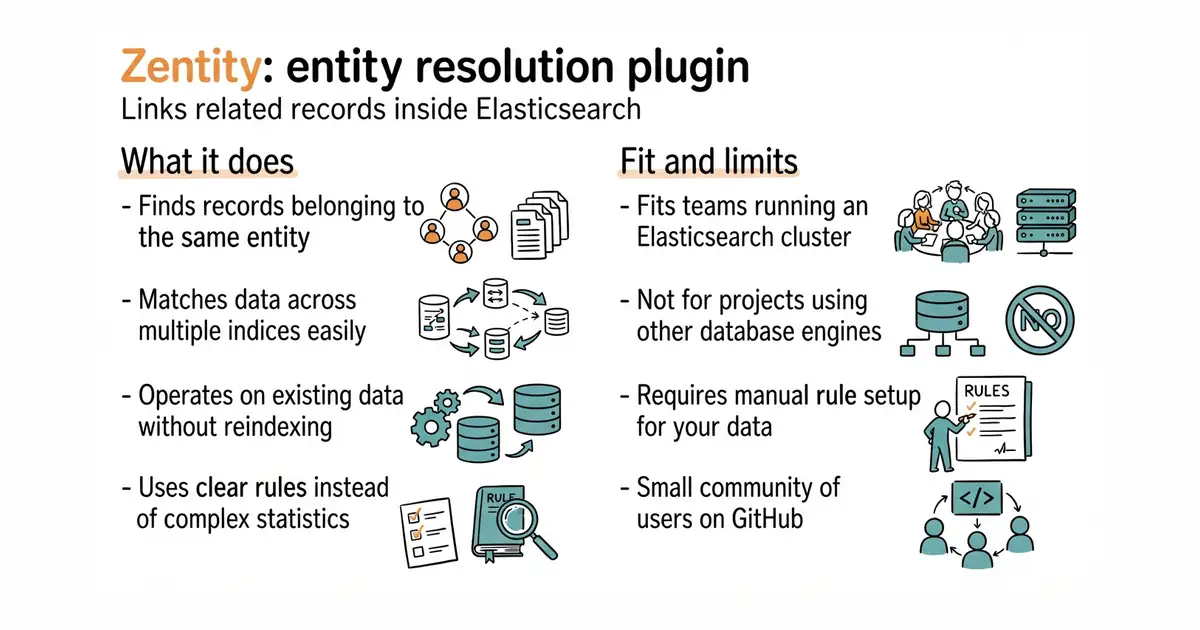
Zentity is a plugin for Elasticsearch (a search engine used to store and query large amounts of text quickly) that performs entity resolution (the process of identifying which different records point to the same real-world entity). It lets you define rules to match names, addresses or IDs across multiple datasets.
What it is good for
Solo builders who store customer records, logs or product data in Elasticsearch and need to clean up duplicates or link related profiles together.
- Works directly on your current data without requiring a complex reindexing step.
- Groups connected records across multiple indices even when the data fields do not match.
- Uses straightforward rules rather than complicated statistical models that are hard to debug.
- Requires an existing Elasticsearch server installation to function at all.
- Written in Java, which can make deep troubleshooting difficult if you are not a Java developer.
- Small community of users with only 171 stars on GitHub.
writing custom scripts to match records across databases
Elasticsearch
- pelias/pelias3.6k stars
Focuses on geographic entity resolution and search, whereas this tool handles any type of record.

- tobymao/sqlglot9.7k stars
Reads, rewrites and translates SQL between more than twenty database dialects, without a database.
- patroni/patroni8.8k stars
Watches a group of PostgreSQL copies and promotes a new leader when the leader fails.
- pgEdge/spock758 stars
An add-on that lets several PostgreSQL databases all accept changes and keep each other in step.
elasticsearch-plugin install https://zentity.io/releases/zentity-1.8.3-elasticsearch-9.5.5.zip