Radar check
What we found when we opened it. Every bar is one fact, with its date.
Last code pushed 22 Oct 2026, 4 days before this check.
Latest release 0.16.2 on 6 Oct 2026.
Public since February 2020, a little over 6 years.
2,005 stars and 187 forks.
15 commits and 0 new issues in the last 90 days.
15 contributors. 10 pull requests merged in 90 days.
A security policy says how to report a problem. No published security advisories.
How the bars are scored
- Alive. Days since the last code push: a week or less 100, a month 90, three months 70, six months 50, a year 30, eighteen months 15, older 0.
- Releases. Age of the latest GitHub release, on a similar scale; no bar when the project publishes no releases.
- Maturity. Age of the project: eight years 100, five 90, three 70, two 55, one 40, six months 25, younger 10.
- Adoption. Stars on a log scale: 100,000 stars is 100, 10,000 is 80, 1,000 is 60, 100 is 40.
- Activity. Commits in the last 90 days: 300 or more 100, 100 85, 30 65, 10 45, any 25.
- Community. People who have contributed: 100 or more 100, 30 80, 10 60, 5 40, 2 25, one 10.
- Security. A published security policy 80, none 40; published advisories are listed, not scored.
Checked by Repo Radar on 26 Oct 2026 from the repository on GitHub.
In simple English
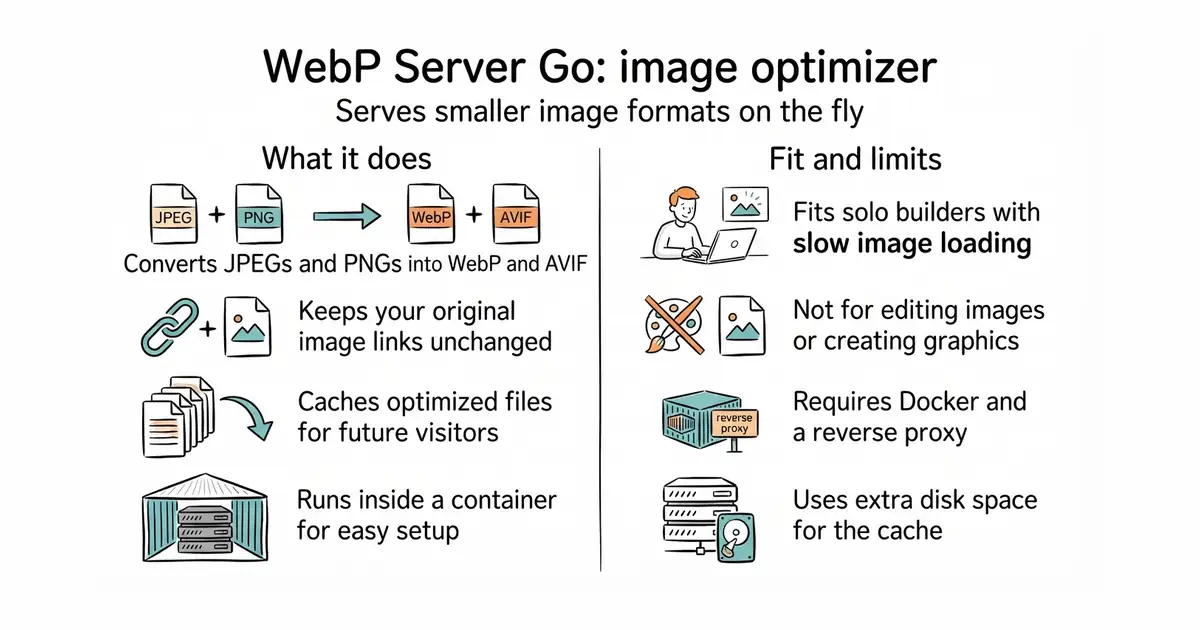
Websites load slowly when images are too large. This program sits behind your website and converts your old JPEG and PNG pictures into smaller modern formats. Visitors get smaller files and faster pages. Your original links stay exactly the same. You run it on your own server using Docker (a way to run a program inside its own sealed box, so it cannot break anything else on your server).
What it is
WebP Server Go is an open-source image optimization proxy written in the Go programming language. It intercepts requests for images, converts them to WebP, AVIF, or JXL formats on the fly, and caches the result for future visitors.
What it is good for
Solo builders and bloggers who want faster page loads and better search engine rankings without manually converting every image on their site.
- Keeps your original image links unchanged.
- Saves bandwidth by serving much smaller files to modern browsers.
- Caches converted images so it only processes each file once.
- Requires Docker knowledge to set up properly on a server.
- Uses extra disk space to store the converted cache files.
- GPL-3.0 licence (a legal rule that requires you to share your code if you modify the program and share it publicly).
manual image conversion scripts and tools
Nginx
- h2non/imaginary6.1k stars
Fast HTTP microservice for high-level image processing powered by a C library.


- evanw/esbuild40k stars
Joins many JavaScript, TypeScript and CSS files into one, in well under a second.
- Textualize/textual38k stars
Lets a Python program draw a real interface inside a terminal, and serve the same thing to a browser.
- python-attrs/cattrs1.1k stars
Turns loose data into declared Python objects, and declared objects back into loose data.
docker-compose up -d