Radar check
What we found when we opened it. Every bar is one fact, with its date.
Last code pushed 25 Oct 2026, one day before this check.
Latest release 2.0.5 on 20 Apr 2026.
Public since April 2015, a little over 11 years.
8,756 stars and 1,947 forks.
74 commits and 17 new issues in the last 90 days.
533 contributors. 68 pull requests merged in 90 days.
No security policy file says how to report a problem. No published security advisories.
How the bars are scored
- Alive. Days since the last code push: a week or less 100, a month 90, three months 70, six months 50, a year 30, eighteen months 15, older 0.
- Releases. Age of the latest GitHub release, on a similar scale; no bar when the project publishes no releases.
- Maturity. Age of the project: eight years 100, five 90, three 70, two 55, one 40, six months 25, younger 10.
- Adoption. Stars on a log scale: 100,000 stars is 100, 10,000 is 80, 1,000 is 60, 100 is 40.
- Activity. Commits in the last 90 days: 300 or more 100, 100 85, 30 65, 10 45, any 25.
- Community. People who have contributed: 100 or more 100, 30 80, 10 60, 5 40, 2 25, one 10.
- Security. A published security policy 80, none 40; published advisories are listed, not scored.
Checked by Repo Radar on 26 Oct 2026 from the repository on GitHub.
In simple English
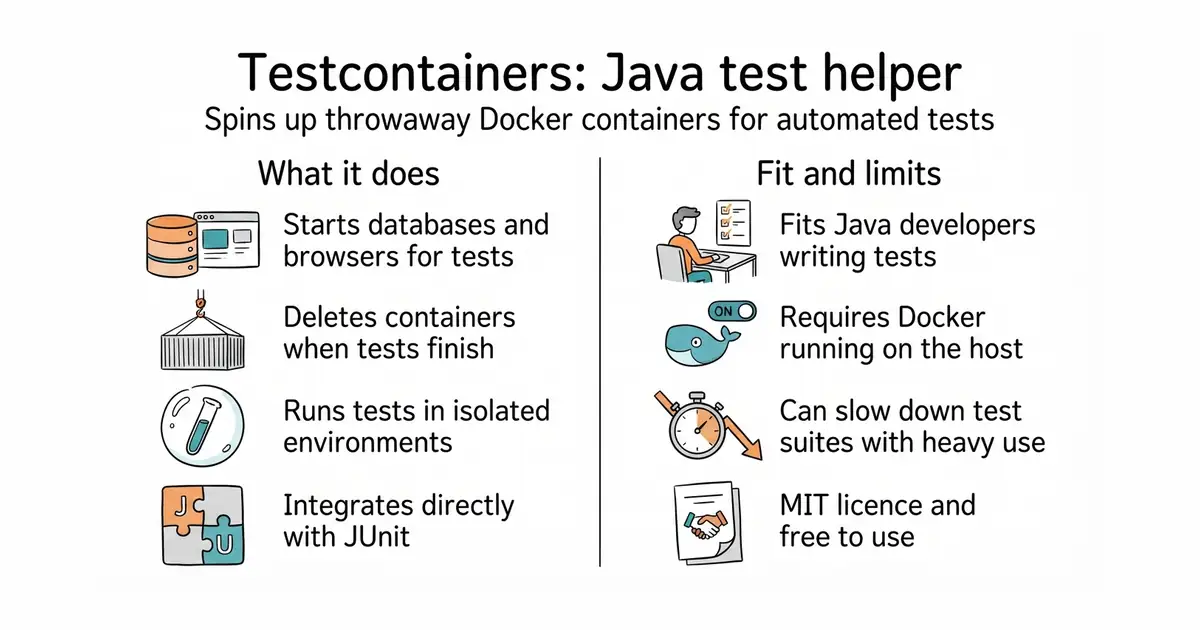
Writing tests for software is hard when your program needs a database or a web browser to run. This library starts those services in the background while your tests run. It deletes them when the tests finish so nothing is left behind. Your tests run in clean, isolated environments every single time. You need Docker installed on your computer or build server to use it. It is free to use under an MIT licence.
What it is
Testcontainers is a Java library that supports JUnit tests by providing temporary, disposable instances of common databases, web browsers, and other services. It starts these components inside Docker (a way to run a program inside its own sealed box, so it cannot break anything else on your server) before your code runs and cleans them up afterwards.
What it is good for
This is good for Java developers who write automated integration tests that need real databases like PostgreSQL or MySQL instead of fake ones. It removes the headache of installing, configuring, and wiping test databases on your local machine or continuous integration server.
- Starts real databases and web browsers automatically for your unit tests.
- Cleans up every container after the test finishes, leaving no junk behind.
- Integrates smoothly with JUnit and common Java build tools.
- Requires Docker installed and running on your machine or build server.
- Can slow down your test suite if you start many heavy containers.
- Uses significant memory while running multiple containers at once.
manual setup of local test databases and shared development servers
JUnit for running the test suite
- testcontainers/testcontainers-go5.0k stars
Brings the same temporary Docker container testing approach to Go developers.
- testcontainers/testcontainers-dotnet4.4k stars
Offers disposable container testing utilities specifically for .NET projects.
- testcontainers/testcontainers-python2.3k stars
Allows Python developers to spin up throwaway Docker services during test runs.

- evanw/esbuild40k stars
Joins many JavaScript, TypeScript and CSS files into one, in well under a second.
- Textualize/textual38k stars
Lets a Python program draw a real interface inside a terminal, and serve the same thing to a browser.
- python-attrs/cattrs1.1k stars
Turns loose data into declared Python objects, and declared objects back into loose data.
testImplementation "org.testcontainers:testcontainers:2.0.5"