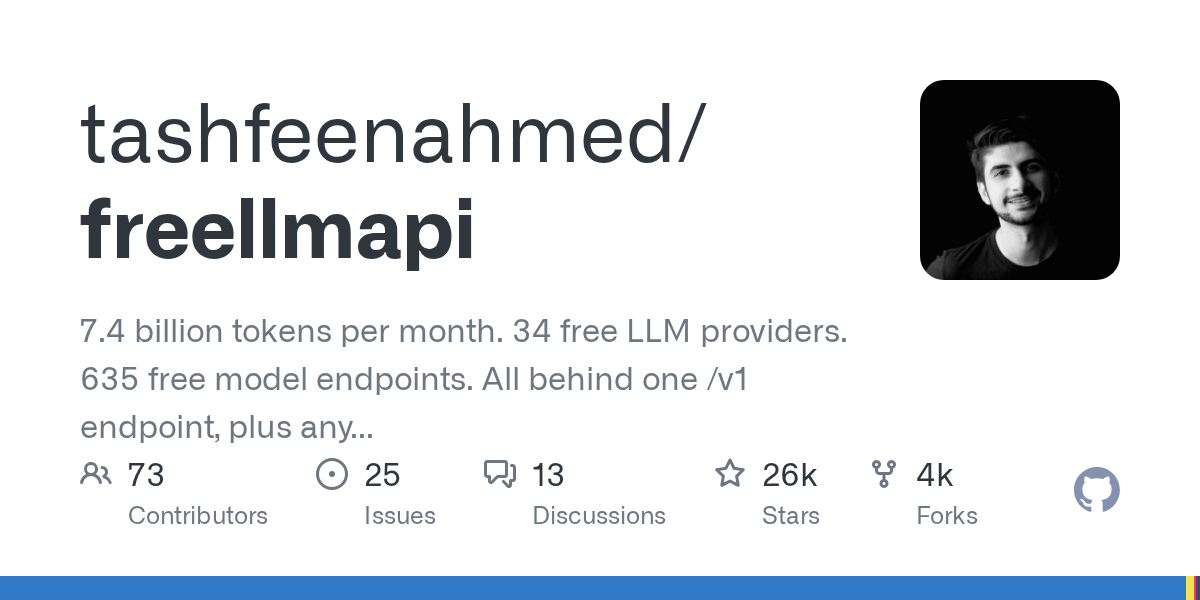
36.6k stars · MIT | v0.16.0, 17 Oct 2026 | [freellmapi.co](https://freellmapi.co) · v0.16.0 (2026-10-17) · Track this in Rising ↗
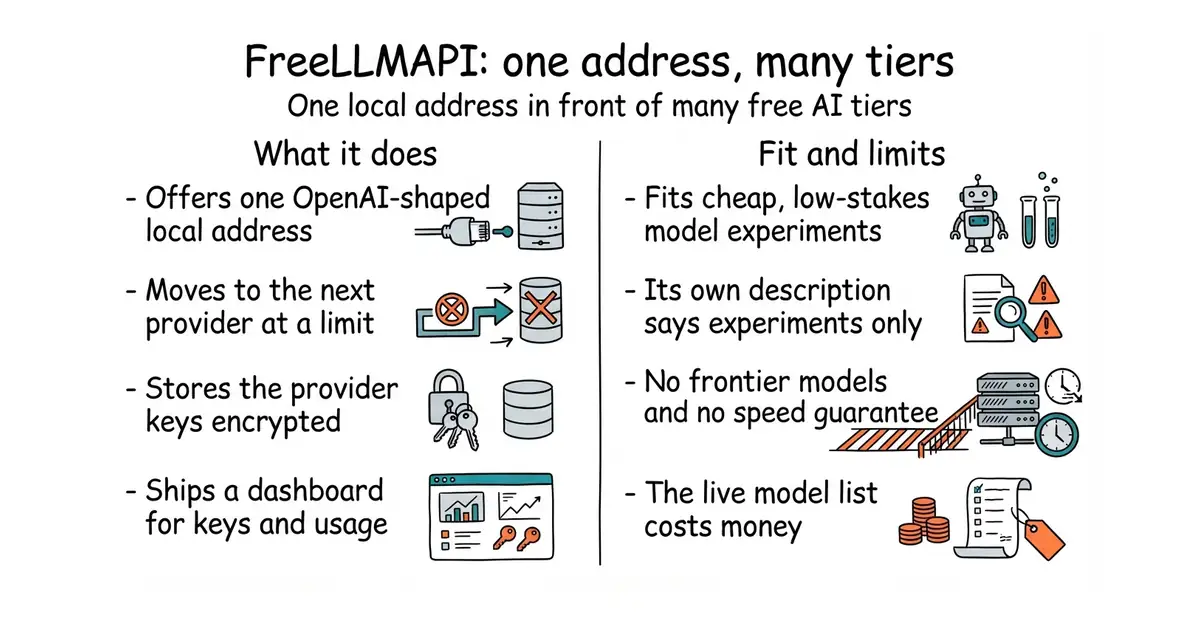
One local address in front of the free tiers of many AI providers.
Radar check
What we found when we opened it. Every bar is one fact, with its date.
Last code pushed 27 Oct 2026, the same day before this check.
Latest release v0.16.11 on 27 Oct 2026.
Public since April 2026, 6 months.
42,504 stars and 5,739 forks.
561 commits and 307 new issues in the last 90 days.
109 contributors. 558 pull requests merged in 90 days.
A security policy says how to report a problem. No published security advisories.
How the bars are scored
- Alive. Days since the last code push: a week or less 100, a month 90, three months 70, six months 50, a year 30, eighteen months 15, older 0.
- Releases. Age of the latest GitHub release, on a similar scale; no bar when the project publishes no releases.
- Maturity. Age of the project: eight years 100, five 90, three 70, two 55, one 40, six months 25, younger 10.
- Adoption. Stars on a log scale: 100,000 stars is 100, 10,000 is 80, 1,000 is 60, 100 is 40.
- Activity. Commits in the last 90 days: 300 or more 100, 100 85, 30 65, 10 45, any 25.
- Community. People who have contributed: 100 or more 100, 30 80, 10 60, 5 40, 2 25, one 10.
- Security. A published security policy 80, none 40; published advisories are listed, not scored.
Checked by Repo Radar on 27 Oct 2026 from the repository on GitHub. Covered in Edition 16.
▶Repo detailsthe review · specs · pros & cons · install
What it does
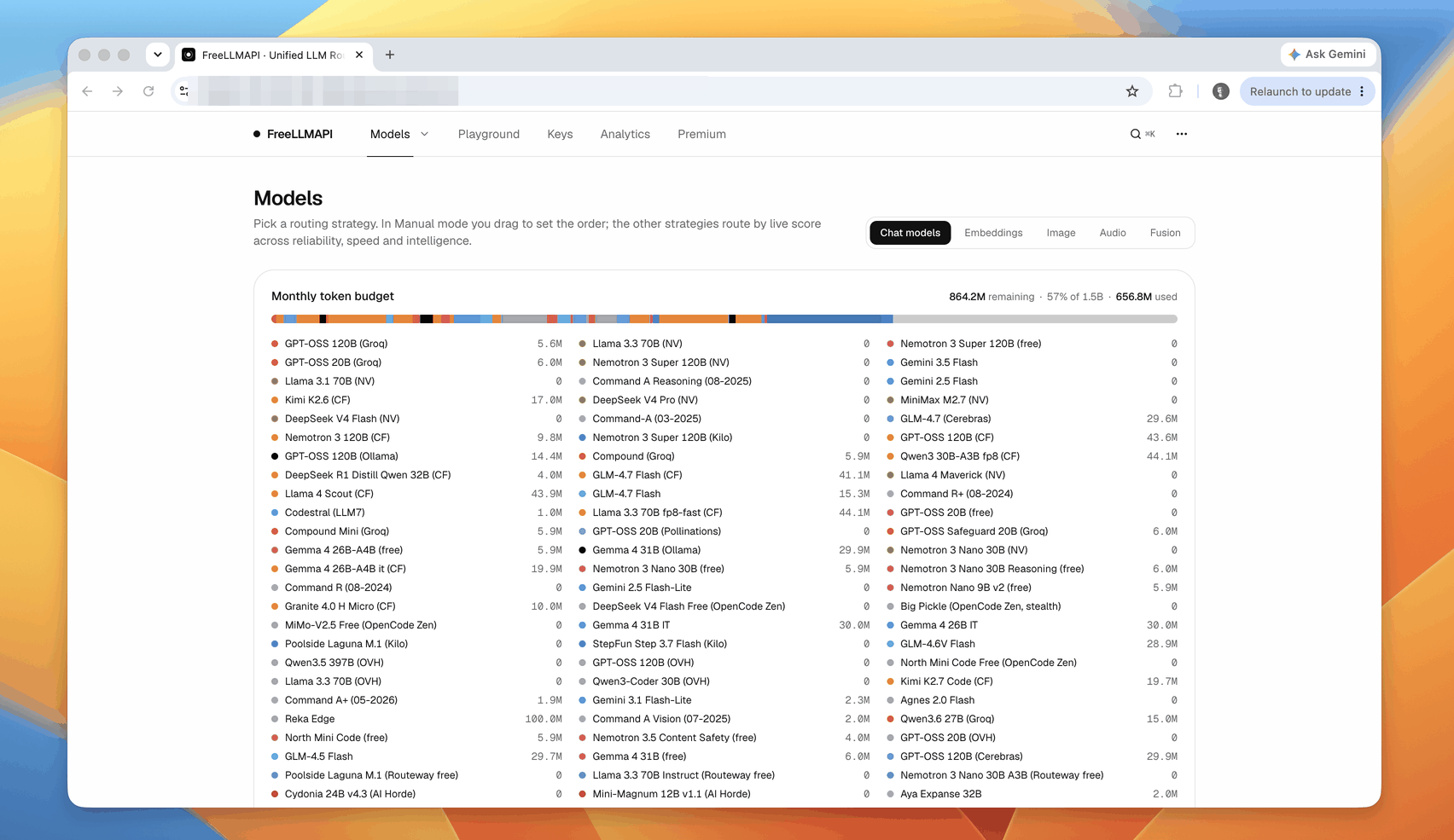
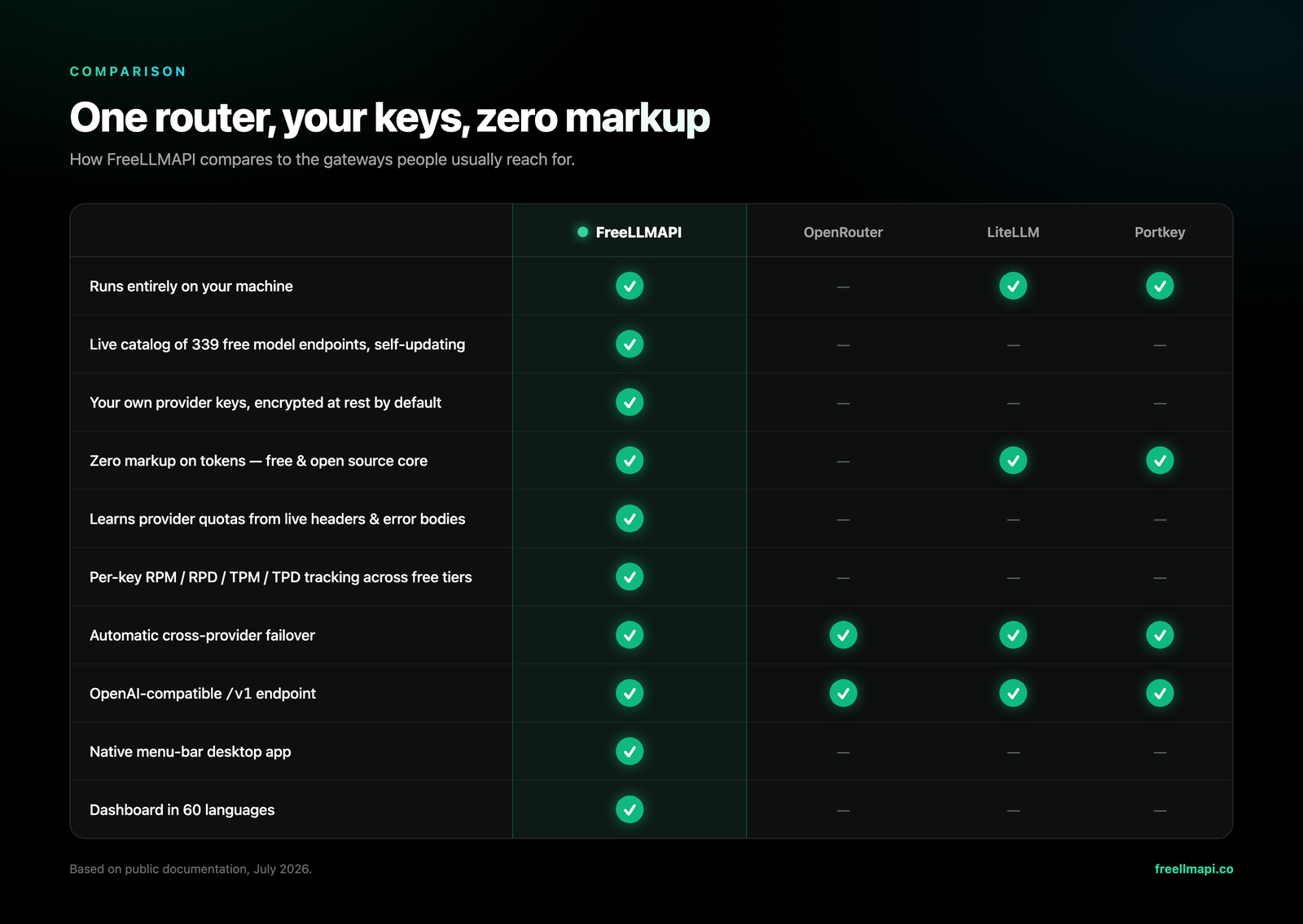
FreeLLMAPI is a program you run yourself that offers one OpenAI-shaped /v1 address and forwards each request to whichever provider you have set up. It picks a model for each request, moves to the next provider when one has hit its limit, and counts usage per key against each free tier's cap. It stores provider keys encrypted and hands out one key of its own to the programs that call it. It covers chat, embeddings, images, video and audio, and also answers in the shapes used by Anthropic and Google as well as OpenAI. It ships a dashboard for keys, routing, a playground and usage figures. The free install receives its list of available models as a monthly snapshot, so new models arrive about thirty days late; a paid tier at $19 a year or $49 once gives the live list, and the router itself stays MIT licensed either way. Its own description says plainly that this is for personal experimentation, and its documentation states there are no frontier models, no guaranteed speed and no service guarantee.
Why it matters
Who it suits. It fits anyone doing a lot of cheap, low-stakes model work: testing prompts, sorting large piles of text, drafts nobody will publish. Six accounts and six keys in six scripts become one address. It is small enough to run on a single-board computer. Skip it entirely for anything a paying customer touches. A stack of free tiers has nothing behind it, and the project says so itself.
Verdict. Worth an hour if prompt experiments are a regular part of the week, and worth nothing at all otherwise. Take the warning at face value rather than treating it as modesty: quality drops later in the day as daily free limits are used up, and the limits reset at midnight UTC. The one-line installer pipes a script from the internet straight into a shell, so download it and read it first. For anything that must keep working, use a paid gateway such as BerriAI/litellm instead, which solves the same shape of problem with accounts you pay for.
Summary (Key Points)from the README
Key features
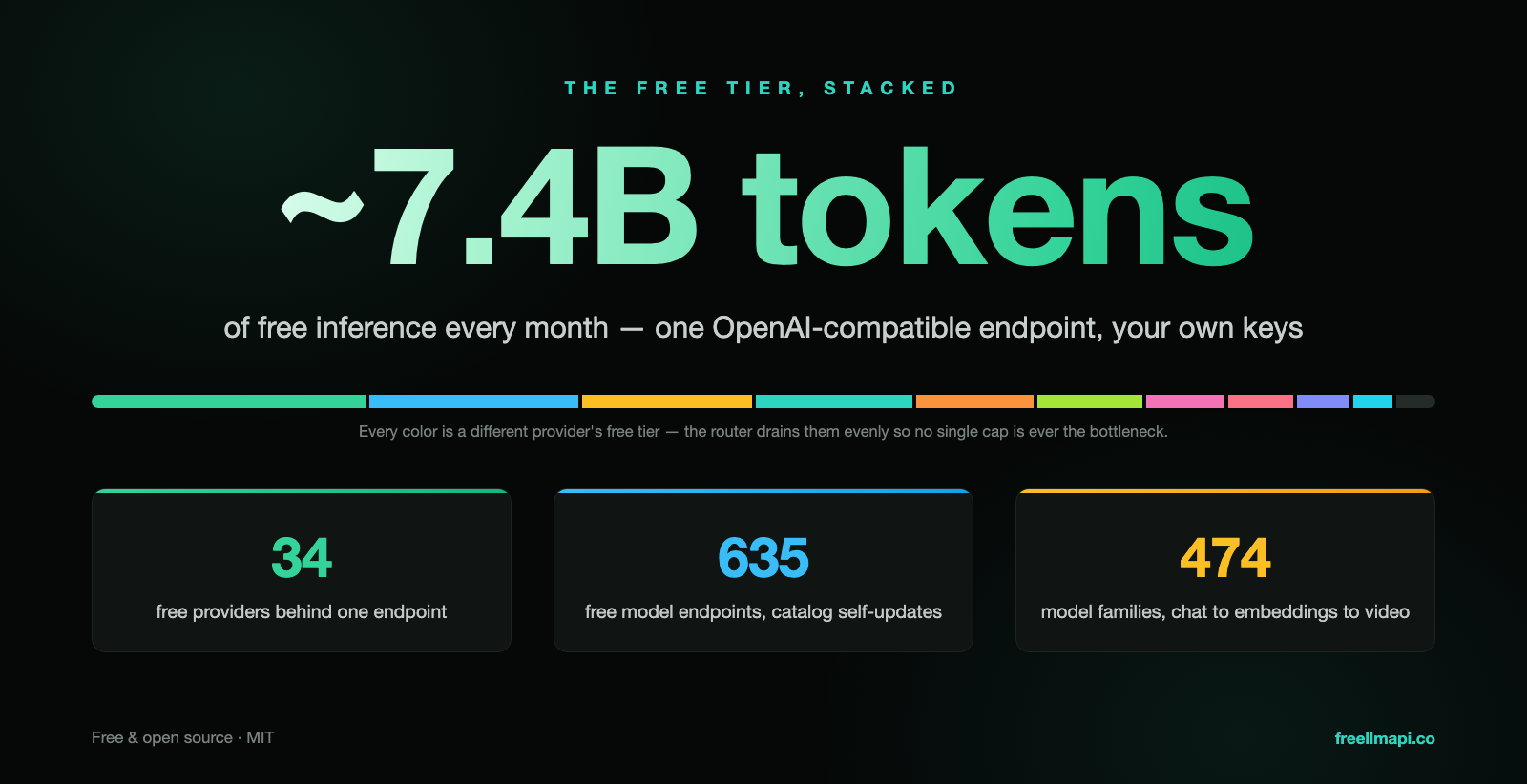
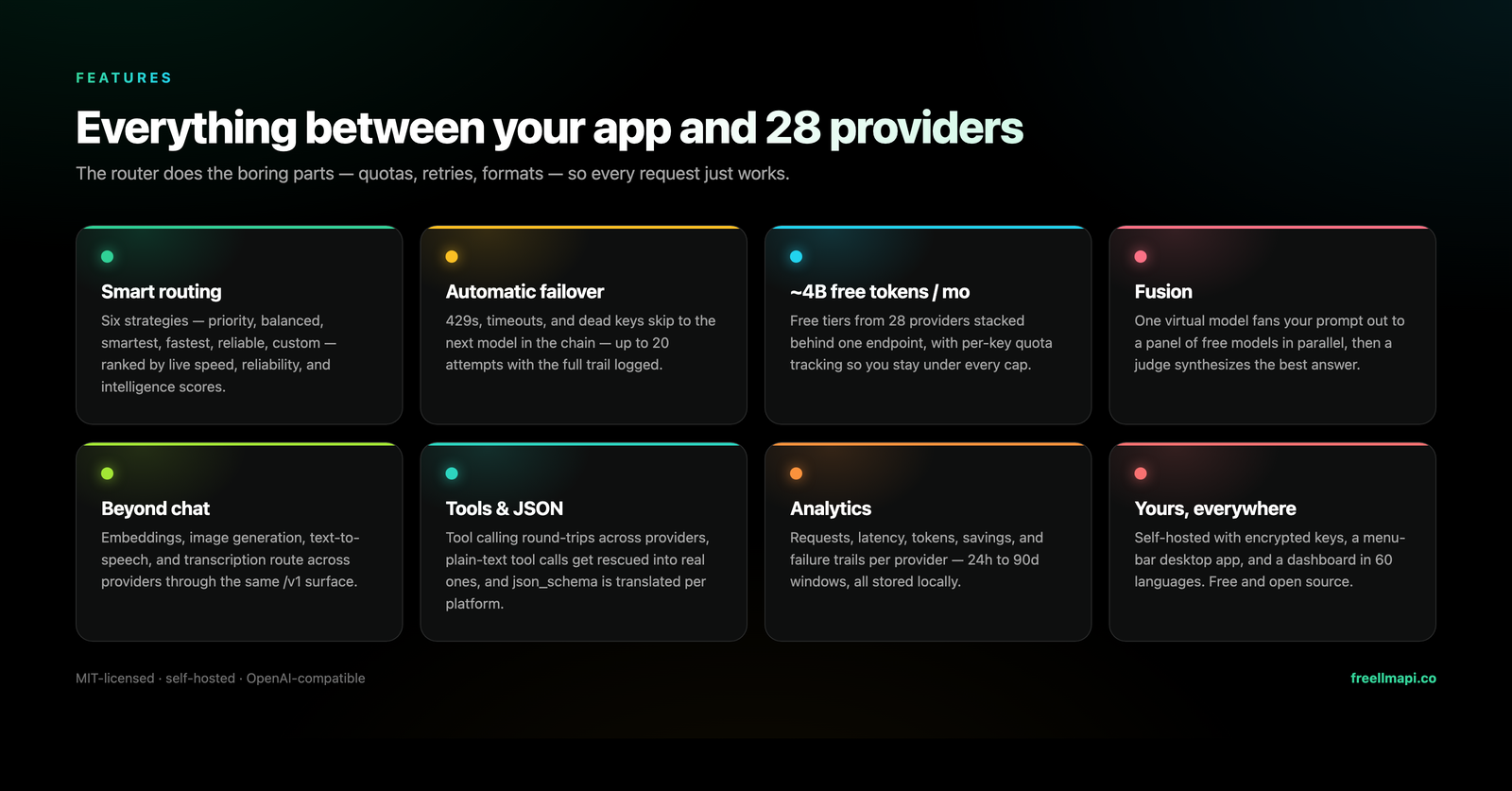
- Single endpoint: One OpenAI-compatible `/v1` API covers 34 providers and 635 free model endpoints, with chat, embeddings, image, video, and audio routes.
- Automatic fallover: On a 429 or 5xx, the router cools that key down and retries the next model in your chain.
- Six routing strategies: Live per-model speed, capability, and reliability scores rank your chain, and `auto:*` strategies can be selected per request.
- Per-key rate tracking: RPM, RPD, TPM, and TPD counters per platform, model, and key learn providers' reported ceilings to stay under caps.
- Encrypted keys: Provider keys are AES-256-GCM encrypted in SQLite and decrypted in memory per request, and apps only see one unified bearer token.
- Self-updating catalog: The router syncs a signed catalog twice a day, so new models and quota changes arrive without a git pull.
- Multi-protocol surfaces: Anthropic Messages, Gemini `/v1beta`, and opt-in Ollama emulation sit alongside the OpenAI routes, and Claude Code and Codex CLI are supported.
- Fusion mode: A virtual fusion model sends prompts to several free models in parallel, and a judge model synthesizes one answer.
- Sticky sessions: Conversations stay on one model for 30 minutes, with an optional handoff note when a mid-chat switch happens.
- Admin dashboard: A React UI manages keys, reorders the chain, runs a playground, and shows p50, p95, and TTFT analytics over 24h to 90d windows, in 60 languages.
Ways to install
| Platform or method | What it needs | Effort |
|---|---|---|
| Docker one-liner script | Docker | Low |
| Docker Compose | Docker and a Compose setup | Medium |
| Local development (npm) | Node 20+ and npm | Medium |
| Windows desktop app (.exe) | Download from Releases | Low |
| macOS desktop app (.dmg or ZIP) | Download from Releases; arm64 or x64, macOS 12 or later | Low |
| Android via Termux (experimental) | Termux and the experimental guide | High |
Important
- Free catalog lag: Free installs get the monthly snapshot, so models arrive 30 days after the live feed; the README says the free build sits about 303 models behind.
- Premium pricing: The live feed costs $19 per year or $49 once for lifetime access; the router itself stays MIT-licensed and free.
- Single-user design: The project is local-first and single-user, and other devices on the LAN see a sign-in form.
- Password recovery: On server installs, the reset code is printed to the server log and expires after 15 minutes.
- No frontier models or SLA: Free tiers bring variable latency and no service guarantee, and effective quality drops late in the day as top models hit daily caps.
- Not for production: The README says to swap in a paid API before shipping anything real, and you remain responsible for each provider's terms.
- Region-bound provider: ModelScope models need an Aliyun cn binding.
- Experimental Android path: The Termux guide is marked experimental.
Written by an AI model from the project’s README; not part of the review, and it can be wrong.
- You bring your own accounts and the keys are stored encrypted. The project is not handing out somebody else's access.
- Very small. It needs Node 20 or newer and runs on Windows, macOS, Linux or a small ARM board.
- One
/v1address means existing OpenAI-shaped code needs no changes.
- The project's own description says personal experimentation only. That is a limit, not modesty.
- No frontier models, changeable speed, and no service guarantee. Quality drops late in the day as the free daily caps run out.
- The free install gets a monthly snapshot of which models exist. The live list costs $19 a year or $49 once.
curl -fsSL https://freellmapi.co/install.sh | bash