Radar check
What we found when we opened it. Every bar is one fact, with its date.
Last code pushed 26 Oct 2026, the same day before this check.
Latest release v2.4.53 on 22 Oct 2026.
Public since July 2011, a little over 15 years.
17,792 stars and 5,947 forks.
6 commits and 2 new issues in the last 90 days.
1,248 contributors. 13 pull requests merged in 90 days.
No security policy file says how to report a problem. 2 published security advisories.
How the bars are scored
- Alive. Days since the last code push: a week or less 100, a month 90, three months 70, six months 50, a year 30, eighteen months 15, older 0.
- Releases. Age of the latest GitHub release, on a similar scale; no bar when the project publishes no releases.
- Maturity. Age of the project: eight years 100, five 90, three 70, two 55, one 40, six months 25, younger 10.
- Adoption. Stars on a log scale: 100,000 stars is 100, 10,000 is 80, 1,000 is 60, 100 is 40.
- Activity. Commits in the last 90 days: 300 or more 100, 100 85, 30 65, 10 45, any 25.
- Community. People who have contributed: 100 or more 100, 30 80, 10 60, 5 40, 2 25, one 10.
- Security. A published security policy 80, none 40; published advisories are listed, not scored.
Checked by Repo Radar on 26 Oct 2026 from the repository on GitHub.
In simple English
You give this program a text file that describes your web API. It reads the file and writes working code in dozens of programming languages. You save days of writing boilerplate code by hand when you change your API. You need Java installed on your computer to run it, and some familiarity with the command line. It costs nothing to use and is free of ongoing fees.
What it is
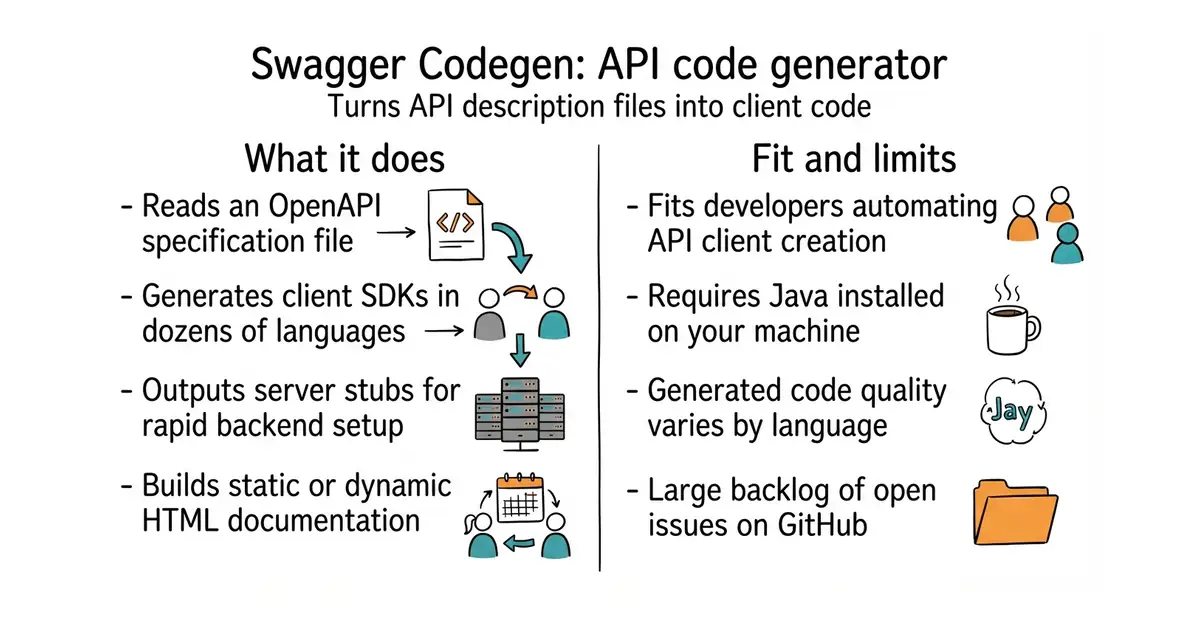
A command-line tool and template engine that turns an OpenAPI specification into client libraries, server stubs, and HTML documentation across dozens of programming languages. It supports multiple versions of the OpenAPI specification through its independently maintained version branches.
What it is good for
Solo builders who need to generate a client library in a specific language for an existing API, or want to create starter code for a new server without writing network request code by hand.
- Supports dozens of programming languages for both clients and server stubs.
- Can generate static or dynamic HTML documentation directly from your API file.
- Integrates into build tools like Maven and Gradle for automated pipelines.
- Requires Java (a programming platform needed to run Java applications) to be installed on your machine.
- High number of open issues on GitHub means community support for bugs can be slow.
- Generated code quality varies wildly depending on the target language and template used.
Writing API client libraries and server request handling code by hand.
OpenAPI Specification (a standard format for describing web APIs in JSON or YAML)
- swagger-api/swagger-ui29k stars
Renders interactive API documentation in a browser from the same OpenAPI definition files.

- evanw/esbuild40k stars
Joins many JavaScript, TypeScript and CSS files into one, in well under a second.
- Textualize/textual38k stars
Lets a Python program draw a real interface inside a terminal, and serve the same thing to a browser.
- python-attrs/cattrs1.1k stars
Turns loose data into declared Python objects, and declared objects back into loose data.
git clone https://github.com/swagger-api/swagger-codegen
cd swagger-codegen
mvn clean package