91k stars · MIT · v10.6.0 (2026-09-02) · Track this in Rising ↗
Every component rendered on its own, in every state, including the states you never remember to open.
Radar check
What we found when we opened it. Every bar is one fact, with its date.
Last code pushed 27 Oct 2026, the same day before this check.
Latest release v10.6.4 on 26 Oct 2026.
Public since March 2016, a little over 10 years.
91,390 stars and 10,468 forks.
5,087 commits and 184 new issues in the last 90 days.
2,838 contributors. 769 pull requests merged in 90 days.
A security policy says how to report a problem. 4 published security advisories.
How the bars are scored
- Alive. Days since the last code push: a week or less 100, a month 90, three months 70, six months 50, a year 30, eighteen months 15, older 0.
- Releases. Age of the latest GitHub release, on a similar scale; no bar when the project publishes no releases.
- Maturity. Age of the project: eight years 100, five 90, three 70, two 55, one 40, six months 25, younger 10.
- Adoption. Stars on a log scale: 100,000 stars is 100, 10,000 is 80, 1,000 is 60, 100 is 40.
- Activity. Commits in the last 90 days: 300 or more 100, 100 85, 30 65, 10 45, any 25.
- Community. People who have contributed: 100 or more 100, 30 80, 10 60, 5 40, 2 25, one 10.
- Security. A published security policy 80, none 40; published advisories are listed, not scored.
Checked by Repo Radar on 27 Oct 2026 from the repository on GitHub. Covered in Edition 12.
▶Repo detailsthe review · specs · pros & cons · install
What it does
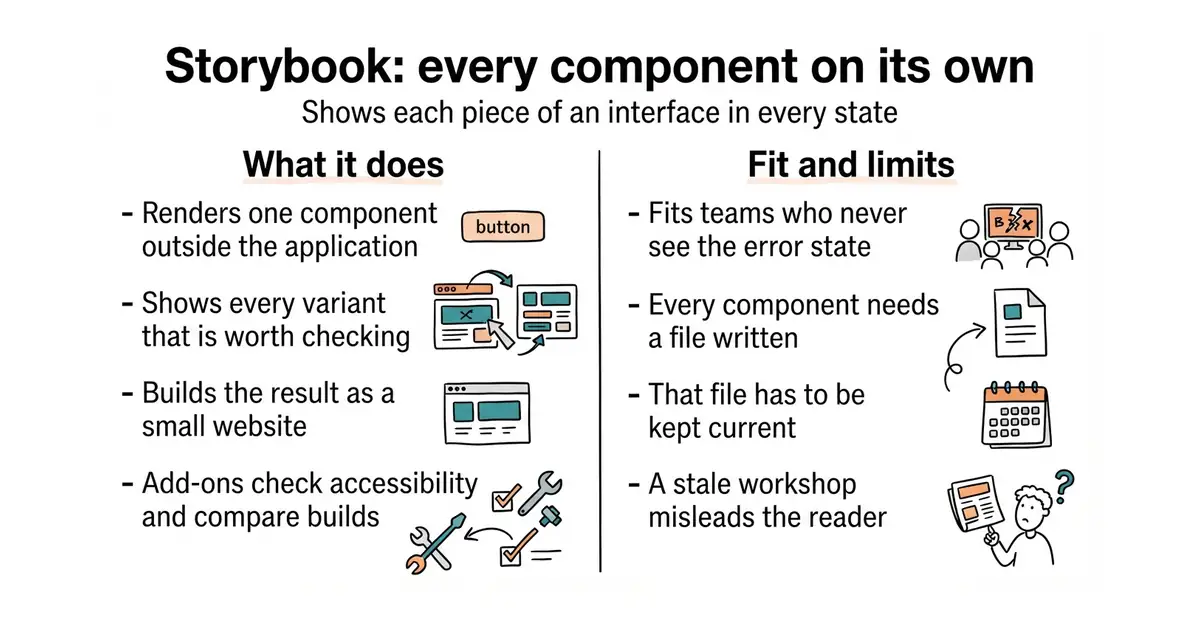
You write a short file for each component describing the variants worth looking at, and Storybook renders each one in isolation, outside the running application. The result is browsable locally and also builds to a static website, which is plain files that can be hosted anywhere. Add-ons cover accessibility checks, interaction tests, visual comparison between builds and documentation generated from the component source. It works with React, Vue, Svelte, Angular, Web Components and several others. The current release is v10.6.2, from 12 October 2026, under the MIT licence. It is not a test runner for an application's logic and not a design tool: it renders components that already exist, and shows nothing about how they behave once wired together.
Why it matters
Who it suits. Small teams whose characteristic failure is not the main path but the empty state, the error state and the state where a translated label is forty per cent longer and breaks the row. Those are invisible during normal development, because development always happens with good data loaded. It also gives a new collaborator one page to look at instead of an explanation. Skip it if nobody will keep the files current, because a stale Storybook actively misleads.
Verdict. Worth it only with a real commitment, and that commitment is the whole decision. Three components written up and then abandoned is worse than none. Start with the four or five components that appear on every screen, and add a story to the definition of done for new work. It pairs naturally with shadcn/ui above, one story per component copied in. If the overhead is too much, histoire-dev/histoire and tajo/ladle are lighter and quicker to start.
Summary (Key Points)from the README
Key features
- Isolated UI workshop: Build UI components and pages in isolation, with use cases spanning development, testing, and documentation.
- Wide framework support: Renderers are listed for React, Angular, Vue 3, Web components, React Native, HTML, Ember, Svelte, Preact, Qwik, and SolidJS.
- Mobile extension: The API has been extended to support React Native, Android, iOS, and Flutter development for mobile.
- Large addon library: Addons cover accessibility (a11y), actions logging, backgrounds, CSS resources, design assets, docs, events, Google Analytics, GraphQL, Jest results, links, measure, outline, query params, and viewport.
- Documentation addon: The docs addon adds high-quality documentation to components.
- Interactive testing and debugging: The a11y, measure, and outline addons check accessibility, box models, and CSS layout inside the Storybook UI.
- Quick sandbox: storybook.new creates an example project in StackBlitz.
- Extensible API: Storybook can be configured and extended in various ways.
Important
- Deprecations: The README says some addons will be deprecated or removed. Info/notes should move to docs, contexts to toolbars, and addon-storyshots to the Storybook test-runner, with migration guides for each.
- Mobile support is an extension: Android, iOS, and Flutter support is described as an extension of the API, not a core framework listed alongside the others.
- Monorepo contributor setup: The development scripts (yarn start, yarn task, yarn lint, yarn test) are for working on the Storybook monorepo itself and rely on yarn.
- Support channel: For help, the README points to GitHub Discussions for issues, with Discord for guidance on contributing.
Written by an AI model from the project’s README; not part of the review, and it can be wrong.
- Forces the empty, error and overflow states into view before a reader finds them.
- The static build doubles as documentation of how the interface is meant to look.
- A very large add-on ecosystem, covering accessibility and visual comparison.
- Real overhead: every component needs a file written and then kept current.
- It is a third build toolchain alongside the site and the application itself.
- The common outcome is a Storybook that goes stale within a month and then misleads.
There is a second, marketing-shaped payoff: the built output is a living style guide, which is the thing you point a freelancer or a future collaborator at instead of writing an explanation.
npx storybook@latest init
npm run storybook