In simple English
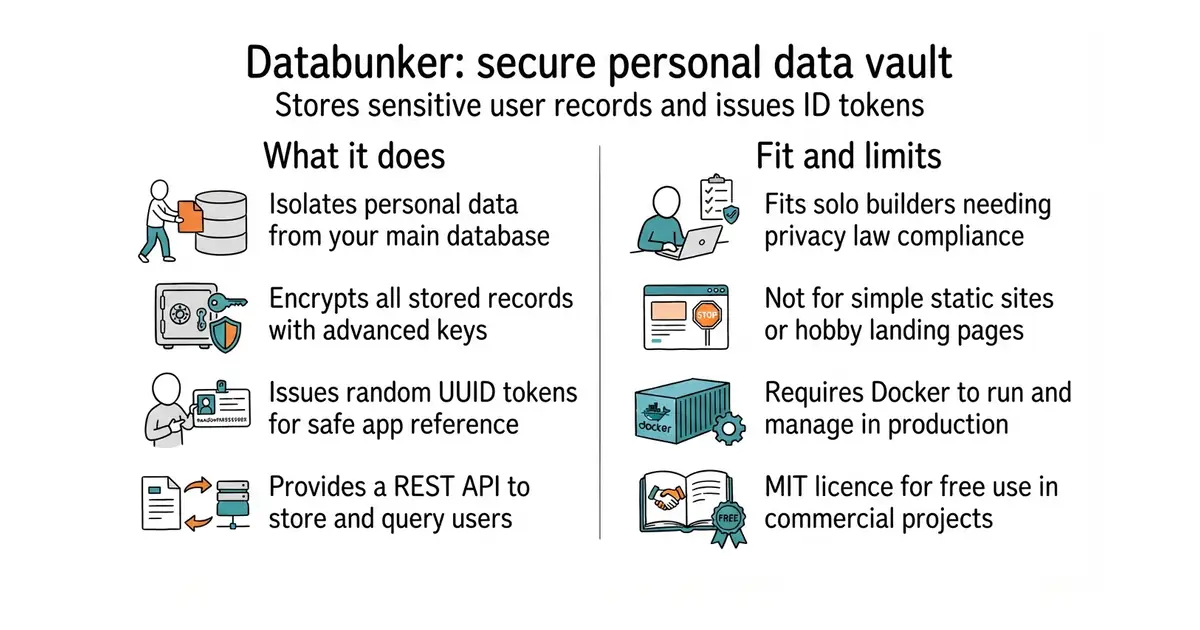
Applications often store names, emails, and passwords inside a standard database. If that database leaks, all your users lose their privacy at once. Databunker (a secure box that isolates sensitive files away from the rest of your program) acts as a separate vault for that information. It gives your app a random token instead of real personal details. You pay for this safety with the extra work of running a second service alongside your main app.
What it is
Databunker is a Go-based self-hosted service that stores personal data and issues unique ID tokens. It encrypts all records with AES-256 and blocks SQL injection attacks by design.
What it is good for
Solo builders who need to follow privacy laws like GDPR or HIPAA without writing custom security layers from scratch.
- Keeps sensitive customer data isolated from your main application database.
- Provides ready-made tools for compliance requests like data deletion.
- Offers a simple REST API and SDKs to integrate with your backend.
- Requires running and maintaining an extra server container in production.
- Adds network latency to every user lookup your application makes.
- Storing all data encrypted means debugging production records takes more effort.
storing plain passwords and customer emails in a standard database table
PostgreSQL (a robust open-source SQL database for storing application state)
- smallstep/certificates9.0k stars
A certificate authority you run yourself, for machines the public internet cannot reach.
- michelp/pgsodium614 stars
A PostgreSQL extension that brings libsodium's encryption functions into SQL, with a root key the database cannot read back.
- pgaudit/pgaudit1.7k stars
A PostgreSQL extension that records what was done to the database, in the database's own log.
docker pull securitybunker/databunker
docker run -p 3000:3000 -d --rm --name dbunker securitybunker/databunker demo