6.1k stars · MIT · v1.10.19 (2026-10-06) · Track this in Rising ↗
One source file rendered into a web page, a PDF and a slide deck, with Python code executed inside the document.
Radar check
What we found when we opened it. Every bar is one fact, with its date.
Last code pushed 26 Oct 2026, one day before this check.
Latest release v1.10.19 on 6 Oct 2026.
Public since September 2020, about 6 years.
6,125 stars and 475 forks.
238 commits and 189 new issues in the last 90 days.
170 contributors. 189 pull requests merged in 90 days.
No security policy file says how to report a problem. No published security advisories.
How the bars are scored
- Alive. Days since the last code push: a week or less 100, a month 90, three months 70, six months 50, a year 30, eighteen months 15, older 0.
- Releases. Age of the latest GitHub release, on a similar scale; no bar when the project publishes no releases.
- Maturity. Age of the project: eight years 100, five 90, three 70, two 55, one 40, six months 25, younger 10.
- Adoption. Stars on a log scale: 100,000 stars is 100, 10,000 is 80, 1,000 is 60, 100 is 40.
- Activity. Commits in the last 90 days: 300 or more 100, 100 85, 30 65, 10 45, any 25.
- Community. People who have contributed: 100 or more 100, 30 80, 10 60, 5 40, 2 25, one 10.
- Security. A published security policy 80, none 40; published advisories are listed, not scored.
Checked by Repo Radar on 27 Oct 2026 from the repository on GitHub. Covered in Edition 14.
▶Repo detailsthe review · specs · pros & cons · install
What it does
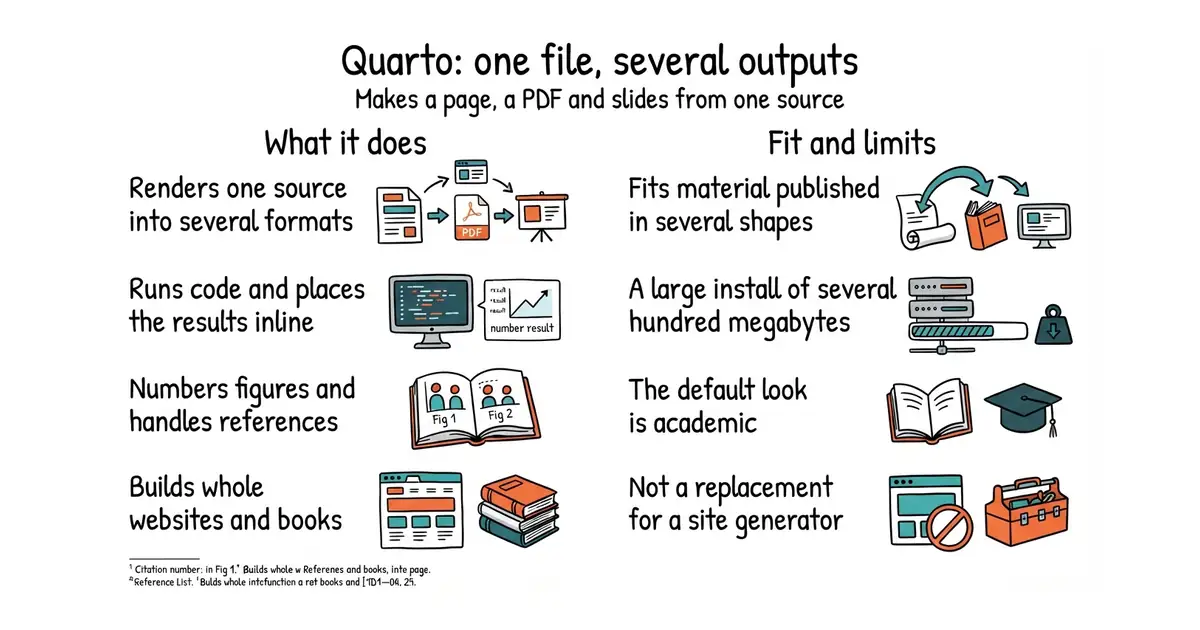
Quarto is a publishing system built on Pandoc. One source file carries the text and a short block of settings that names the output formats. It renders to HTML, PDF, Word, slides, and whole websites or books. Code blocks written in Python, R, Julia or Observable are run while the document is rendered, and their output is placed in the finished file. Cross-references, citations and figure numbering are handled without extra work. Version 1.10.19 was published on 6 October 2026. It is a large install, several hundred megabytes, because Pandoc and a JavaScript runtime travel with it. It is not a content editor, and its default look is academic rather than branded.
Why it matters
Who it suits. It suits anyone publishing the same material in more than one shape, such as a lesson that has to become slides, an article and a download. It suits reports rebuilt from fresh numbers, because the code runs inside the document. Skip it for an ordinary marketing site, where a site generator does that job with far less weight.
Verdict. The only tool here that removes a duplicate writing job, and the saving is real as soon as the same content goes out twice. Budget an afternoon for the first document, and real CSS work to make it match a brand. slidevjs/slidev makes better-looking slides and nothing else, and jgm/pandoc (#6) is the far smaller install when one output format is enough.
Summary (Key Points)from the README
Key features
- Pandoc-based publishing: Quarto builds on Pandoc and keeps its core capabilities, with documents written in plain-text Markdown.
- Multi-language code embedding: Python, R, Julia and JavaScript code and output can be embedded through Jupyter, Knitr and Observable.
- Technical Markdown extensions: Cross-references, sub-figures, layout panels, hoverable citations and footnotes, and callouts are available.
- Project system: Groups of documents can be rendered together, share options, and produce aggregate output such as websites and books.
- Editor support: Authoring works in JupyterLab, RStudio and VS Code, among other editors and notebooks.
- Visual Markdown editor: A visual editing interface is provided for composing long-form documents.
- Open-source license: Quarto is released under the MIT license.
Ways to install
| Platform or method | What it needs | Effort |
|---|---|---|
| Linux or macOS (development version) | Clone the quarto-cli repository, then run the configure.sh script | Clone and run one script |
| Windows (development version) | Clone the quarto-cli repository, then run the configure.cmd script | Clone and run one script |
Important
- Development build only: The README describes installation from the development version of the Quarto CLI cloned from source, not a packaged release.
- PATH change: The configure.sh script adds a symlink to quarto on your path, which changes your shell environment.
- Manual updates: To update, you must run git pull in the local repository directory.
- Fallback binary path: If the symlink is not created, quarto can still be run from package/dist/bin/quarto.
- Unit tests: All unit tests run through a script in the test directory, and a single test runs by passing its script name.
Written by an AI model from the project’s README; not part of the review, and it can be wrong.
- One source file, several finished formats. That is the whole reason to use it.
- Python runs inside the document, so numbers and charts in a report are never out of date.
- MIT licence, with releases every few weeks.
- A large install, several hundred megabytes, because it carries Pandoc and a JavaScript runtime with it.
- The default look is academic. Matching a brand takes real CSS work.
- Its website output overlaps ordinary site generators. Use it for documents and slides rather than rebuilding a site with it.
brew install --cask quarto
quarto render lesson.qmd --to html
quarto render lesson.qmd --to pdf
quarto render lesson.qmd --to revealjs