Radar check
What we found when we opened it. Every bar is one fact, with its date.
Last code pushed 25 Oct 2026, the same day before this check.
Latest release 9.1.1 on 19 Jun 2026.
Public since June 2015, a little over 11 years.
14,645 stars and 3,553 forks.
260 commits and 74 new issues in the last 90 days.
1,182 contributors. 139 pull requests merged in 90 days.
A security policy says how to report a problem. No published security advisories.
How the bars are scored
- Alive. Days since the last code push: a week or less 100, a month 90, three months 70, six months 50, a year 30, eighteen months 15, older 0.
- Releases. Age of the latest GitHub release, on a similar scale; no bar when the project publishes no releases.
- Maturity. Age of the project: eight years 100, five 90, three 70, two 55, one 40, six months 25, younger 10.
- Adoption. Stars on a log scale: 100,000 stars is 100, 10,000 is 80, 1,000 is 60, 100 is 40.
- Activity. Commits in the last 90 days: 300 or more 100, 100 85, 30 65, 10 45, any 25.
- Community. People who have contributed: 100 or more 100, 30 80, 10 60, 5 40, 2 25, one 10.
- Security. A published security policy 80, none 40; published advisories are listed, not scored.
Checked by Repo Radar on 26 Oct 2026 from the repository on GitHub.
In simple English
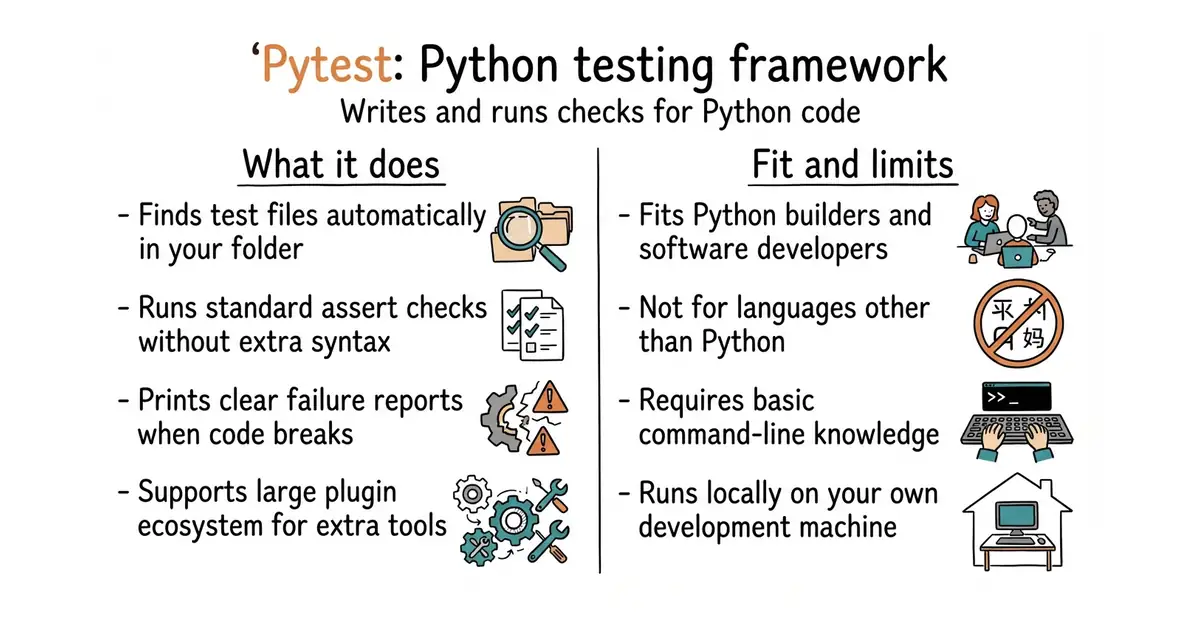
Pytest checks your code to make sure it works correctly. You write simple checks with standard Python code instead of learning a special testing language. If something breaks, the tool shows you exactly what went wrong and where. It costs nothing to use and runs locally on your own computer. Most Python projects use it as their main testing system.
What it is
Pytest is a testing framework for Python (a popular programming language used for web apps and scripts). It finds your test files automatically, runs them, and prints a clear report of successes and failures.
What it is good for
Solo builders who write Python want a fast way to verify their code works before sending it to a server. This tool removes the need for complex testing setups and catches bugs early.
- Uses plain assert statements instead of hard-to-remember check methods.
- Finds test files automatically without needing complex configuration.
- Supports a large library of plugins to add extra features.
- Requires knowing basic Python to write tests.
- Large test suites can take time to run without parallel execution.
- Debugging complex fixture dependencies can be tricky for beginners.
Python's built-in unittest module
tox

- evanw/esbuild40k stars
Joins many JavaScript, TypeScript and CSS files into one, in well under a second.
- Textualize/textual38k stars
Lets a Python program draw a real interface inside a terminal, and serve the same thing to a browser.
- python-attrs/cattrs1.1k stars
Turns loose data into declared Python objects, and declared objects back into loose data.
source venv/bin/activate
pip install pytest