Radar check
What we found when we opened it. Every bar is one fact, with its date.
Last code pushed 26 Oct 2026, the same day before this check.
Latest release v0.32.59 on 26 Oct 2026.
Public since March 2018, a little over 8 years.
1,499 stars and 201 forks.
147 commits and 85 new issues in the last 90 days.
135 contributors. 75 pull requests merged in 90 days.
No security policy file says how to report a problem. No published security advisories.
How the bars are scored
- Alive. Days since the last code push: a week or less 100, a month 90, three months 70, six months 50, a year 30, eighteen months 15, older 0.
- Releases. Age of the latest GitHub release, on a similar scale; no bar when the project publishes no releases.
- Maturity. Age of the project: eight years 100, five 90, three 70, two 55, one 40, six months 25, younger 10.
- Adoption. Stars on a log scale: 100,000 stars is 100, 10,000 is 80, 1,000 is 60, 100 is 40.
- Activity. Commits in the last 90 days: 300 or more 100, 100 85, 30 65, 10 45, any 25.
- Community. People who have contributed: 100 or more 100, 30 80, 10 60, 5 40, 2 25, one 10.
- Security. A published security policy 80, none 40; published advisories are listed, not scored.
Checked by Repo Radar on 26 Oct 2026 from the repository on GitHub.
In simple English
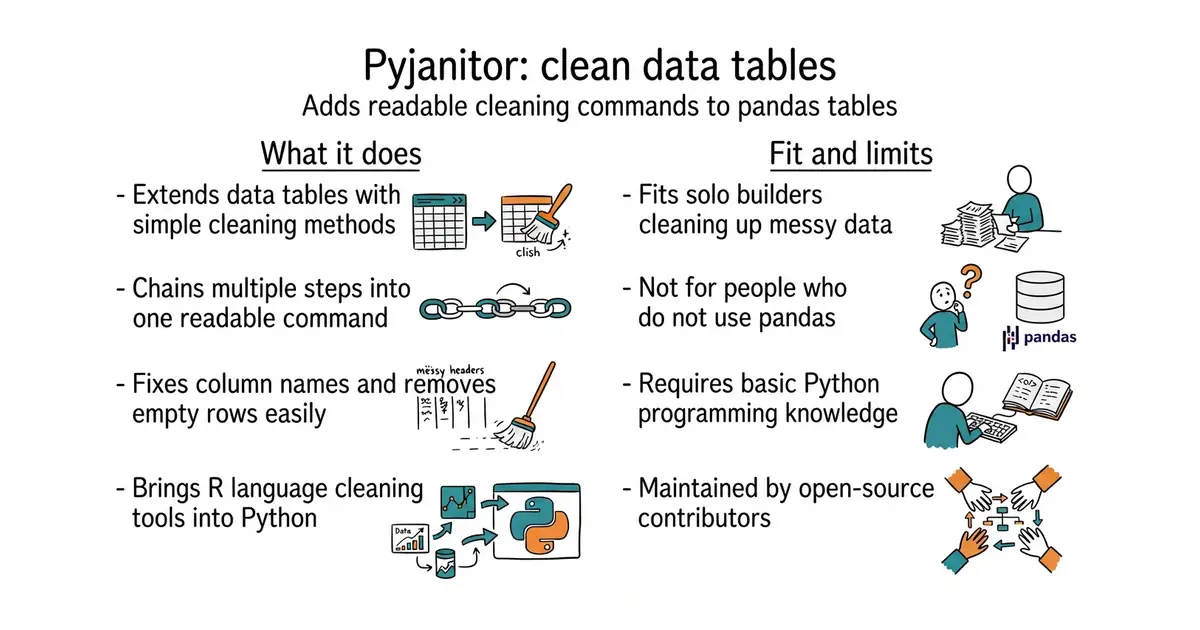
When you work with spreadsheets or data tables in Python, you often need to clean up messy text and fix broken dates. Doing this work requires writing long, confusing lines of code that are hard to read later. This tool adds simple, plain-English commands directly to your data tables. You can chain these commands together so your cleaning steps read like a clear sentence. It costs you nothing to use, and it is free of ongoing fees.
What it is
Pyjanitor is a Python (a programming language that reads like plain English) library (a collection of pre-written code you can use in your own programs) that extends pandas (a popular Python tool for working with tables of numbers and text). It brings the popular data-cleaning functions from the R programming language into the Python ecosystem.
What it is good for
This is good for solo builders and analysts who spend hours writing repetitive code to clean up CSV files or database exports. It removes the need to write custom functions for common tasks like removing empty rows or fixing column names.
- Adds intuitive cleaning methods directly to your data tables.
- Lets you chain multiple cleaning steps into one readable block of code.
- Saves time on writing custom data-wrangling scripts.
- Requires comfort with the Python programming language and pandas.
- Depends on an external library that might change its internal rules.
- Documentation can be sparse for advanced or edge-case functions.
Writing repetitive custom functions to clean up messy data tables
pandas
- pola-rs/polars40k stars
A faster data table library with its own built-in expression syntax for cleaning data.
- pandas-dev/pandas50k stars
The core data table library that pyjanitor extends with extra cleaning functions.


- tobymao/sqlglot9.7k stars
Reads, rewrites and translates SQL between more than twenty database dialects, without a database.
- patroni/patroni8.8k stars
Watches a group of PostgreSQL copies and promotes a new leader when the leader fails.
- pgEdge/spock758 stars
An add-on that lets several PostgreSQL databases all accept changes and keep each other in step.
source venv/bin/activate
pip install pyjanitor