2.8k stars · MIT · no releases; rolling docker-compose.yml · Track this in Rising ↗
The self-host distribution for Plausible Analytics (the analytics engine itself lives in plausible/analytics).
Radar check
What we found when we opened it. Every bar is one fact, with its date.
Last code pushed 15 May 2026, 5 months before this check.
No releases published on GitHub; the code date above is the one to trust.
Public since September 2020, about 6 years.
2,928 stars and 465 forks.
0 commits and 4 new issues in the last 90 days.
4 contributors. No pull requests merged in 90 days; changes go in directly. A small team carries it.
No security policy file says how to report a problem. No published security advisories.
How the bars are scored
- Alive. Days since the last code push: a week or less 100, a month 90, three months 70, six months 50, a year 30, eighteen months 15, older 0.
- Releases. Age of the latest GitHub release, on a similar scale; no bar when the project publishes no releases.
- Maturity. Age of the project: eight years 100, five 90, three 70, two 55, one 40, six months 25, younger 10.
- Adoption. Stars on a log scale: 100,000 stars is 100, 10,000 is 80, 1,000 is 60, 100 is 40.
- Activity. Commits in the last 90 days: 300 or more 100, 100 85, 30 65, 10 45, any 25.
- Community. People who have contributed: 100 or more 100, 30 80, 10 60, 5 40, 2 25, one 10.
- Security. A published security policy 80, none 40; published advisories are listed, not scored.
Checked by Repo Radar on 27 Oct 2026 from the repository on GitHub. Covered in Edition 18.
▶Repo detailsthe review · specs · pros & cons · install
What it does
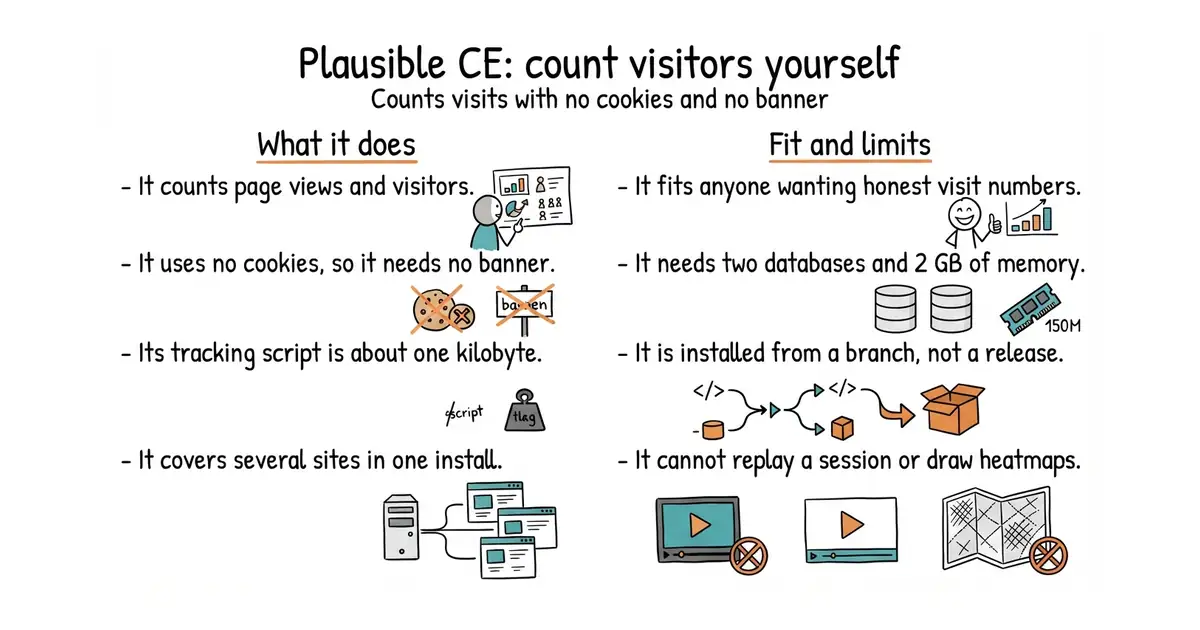
This repository is the self-hosted distribution of Plausible Analytics: a Docker Compose setup plus the settings needed to run it. Plausible counts page views, visitors, referrers, countries and devices without storing anything that identifies a person, which is why it needs no consent banner in Europe. The tracking script is about one kilobyte, so it barely affects page speed. It supports custom events and goals, campaign tags, and several sites in one installation. It runs a PostgreSQL database for its own records and a ClickHouse database for the counting, so expect about 2 GB of memory or more. The installation is a named branch rather than a release: the quickstart currently gives v3.2.1, and the newest code change here landed on 15 May 2026. It does not replay sessions, it draws no heatmaps, and it will not say why somebody left.
Why it matters
Who it suits. It suits anyone who wants honest visitor numbers with a much shorter privacy policy, and who would rather hold the numbers themselves than rent them. It suits a small set of sites on one machine, since one installation covers several. Skip it if session replay, funnels or product analytics are the real need. Skip it too if nobody wants to run two databases, in which case the company's own hosted plan is the sensible answer and paying for it supports the project.
Verdict. Worth an afternoon, and worth being straight about the crowd it joins. Editions 1 and 5 covered umami-software/umami, which does nearly the same job and is also MIT-licensed, and is lighter because it needs only one database. Edition 11 covered PostHog/posthog, which does far more and is easiest on its hosted free tier. Edition 9 covered Counterscale, for Cloudflare. Edition 8 covered allinurl/goaccess, which reads server log files and needs no script on the page at all. That makes five ways to count visitors on this radar. The useful advice is to pick one and install it, and for most people on one machine, Umami is the lighter start and Plausible the better-looking report.
Summary (Key Points)from the README
Key features
- Docker Compose setup: The service runs from a cloned repository, configured through an environment file and started with Docker Compose.
- Automatic TLS: Setting HTTP_PORT=80 and HTTPS_PORT=443 enables automatic Let's Encrypt certificate issuance for your domain.
- Reverse proxy option: Different HTTP and HTTPS ports let you run Plausible behind your own reverse proxy.
- Local evaluation mode: You can try the service on your own machine by setting a local BASE_URL with a custom port and mapping that port in a compose override file.
- Required secret key: SECRET_KEY_BASE must be at least 64 bytes, which the setup relies on for security.
- First-user setup: After startup, you visit your instance at the configured domain and create the first user there.
- Wiki documentation: The project wiki covers installation, upgrades, configuration and integrations.
Important
- Docker requirement: Docker and Docker Compose must be installed on the machine before you start.
- CPU requirement: The CPU must support the SSE 4.2 or NEON instruction set or higher, which ClickHouse needs.
- Memory: At least 2 GB of RAM is recommended to run ClickHouse and Plausible without running out of memory.
- DNS for TLS: The domain must point to your server before automatic Let's Encrypt certificates can be issued.
- Port availability: Automatic TLS depends on HTTP_PORT=80 and HTTPS_PORT=443, so those ports must be free and reachable for the default setup.
- Local evaluation tip: The README's local evaluation tip is garbled in places, so check the exact BASE_URL and port mapping before you rely on it.
Written by an AI model from the project’s README; not part of the review, and it can be wrong.
- No cookies, so no consent banner and a much shorter privacy policy.
- The tracking script is about one kilobyte, so pages stay fast.
- MIT-licensed and self-hosted, so the numbers stay where they are collected.
- It is a real service to keep running: one container plus PostgreSQL and ClickHouse. Expect 2 GB of memory or more.
- This repository publishes no releases, so the installation is a named branch and there is no release page to read.
- It counts pages and visits. It will not replay a session or explain why somebody left.
git clone -b v3.2.1 --single-branch https://github.com/plausible/community-edition plausible-ce
cd plausible-ce
touch .env
echo "BASE_URL=https://plausible.example.com" >> .env
echo "SECRET_KEY_BASE=$(openssl rand -base64 48)" >> .env
docker compose up -d