In simple English
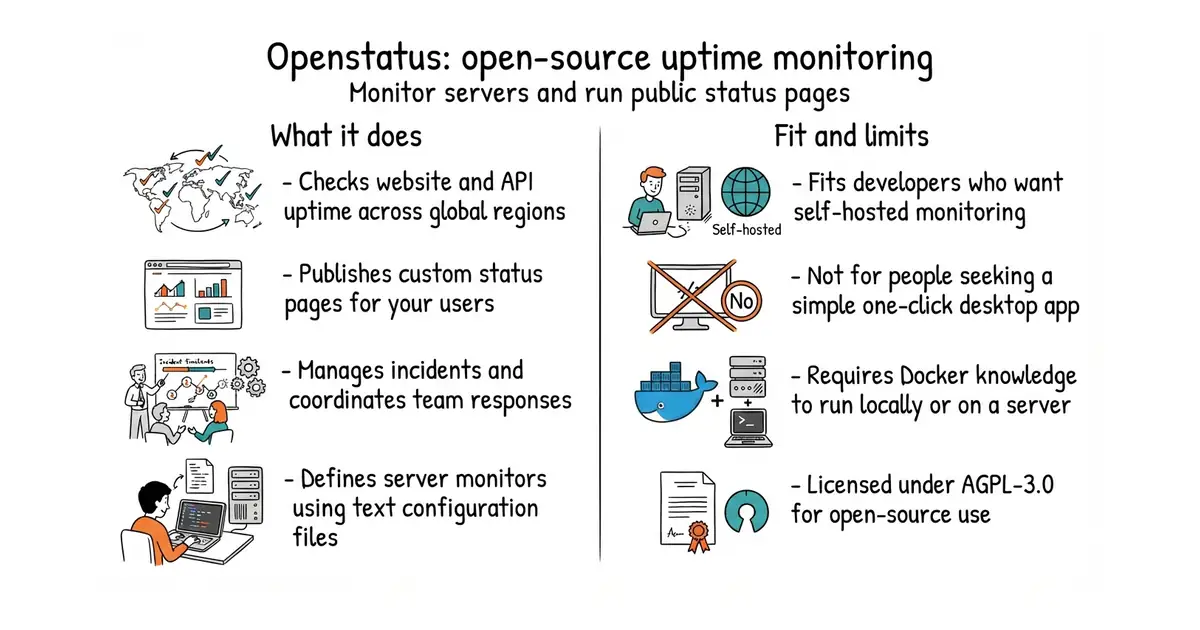
This tool lets you check if your website or server is online. If something breaks, it shows a public page to tell your users. You can write your server checks in text files using code. You can also run it yourself on your own server for free. It saves you from paying monthly fees to commercial uptime services.
What it is
Openstatus is an open-source platform for uptime monitoring, incident response, and public status pages. It integrates with text-based configuration and AI assistants.
What it is good for
Solo builders who want to monitor their servers and show a professional status page to customers without paying for commercial cloud tools.
- Combines uptime monitoring and public status pages in one dashboard.
- Can be deployed easily using Docker or on hosting platforms like Railway.
- Allows defining monitors using plain configuration files or Terraform (infrastructure as code).
- Self-hosting requires managing multiple database and backend services.
- Licensed under AGPL-3.0, which has strict rules if you modify and host it as a service.
- Setup complexity is high for non-programmers due to multiple moving parts.
Paid uptime monitoring services like Better Stack or Statuspage
Grafana for metric dashboards and Docker for running services
- louislam/uptime-kuma93k stars
A popular self-hosted monitoring tool with a simpler setup and a built-in status page.


- slok/sloth2.6k stars
Generates Prometheus alerting and recording rules from a short specification of a service level objective.
- nicolargo/glances34k stars
A live view of one computer's health, in a terminal, in a browser, or through an AI assistant.
- dokku/dokku32k stars
A small platform you install on one server, which builds and runs an app every time you push code to it.
cp .env.docker.example .env.docker
docker compose up -d