Radar check
What we found when we opened it. Every bar is one fact, with its date.
Last code pushed 22 Oct 2026, 4 days before this check.
Latest release v0.29.1 on 30 Aug 2026.
Public since February 2020, a little over 6 years.
1,997 stars and 299 forks.
7 commits and 4 new issues in the last 90 days.
91 contributors. 7 pull requests merged in 90 days.
A security policy says how to report a problem. 3 published security advisories.
How the bars are scored
- Alive. Days since the last code push: a week or less 100, a month 90, three months 70, six months 50, a year 30, eighteen months 15, older 0.
- Releases. Age of the latest GitHub release, on a similar scale; no bar when the project publishes no releases.
- Maturity. Age of the project: eight years 100, five 90, three 70, two 55, one 40, six months 25, younger 10.
- Adoption. Stars on a log scale: 100,000 stars is 100, 10,000 is 80, 1,000 is 60, 100 is 40.
- Activity. Commits in the last 90 days: 300 or more 100, 100 85, 30 65, 10 45, any 25.
- Community. People who have contributed: 100 or more 100, 30 80, 10 60, 5 40, 2 25, one 10.
- Security. A published security policy 80, none 40; published advisories are listed, not scored.
Checked by Repo Radar on 26 Oct 2026 from the repository on GitHub.
In simple English
This tool reads an OpenAPI file and writes a complete Python library for your API. You do not need to write HTTP requests by hand. It creates clean code with type hints and data classes. You install it on your computer and run it in the terminal. It costs nothing and runs locally.
What it is
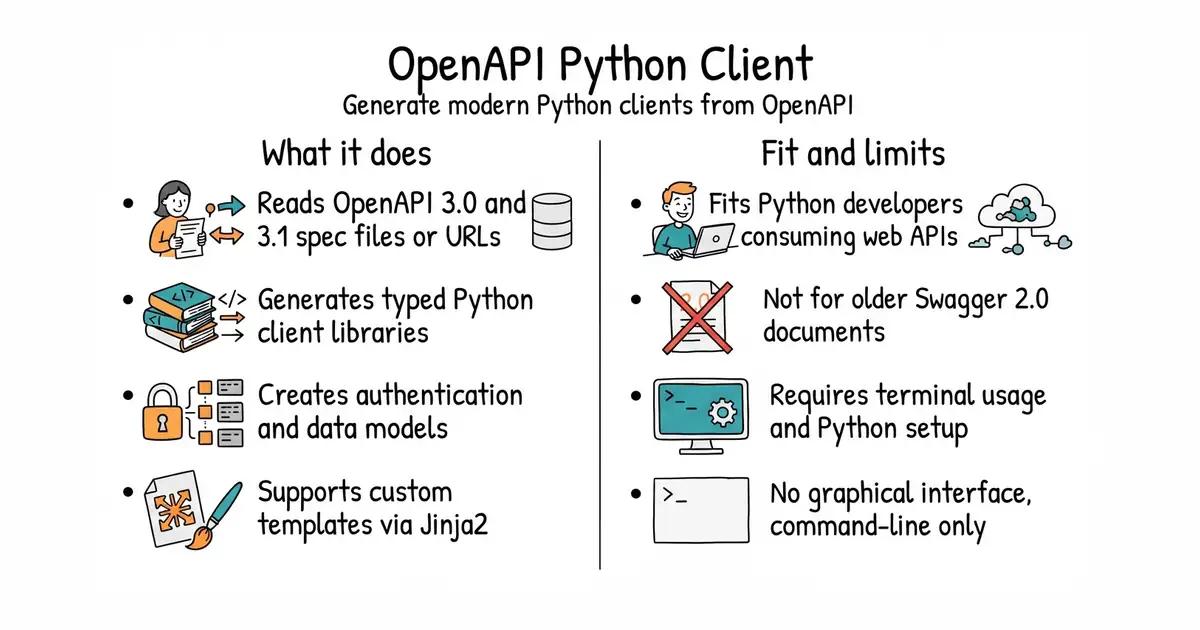
A command-line tool that generates typed Python client libraries from OpenAPI 3.0 and 3.1 specifications. It writes ready-to-use project folders containing authentication handlers, data models, and API endpoints.
What it is good for
Solo builders who need to call a web service from Python and want clean, auto-generated code instead of writing request boilerplate.
- Generates modern code with type hints and data classes.
- Supports custom templates via Jinja2 if you need to tweak the output.
- Includes configuration options for renaming classes and handling enums.
- Does not support older OpenAPI 2.0 (Swagger) documents without prior conversion.
- Requires Python on your machine and familiarity with terminal commands.
- Advanced customisation requires editing undocumented template files.
Writing custom HTTP request boilerplate and data classes by hand.
FastAPI
- deepset-ai/haystack27k stars
Focuses on language model pipelines rather than generic API client generation.


- evanw/esbuild40k stars
Joins many JavaScript, TypeScript and CSS files into one, in well under a second.
- Textualize/textual38k stars
Lets a Python program draw a real interface inside a terminal, and serve the same thing to a browser.
- python-attrs/cattrs1.1k stars
Turns loose data into declared Python objects, and declared objects back into loose data.
pipx install openapi-python-client --include-deps