40.2k stars · MIT, plus a paid edition | `@novu/framework@v2.14.0`, 28 Sep 2026 | [novu.co](https://novu.co) · @novu/framework@v2.14.0 (2026-09-28) · Track this in Rising ↗
One place to write the messages an application sends, and one way to send them by email, phone alert or in the app.
Radar check
What we found when we opened it. Every bar is one fact, with its date.
Last code pushed 26 Oct 2026, one day before this check.
Latest release @novu/framework@v2.14.0 on 28 Sep 2026.
Public since August 2021, a little over 5 years.
40,208 stars and 4,518 forks.
601 commits and 42 new issues in the last 90 days.
539 contributors. 633 pull requests merged in 90 days.
A security policy says how to report a problem. 34 published security advisories.
How the bars are scored
- Alive. Days since the last code push: a week or less 100, a month 90, three months 70, six months 50, a year 30, eighteen months 15, older 0.
- Releases. Age of the latest GitHub release, on a similar scale; no bar when the project publishes no releases.
- Maturity. Age of the project: eight years 100, five 90, three 70, two 55, one 40, six months 25, younger 10.
- Adoption. Stars on a log scale: 100,000 stars is 100, 10,000 is 80, 1,000 is 60, 100 is 40.
- Activity. Commits in the last 90 days: 300 or more 100, 100 85, 30 65, 10 45, any 25.
- Community. People who have contributed: 100 or more 100, 30 80, 10 60, 5 40, 2 25, one 10.
- Security. A published security policy 80, none 40; published advisories are listed, not scored.
Checked by Repo Radar on 26 Oct 2026 from the repository on GitHub. Covered in Edition 15.
▶Repo detailsthe review · specs · pros & cons · install
What it does
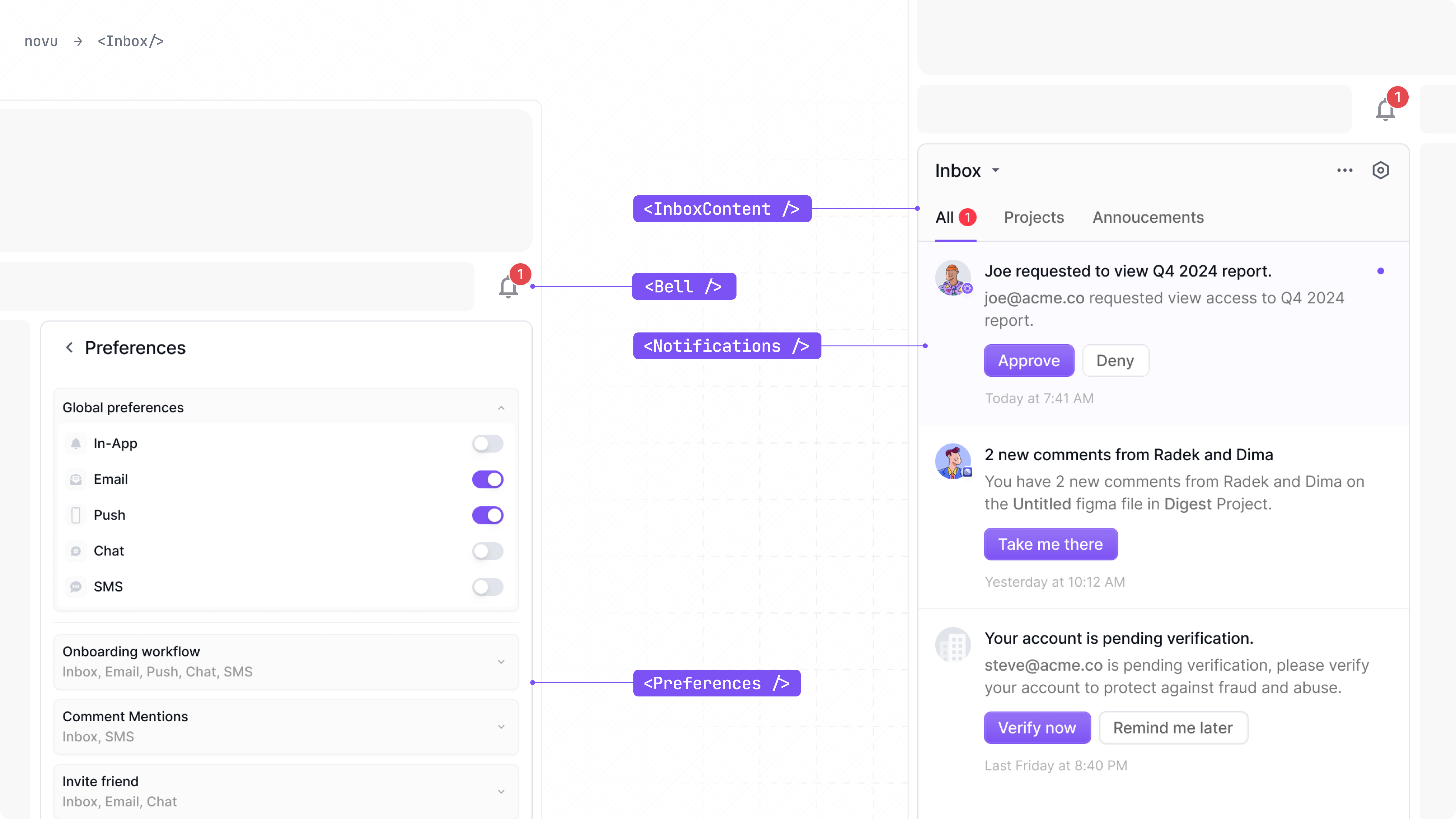
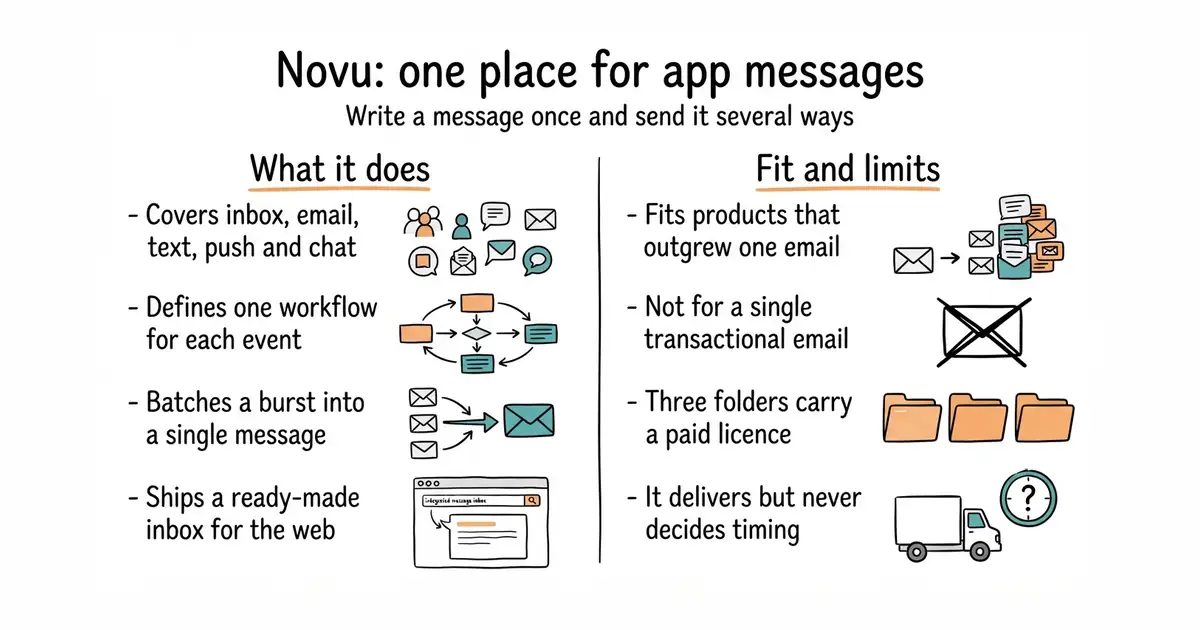
Novu is a layer that carries messages between an application and its users. It covers an in-app inbox, email through 20 providers, text messages through 37, phone alerts through 8, and chat through 13, including Slack, Microsoft Teams, Telegram and WhatsApp. A workflow is defined once, with per-channel conditions, so one event can mean an email for one person and a phone alert for another. A digest step batches a run of messages into one, which is the fix for a noisy feature. It ships an embeddable inbox component for React, with React Native, Vue and Angular listed as coming, and a preferences component so each person can turn channels off. There is also a no-code email editor. It explicitly does not contain the logic that decides what to say — the project is clear that the agent or application stays yours and Novu only delivers.
Why it matters
Who it suits. A product that has outgrown one hard-coded email and now needs several channels, consent handling and an in-app list. It suits teams who would rather not build the per-person "stop emailing me" setting themselves, which the law in most places expects to exist. Skip it if one transactional email is the whole requirement, because a single provider's library is a smaller thing to own.
Verdict. Worth a day once two channels are in play, and the hosted free account is the sensible way to judge it before self-hosting. Self-hosting is the real cost: an API service, a worker, a dashboard, MongoDB and Redis, 2 GB of memory upwards, and MongoDB is a second kind of database to keep running. Check whether the feature you want sits in the MIT part, because the enterprise folder and two ee folders are commercial. caronc/apprise is the much smaller answer when the need is only to deliver an alert.
Summary (Key Points)from the README
Key features
- Provider coverage: Email has 20 supported providers, SMS has 37, Push has 8, Chat has 13, and In-App has 1 (Novu Inbox), all behind one API.
- Workflow engine: Custom notification workflows with branching and per-channel conditions, so Novu picks how each notification is delivered.
- Digest engine: Batches multiple notifications into a single message.
- Embeddable Inbox: A real-time notification center for web apps, available as a React component or built on the API and SDK.
- Embeddable preferences: Lets users control their own notification settings.
- No-code email editor: Builds email notifications without writing code.
- Unified conversation model (ACI): One consistent message shape across Slack, Microsoft Teams, Telegram, WhatsApp, Email, and an In-App Inbox, instead of per-platform formats and webhooks.
- Bidirectional messaging: Receives user messages from each channel, routes them to your agent, and sends the agent's replies back out.
- Bring your own agent: Works with agents built on Claude Managed Agents, AI SDK, LangGraph, or a custom stack.
Important
- Open core licensing: The core is MIT-licensed, but the `/enterprise` folder and its subfolders and modules fall under a commercial license.
- Not an agent: Novu connects an agent to channels; it does not provide the agent logic itself.
- Framework support: React is the only embeddable Inbox option today. React Native, Vue, and Angular are listed as coming soon.
- Setup claim: The README says Novu Connect can integrate an existing Claude Managed Agent into Slack, Telegram, or Email in less than 2 minutes. This is the project's own claim and is not independently verified.
Written by an AI model from the project’s README; not part of the review, and it can be wrong.
- One workflow, several channels. The wording changes in a dashboard rather than in code.
- A ready-made inbox component for React, so the in-app half is an afternoon rather than a week.
- The digest step turns a burst of notifications into one message, which is otherwise fiddly code.
- The About sidebar says MIT, but three folders are under a separate commercial licence. Check before planning around a feature.
- Self-hosting means five moving parts and two kinds of database. The hosted free tier is the sensible start.
- It delivers messages and does not decide when to send them. That decision stays in your own code.
git clone -b next https://github.com/novuhq/novu.git
cd novu/docker/community
cp .env.example .env
# Set the secret values listed in .env, then:
sudo docker compose up -d