Radar check
What we found when we opened it. Every bar is one fact, with its date.
Last code pushed 18 Aug 2026, 2 months before this check.
No releases published on GitHub; the code date above is the one to trust.
Public since August 2026, 2 months.
0 stars and 0 forks.
2 commits and 0 new issues in the last 90 days.
1 contributor. No pull requests merged in 90 days; changes go in directly. A small team carries it.
No security policy file says how to report a problem. No published security advisories.
How the bars are scored
- Alive. Days since the last code push: a week or less 100, a month 90, three months 70, six months 50, a year 30, eighteen months 15, older 0.
- Releases. Age of the latest GitHub release, on a similar scale; no bar when the project publishes no releases.
- Maturity. Age of the project: eight years 100, five 90, three 70, two 55, one 40, six months 25, younger 10.
- Adoption. Stars on a log scale: 100,000 stars is 100, 10,000 is 80, 1,000 is 60, 100 is 40.
- Activity. Commits in the last 90 days: 300 or more 100, 100 85, 30 65, 10 45, any 25.
- Community. People who have contributed: 100 or more 100, 30 80, 10 60, 5 40, 2 25, one 10.
- Security. A published security policy 80, none 40; published advisories are listed, not scored.
Checked by Repo Radar on 26 Oct 2026 from the repository on GitHub.
In simple English
This tool turns thousands of messy hospital paper scans into clean spreadsheets. It reads handwritten notes, tables and lab slips using artificial intelligence. Each extracted value gets a score so you know which parts need a human eye. You can run it on your own computer if you have Python and a cloud account.
What it is
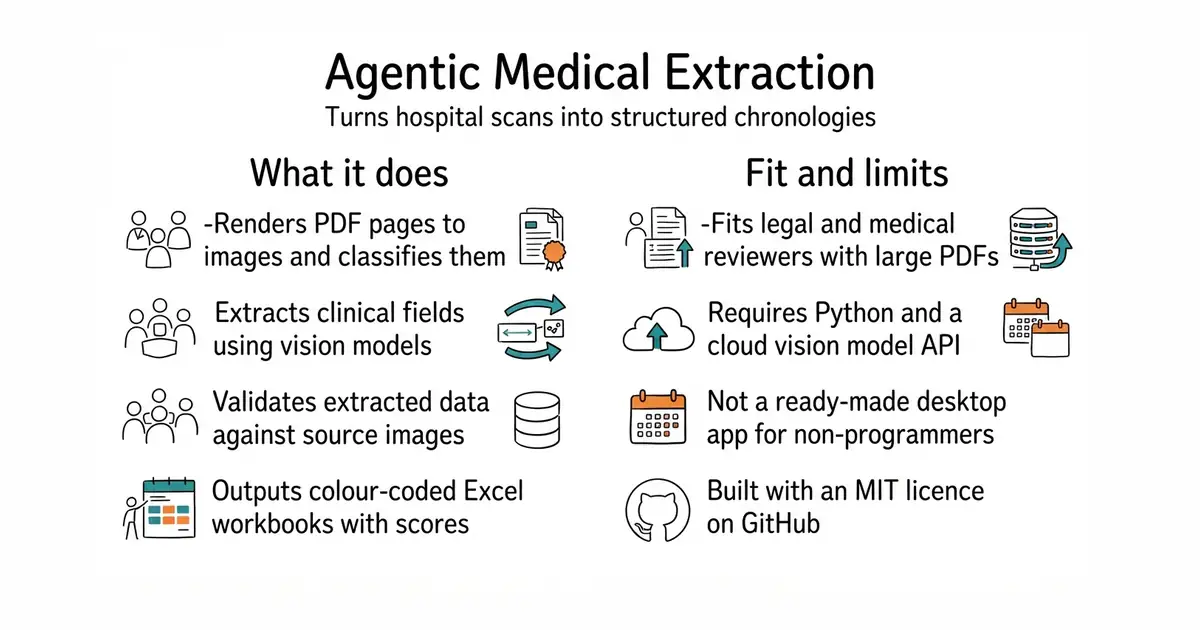
A multi-agent Python pipeline that extracts structured clinical chronologies from scanned medical records. It breaks the work into nine distinct steps, runs an adversarial validation pass to check the extracted data against the source image, and exports a colour-coded Excel workbook.
What it is good for
Solo builders or legal and medical researchers who need to turn large volumes of unstructured hospital PDFs into clean, searchable data without weeks of manual data entry.
- Splits extraction into narrow steps so any stage can be inspected, re-run or resumed.
- Includes a separate validation agent with the opposite incentive to catch extraction errors.
- Generates a confidence score for every extracted value, saving review time.
- Requires Python 3.11 and a cloud account with a vision-capable language model.
- Setting up custom schemas and YAML case files takes technical effort.
- Running vision models across thousands of scanned pages can incur significant cloud API costs.
weeks of manual data entry and reading scanned hospital charts by hand
LangChain (a software framework for building applications with language models)

- basicmachines-co/basic-memory4.3k stars
Gives an AI assistant a memory that is stored as plain text files you can read.
- deepset-ai/haystack27k stars
A Python framework for joining language models, document search and tools into one working pipeline.
- Giskard-AI/giskard-oss5.9k stars
A Python library that writes tests for language-model programs and tries to break them on purpose.
git clone https://github.com/munibqasim/agentic-medical-extraction.git
cd agentic-medical-extraction
python -m venv .venv && source .venv/bin/activate
pip install -r requirements.txt
cp .env.example .env