90.2k stars · MIT · @mermaid-js/tiny@11.17.2 (2026-08-25)
Diagrams from a few lines of plain text, rendered natively by GitHub, Notion, Obsidian and Claude.
▶Repo detailsthe review · specs · pros & cons · install
What it is
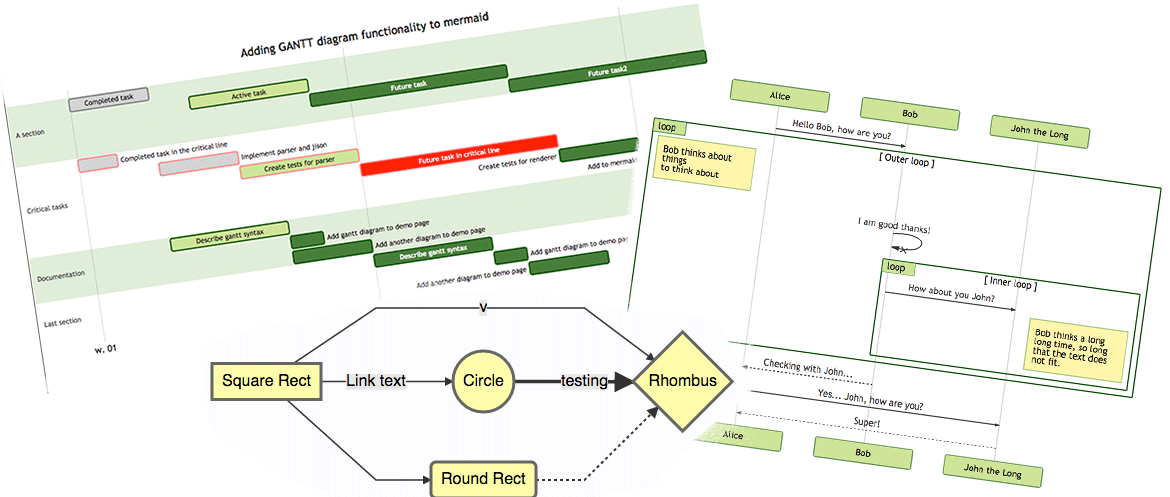
A library that renders diagrams — flowcharts, mind maps, timelines, sequences — from a few lines of plain text. GitHub, Notion, Obsidian and Claude all render Mermaid natively, so the recipient needs nothing installed.
Why it matters
Grasppy's map currently lives inside Grasppy. The moment a user wants it in a report, a wiki page or a message to a colleague, the best they can do is a screenshot — a dead image with your product cropped out of the frame. A "Copy as Mermaid" button turns the map into portable text that redraws itself wherever it is pasted, and every one of those places is a surface where somebody else's colleague sees the shape of your output. That is the cheapest distribution mechanism available to a tool like yours, and it costs one serialiser over the tree you already hold in state. It is also a second, phone-friendly view of the hierarchy alongside react-arborist (Ed. 7 #11).
- Renders natively on GitHub, in Notion and in Claude — no library for the person you send it to.
- The output is small, diffable text, so it can live in a repo or a document.
- Its mindmap and flowchart types match the shape Grasppy already produces.
- Layout control is limited: a two-hundred-node map will come out ugly and there is little you can do.
- Embedding the renderer in your own app adds real weight — prefer exporting text over shipping the library.
- Text export loses your styling and the drill-in interaction entirely; it is a portable summary, not the product.
It is also a second, phone-friendly view of the hierarchy alongside react-arborist (Ed.
Pure serialisation: a FastAPI endpoint or a front-end function that walks the existing subtopic tree and emits Mermaid syntax.