Radar check
What we found when we opened it. Every bar is one fact, with its date.
Last code pushed 26 Oct 2026, the same day before this check.
Latest release v5.4.2 on 20 Oct 2026.
Public since May 2013, a little over 13 years.
6,451 stars and 271 forks.
752 commits and 104 new issues in the last 90 days.
91 contributors. 230 pull requests merged in 90 days.
A security policy says how to report a problem. No published security advisories.
How the bars are scored
- Alive. Days since the last code push: a week or less 100, a month 90, three months 70, six months 50, a year 30, eighteen months 15, older 0.
- Releases. Age of the latest GitHub release, on a similar scale; no bar when the project publishes no releases.
- Maturity. Age of the project: eight years 100, five 90, three 70, two 55, one 40, six months 25, younger 10.
- Adoption. Stars on a log scale: 100,000 stars is 100, 10,000 is 80, 1,000 is 60, 100 is 40.
- Activity. Commits in the last 90 days: 300 or more 100, 100 85, 30 65, 10 45, any 25.
- Community. People who have contributed: 100 or more 100, 30 80, 10 60, 5 40, 2 25, one 10.
- Security. A published security policy 80, none 40; published advisories are listed, not scored.
Checked by Repo Radar on 26 Oct 2026 from the repository on GitHub.
In simple English
When you copy and paste code in your project, bugs spread and fixing them takes twice as long. This tool scans your files and finds duplicated blocks, dead code, and complex spots. It runs fast because it is written in Rust, and it works with AI coding assistants. You install it with a simple command, and it costs nothing to use.
What it is
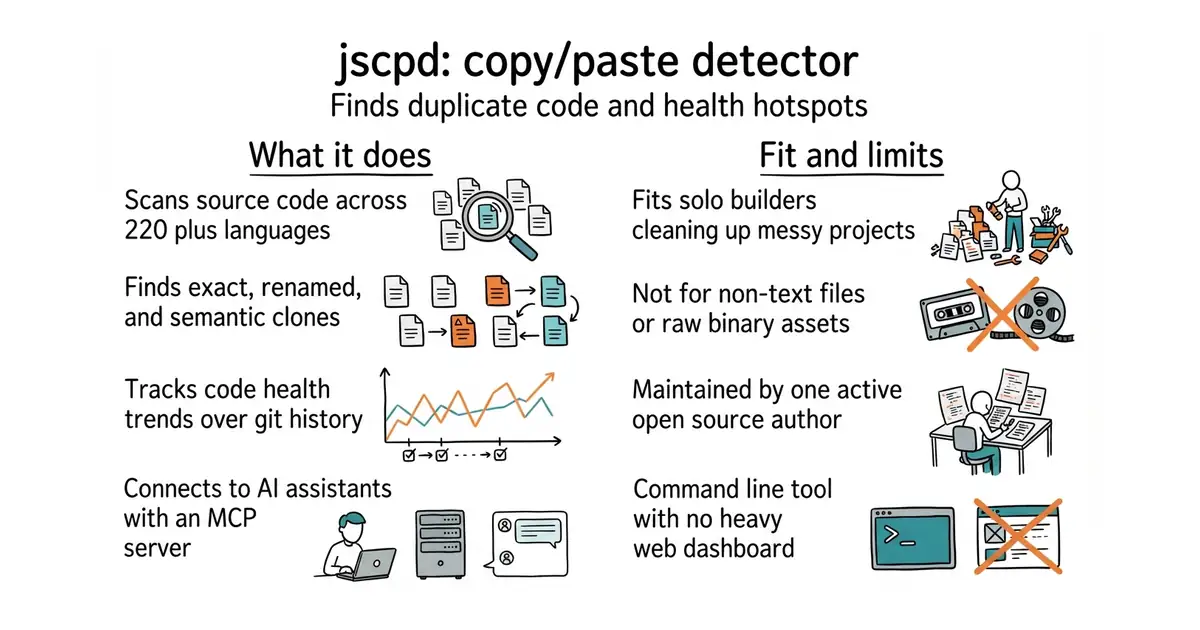
A copy and paste detector for source code that spots exact matches, renamed variables, near-identical logic, and semantic duplicates. It ships as a single self-contained binary with built-in support for GitHub Actions and language servers.
What it is good for
Solo builders who want to clean up messy codebases, spot duplicated logic before it causes bugs, and keep their repositories tidy without spending hours manually reading every file.
- Supports over 220 programming formats with language-aware tokenization.
- Includes an MCP server so AI agents can check your code for duplicates.
- Runs extremely fast on a single CPU core thanks to its Rust engine.
- Semantic clone detection requires downloading a large embedding model first.
- Can produce false positives on generated code or routine boilerplate.
- Configuring complex boundary rules takes time to learn.
manual code reviews and older duplicate finders
GitHub Actions


- evanw/esbuild40k stars
Joins many JavaScript, TypeScript and CSS files into one, in well under a second.
- Textualize/textual38k stars
Lets a Python program draw a real interface inside a terminal, and serve the same thing to a browser.
- python-attrs/cattrs1.1k stars
Turns loose data into declared Python objects, and declared objects back into loose data.
curl -fsSL https://jscpd.dev/install.sh | bash
jscpd /path/to/code