Radar check
What we found when we opened it. Every bar is one fact, with its date.
Last code pushed 26 Oct 2026, the same day before this check.
Latest release r6.1.3 on 7 Aug 2026.
Public since January 2015, a little over 11 years.
7,060 stars and 1,711 forks.
217 commits and 23 new issues in the last 90 days.
300 contributors. 232 pull requests merged in 90 days.
A security policy says how to report a problem. 1 published security advisory.
How the bars are scored
- Alive. Days since the last code push: a week or less 100, a month 90, three months 70, six months 50, a year 30, eighteen months 15, older 0.
- Releases. Age of the latest GitHub release, on a similar scale; no bar when the project publishes no releases.
- Maturity. Age of the project: eight years 100, five 90, three 70, two 55, one 40, six months 25, younger 10.
- Adoption. Stars on a log scale: 100,000 stars is 100, 10,000 is 80, 1,000 is 60, 100 is 40.
- Activity. Commits in the last 90 days: 300 or more 100, 100 85, 30 65, 10 45, any 25.
- Community. People who have contributed: 100 or more 100, 30 80, 10 60, 5 40, 2 25, one 10.
- Security. A published security policy 80, none 40; published advisories are listed, not scored.
Checked by Repo Radar on 26 Oct 2026 from the repository on GitHub.
In simple English
JUnit is a tool for developers writing code in Java. It helps you write automated checks to ensure your program behaves correctly. Every time you change your code, you run these checks to catch mistakes early. It costs nothing to use and forms the backbone of almost all Java testing. You add it to your project configuration file to get started.
What it is
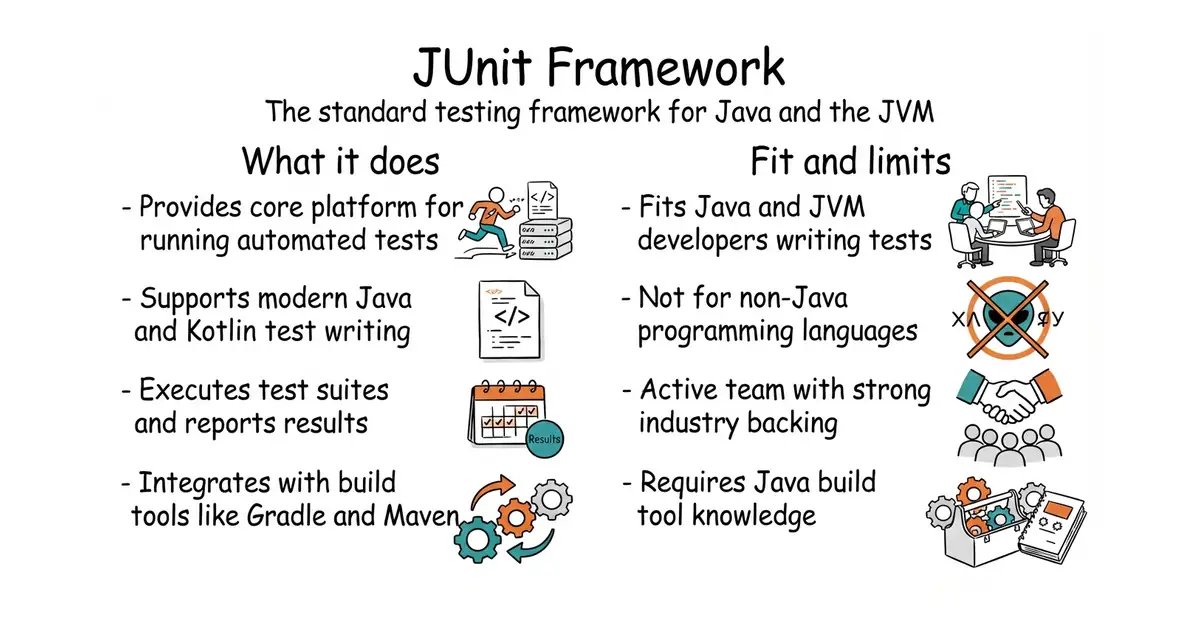
This repository contains the source code for the JUnit Platform, Jupiter, and Vintage modules. It provides the core engine that runs tests and reports their results.
What it is good for
Java developers who want to write and run unit tests, integration tests, and parameterized checks for their applications.
- Industry standard used across millions of Java projects.
- Supports modern Java features and Kotlin testing out of the box.
- Active development with frequent releases and strong sponsor backing.
- Requires JDK 25 to build from source, though older versions run compiled tests.
- Requires familiarity with build tools like Gradle or Maven.
- Extensive configuration options can overwhelm beginners.
Manual code inspection and ad-hoc main methods for checking code behavior
Gradle
- testng-team/testng2.1k stars
Another testing framework for Java with different configuration annotations and grouping features.
- assertj/assertj2.9k stars
A fluent assertion library often paired with JUnit to write readable test checks.


- evanw/esbuild40k stars
Joins many JavaScript, TypeScript and CSS files into one, in well under a second.
- Textualize/textual38k stars
Lets a Python program draw a real interface inside a terminal, and serve the same thing to a browser.
- python-attrs/cattrs1.1k stars
Turns loose data into declared Python objects, and declared objects back into loose data.
./gradlew build