In simple English
When you test your website or app with people, you often use a standard ten-question survey called the System Usability Scale. This tool takes the answers from your survey and calculates a final score from zero to one hundred. It shows charts that explain what your score means compared to other products. You can run it on your own computer, or use it directly on the web for free. It costs nothing to run, and your survey data stays private on your device.
What it is
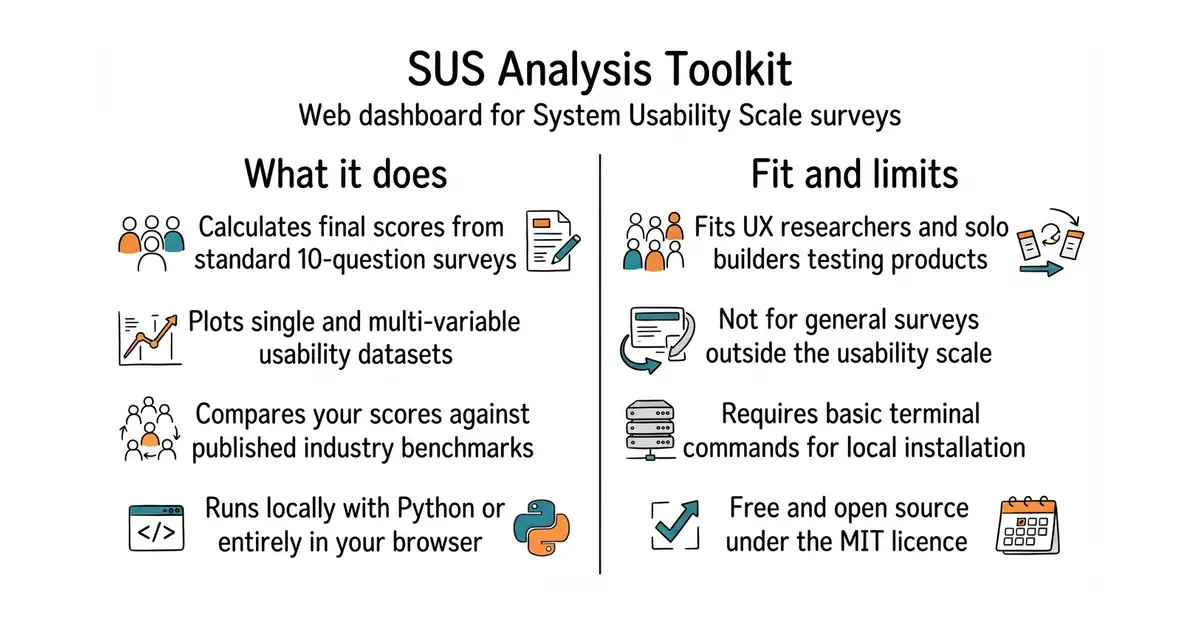
A Python-based dashboard that analyses, plots, and contextualises survey data from the System Usability Scale. It lets researchers and product builders compare single studies or multiple datasets against published industry benchmarks.
What it is good for
Product builders and user researchers who want to process usability questionnaires quickly without writing custom statistical scripts.
- Processes your survey data instantly in your web browser without sending files to an external server.
- Includes scientific benchmarks so you can see how your product compares to industry averages.
- Can be run locally with Python or Docker, or hosted as a static website.
- Requires basic familiarity with the command line to install and run locally.
- Depends on older Python package versions that may need careful dependency management.
- Geared strictly toward one specific questionnaire format rather than general survey creation.
manual spreadsheet calculations for usability questionnaires
pandas
- jblattgerste/sus-pdf-generator7 stars
Generates printable PDF questionnaires for the same usability scale.

- dbeaver/dbeaver52k stars
A free desktop program that connects to more than a hundred kinds of database and lets you browse and edit them.
- dimitri/pgloader6.5k stars
Loads data into PostgreSQL from other databases and from files, keeping going when individual rows fail.
git clone https://github.com/jblattgerste/sus-analysis-toolkit.git
cd sus-analysis-toolkit
python -m venv venv
source venv/bin/activate
pip install -r requirements.txt
python dashApp.py