3.7k stars · MIT · 2.6.0 (2026-03-16) · Track this in Rising ↗
Lightweight self-hosted social scheduler — the low-RAM alternative to Postiz on a box already running two products.
Radar check
What we found when we opened it. Every bar is one fact, with its date.
Last code pushed 16 Mar 2026, 7 months before this check.
Latest release 2.6.0 on 16 Mar 2026.
Public since July 2022, a little over 4 years.
3,866 stars and 583 forks.
0 commits and 6 new issues in the last 90 days.
5 contributors. No pull requests merged in 90 days; changes go in directly. A small team carries it.
A security policy says how to report a problem. No published security advisories.
How the bars are scored
- Alive. Days since the last code push: a week or less 100, a month 90, three months 70, six months 50, a year 30, eighteen months 15, older 0.
- Releases. Age of the latest GitHub release, on a similar scale; no bar when the project publishes no releases.
- Maturity. Age of the project: eight years 100, five 90, three 70, two 55, one 40, six months 25, younger 10.
- Adoption. Stars on a log scale: 100,000 stars is 100, 10,000 is 80, 1,000 is 60, 100 is 40.
- Activity. Commits in the last 90 days: 300 or more 100, 100 85, 30 65, 10 45, any 25.
- Community. People who have contributed: 100 or more 100, 30 80, 10 60, 5 40, 2 25, one 10.
- Security. A published security policy 80, none 40; published advisories are listed, not scored.
Checked by Repo Radar on 26 Oct 2026 from the repository on GitHub. Covered in Edition 4.
▶Repo detailsthe review · specs · pros & cons · install
What it does
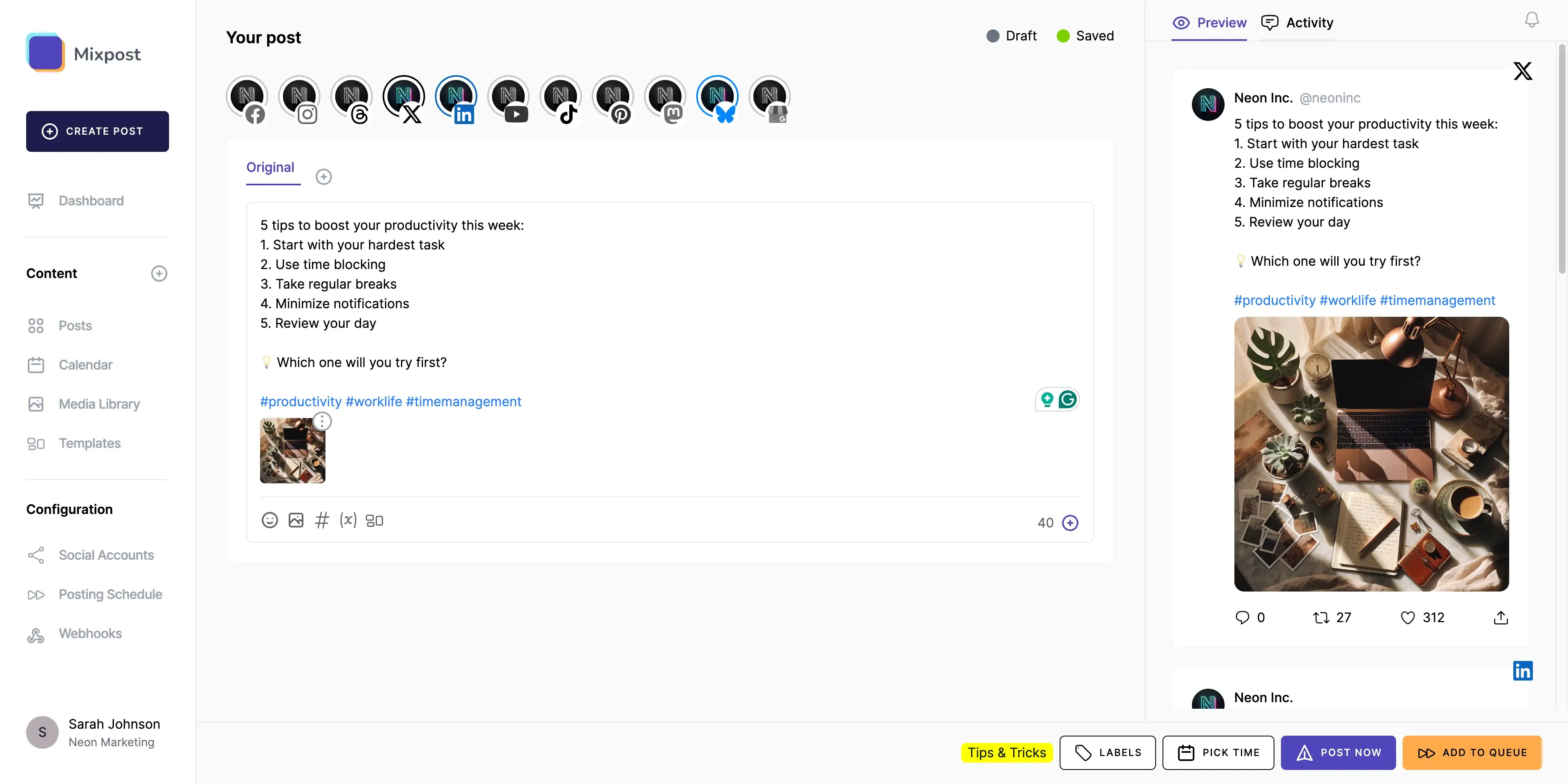
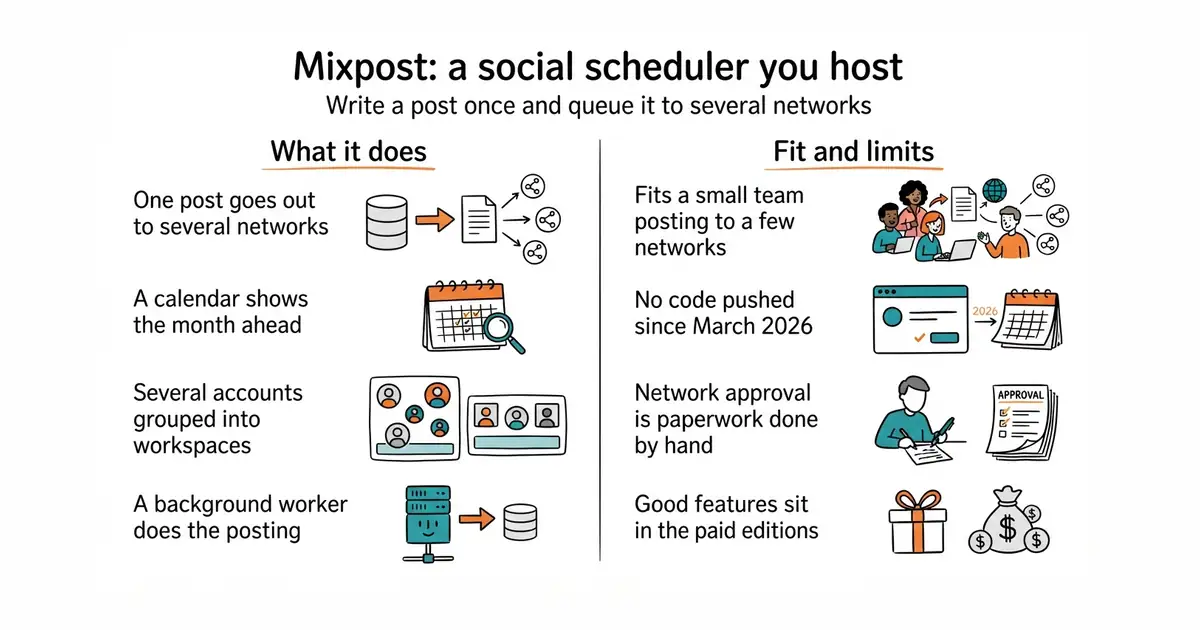
It composes a post once and queues it to several social networks. A calendar view shows what is scheduled and when, which is what makes a month of posts plannable in one sitting. Media files are stored alongside the posts, and several accounts can be grouped into separate workspaces. It runs as a package inside a Laravel application, which is a common PHP web framework, with a background worker doing the actual posting. The Lite edition is MIT-licensed and self-hosted with no per-account metering, and paid editions add more networks and features. It does not obtain posting permission from the networks. Each network's developer approval is paperwork done by hand, and no scheduler removes it. It also does not write the posts.
Why it matters
Who it suits. A small team or one person posting to a few networks who would rather host a tool than pay per account every month. Weight is the real argument for it. It is a PHP application and a worker, where the main alternative is two separate server runtimes plus a database and a cache. Skip it if a hosted service at a few pounds a month costs less than the hour a month of patching a server.
Verdict. Worth installing if the choice is otherwise between a heavy tool and nothing. Postiz covers more networks and has far more attention behind it, and it is also a much larger thing to run. Pick one of the two, install it this month, and queue thirty posts in a single sitting; an audience is built by consistency rather than cleverness. Two cautions, and the first is the honest one. No code has been pushed to this repository since 16 March 2026, which is seven months. That is well inside the eighteen-month line used here, but it is the quietest project on this page. And several of the more interesting features sit in the paid editions.
Summary (Key Points)from the README
Key features
- Account management: Brings all your social media accounts together in one place.
- Advanced analytics: Provides detailed analytics for each platform, based on the data each platform shares.
- Post versions and conditions: Tailors content for each social network and automates follow-up comments on high-performing posts.
- Media library: Lets you reuse images, GIFs, and videos, and integrates with stock image sources.
- Team workspaces: Offers dedicated workspaces for discussing ideas, managing tasks, and monitoring performance.
- Queue and calendar: Builds a posting schedule and shows your strategy in a calendar view.
- Post templates: Provides reusable templates to keep content consistent across channels.
- Dynamic variables and hashtag groups: Inserts dynamic text and organizes hashtags for each post.
Important
- Lite edition: This repository contains the Lite version of Mixpost Pro, a commercial product. The README promotes Mixpost Pro/Enterprise as an upgrade.
- Analytics scope: Analytics depend on what each platform shares, and the project says it works to keep its API integrations up to date.
- Feature requests: Open an issue to discuss any new feature before writing code, so Lite features stay distinct from Pro.
- Code style: Contributed code must follow the PSR-12 Coding Standard.
- Pull requests: PRs with empty descriptions may be rejected.
- Installation: The README gives no install steps and only links to external documentation.
- License: Mixpost is released under the MIT License and is sponsored by Inovector.
Written by an AI model from the project’s README; not part of the review, and it can be wrong.
- Meaningfully lighter than the main alternative: one PHP application and a worker
- MIT Lite edition, self-hosted, with no metering per connected account
- A real calendar view, which is what makes a month of posts plannable at once
- Nothing has been pushed to the code since March 2026, the quietest project here
- Fewer networks than the main alternative, and good features sit in the paid editions
- PHP is another runtime to keep patched, on top of whatever else the machine runs
Feed it by hand, or let n8n from Edition 1 push a post whenever a new video goes live.
The documentation gives three paths: a Docker image, a manual PHP deployment, or installation as a package inside an existing Laravel application.