Radar check
What we found when we opened it. Every bar is one fact, with its date.
Last code pushed 22 Oct 2026, 4 days before this check.
Latest release v0.2.0 on 20 Aug 2025.
Public since January 2019, a little over 7 years.
1,109 stars and 161 forks.
3 commits and 1 new issues in the last 90 days.
21 contributors. 2 pull requests merged in 90 days.
No security policy file says how to report a problem. No published security advisories.
How the bars are scored
- Alive. Days since the last code push: a week or less 100, a month 90, three months 70, six months 50, a year 30, eighteen months 15, older 0.
- Releases. Age of the latest GitHub release, on a similar scale; no bar when the project publishes no releases.
- Maturity. Age of the project: eight years 100, five 90, three 70, two 55, one 40, six months 25, younger 10.
- Adoption. Stars on a log scale: 100,000 stars is 100, 10,000 is 80, 1,000 is 60, 100 is 40.
- Activity. Commits in the last 90 days: 300 or more 100, 100 85, 30 65, 10 45, any 25.
- Community. People who have contributed: 100 or more 100, 30 80, 10 60, 5 40, 2 25, one 10.
- Security. A published security policy 80, none 40; published advisories are listed, not scored.
Checked by Repo Radar on 26 Oct 2026 from the repository on GitHub.
In simple English
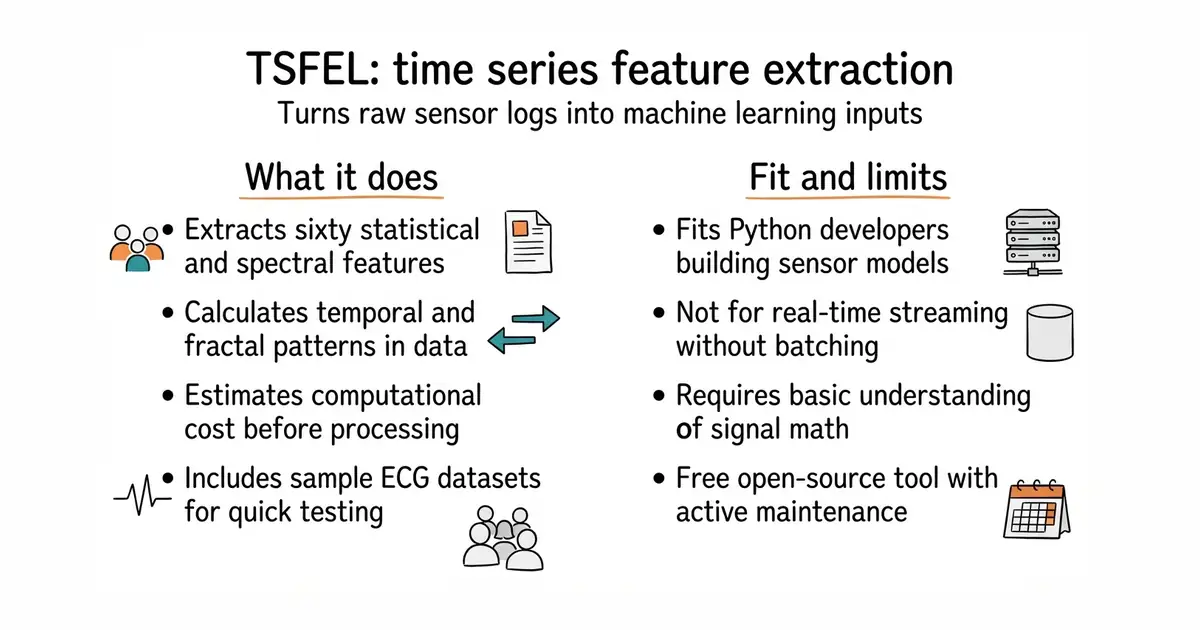
Sensor readings change every second, but machine learning models cannot read raw squiggles directly. This tool turns those squiggles into plain numbers that a computer program can study. It calculates sixty different statistical facts from your data files. You need to know some Python code to run it. It costs nothing to use, and your data stays on your own computer.
What it is
Time Series Feature Extraction Library is an open-source Python library that calculates statistical, temporal, spectral, and fractal features from time series data. It helps prepare sensor logs, financial tickers, and medical recordings for classification and regression tasks.
What it is good for
This is good for solo builders who collect data from sensors, smart meters, or medical devices and want to train a machine learning model on that data without writing math formulas from scratch.
- Extracts over sixty features across four different mathematical domains automatically.
- Estimates how long the calculation will take before running on large datasets.
- Includes sample datasets so you can test feature extraction immediately.
- Requires writing and running Python code in a command-line environment.
- Some complex fractal and spectral calculations take noticeable time on large files.
- Documentation assumes prior knowledge of signal processing concepts.
Writing custom math functions in NumPy or SciPy to calculate signal variance, entropy, and frequency spectra by hand.
Used together with scikit-learn for training classification models on the extracted features.
- blue-yonder/tsfresh9.5k stars
Another Python library that automatically extracts relevant features from time series for machine learning tasks.

- basicmachines-co/basic-memory4.3k stars
Gives an AI assistant a memory that is stored as plain text files you can read.
- deepset-ai/haystack27k stars
A Python framework for joining language models, document search and tools into one working pipeline.
- Giskard-AI/giskard-oss5.9k stars
A Python library that writes tests for language-model programs and tries to break them on purpose.
python -m venv venv
source venv/bin/activate
pip install tsfel