In simple English
Google Trends is a free web tool that shows what people are searching for online. For a long time, the standard Python library for it stopped working properly. This tool replaces it with a working version that pulls trending topics and search interest history. You can use it in your own Python scripts, from your terminal, or connect it to an artificial intelligence assistant. It is free to use under an open licence, but heavy use can trigger Google rate limits.
What it is
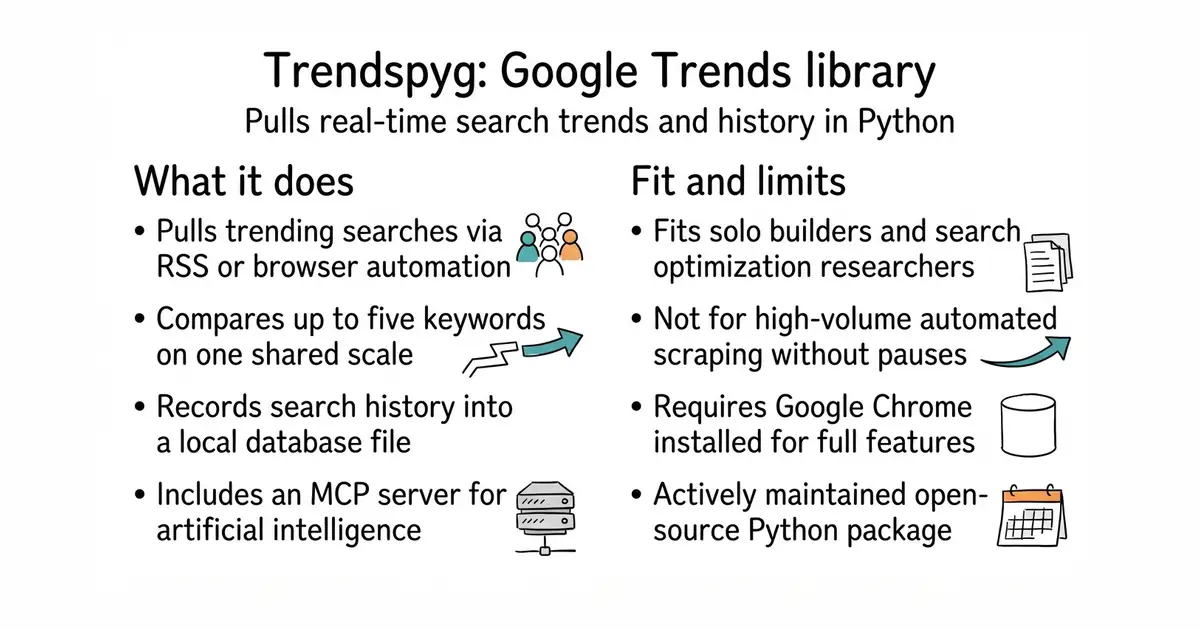
Trendspyg is an actively maintained Python library and command-line tool that pulls real-time trends and historical search data from Google. It acts as a drop-in replacement for the abandoned pytrends library while adding local caching, history archiving, and an MCP (a way for an artificial intelligence assistant to talk to external tools) server.
What it is good for
Solo builders who need to track keyword popularity, do search engine optimization research, or feed real-time search trends into their automated applications without paying for a commercial data provider.
- Acts as a drop-in replacement for the abandoned pytrends library.
- Includes a command-line interface and an AI assistant server.
- Saves search history locally in a lightweight SQLite (a self-contained, serverless database engine) file.
- Requires Google Chrome (a web browser made by Google) installed on your system for certain deep search queries.
- Heavy usage will quickly hit Google rate limits and block your IP address.
- Requires Python knowledge to set up and run beyond basic command-line tasks.
pytrends
Claude Desktop
- dbeaver/dbeaver52k stars
A free desktop program that connects to more than a hundred kinds of database and lets you browse and edit them.
- dimitri/pgloader6.5k stars
Loads data into PostgreSQL from other databases and from files, keeping going when individual rows fail.
source venv/bin/activate
pip install trendspyg[all]