Radar check
What we found when we opened it. Every bar is one fact, with its date.
Last code pushed 19 Sep 2026, 37 days before this check.
Latest release v1.9.4 on 21 Jul 2026.
Public since December 2018, a little over 7 years.
2,292 stars and 387 forks.
15 commits and 10 new issues in the last 90 days.
69 contributors. 86 pull requests merged in 90 days.
A security policy says how to report a problem. No published security advisories.
How the bars are scored
- Alive. Days since the last code push: a week or less 100, a month 90, three months 70, six months 50, a year 30, eighteen months 15, older 0.
- Releases. Age of the latest GitHub release, on a similar scale; no bar when the project publishes no releases.
- Maturity. Age of the project: eight years 100, five 90, three 70, two 55, one 40, six months 25, younger 10.
- Adoption. Stars on a log scale: 100,000 stars is 100, 10,000 is 80, 1,000 is 60, 100 is 40.
- Activity. Commits in the last 90 days: 300 or more 100, 100 85, 30 65, 10 45, any 25.
- Community. People who have contributed: 100 or more 100, 30 80, 10 60, 5 40, 2 25, one 10.
- Security. A published security policy 80, none 40; published advisories are listed, not scored.
Checked by Repo Radar on 26 Oct 2026 from the repository on GitHub.
In simple English
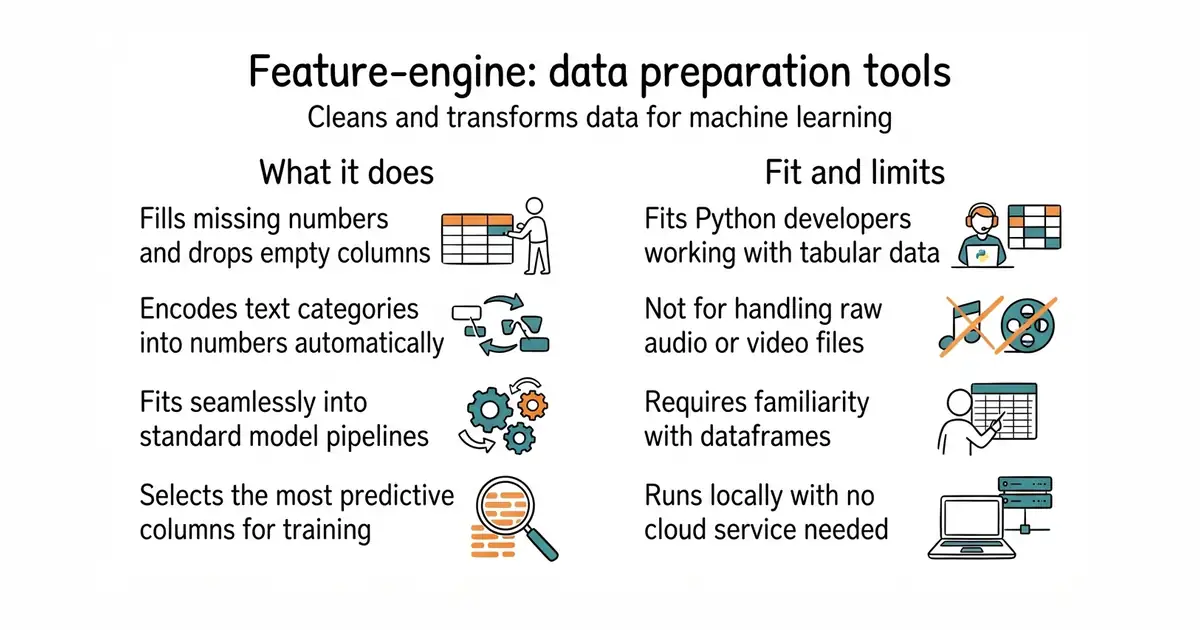
When building machine learning (a way to teach computers to make predictions from past examples) models, raw data needs cleaning before a computer can read it. Doing this cleaning by hand takes many lines of custom code. Feature-engine provides ready-made blocks for filling in missing numbers, encoding text categories, and removing bad columns. It costs nothing to use, as it is open-source. You only invest the time needed to learn how to plug it into your existing scripts.
What it is
Feature-engine is a Python (a popular programming language for data work) library with modular transformers for data preprocessing, feature engineering, and feature selection. It matches the standard interface of Scikit-learn (a core Python library for machine learning), using fit and transform methods to process tabular dataframes.
What it is good for
Data scientists and solo builders who want to speed up tabular data preparation without writing repetitive cleaning logic from scratch.
- Plugs directly into existing Scikit-learn pipelines without extra glue code.
- Covers common data tasks like missing value imputation and rare label grouping.
- Includes extensive documentation and community tutorials.
- Requires working knowledge of Python and Pandas dataframes.
- Memory use depends entirely on the size of your input dataset.
- No graphical user interface, as it is strictly a code library.
Writing custom Pandas scripts for every data cleaning step
Scikit-learn for training machine learning models
- scikit-learn/scikit-learn68k stars
Provides core machine learning tools and preprocessing utilities that Feature-engine extends.
- DistrictDataLabs/yellowbrick4.4k stars
Offers visual diagnostic tools for machine learning models and feature evaluation.


- evanw/esbuild40k stars
Joins many JavaScript, TypeScript and CSS files into one, in well under a second.
- Textualize/textual38k stars
Lets a Python program draw a real interface inside a terminal, and serve the same thing to a browser.
- python-attrs/cattrs1.1k stars
Turns loose data into declared Python objects, and declared objects back into loose data.
source venv/bin/activate
pip install feature_engine