Radar check
What we found when we opened it. Every bar is one fact, with its date.
Last code pushed 25 Oct 2026, one day before this check.
Latest release v0.67.0 on 13 Oct 2026.
Public since December 2018, a little over 7 years.
7,347 stars and 1,486 forks.
208 commits and 105 new issues in the last 90 days.
439 contributors. 195 pull requests merged in 90 days.
A security policy says how to report a problem. 1 published security advisory.
How the bars are scored
- Alive. Days since the last code push: a week or less 100, a month 90, three months 70, six months 50, a year 30, eighteen months 15, older 0.
- Releases. Age of the latest GitHub release, on a similar scale; no bar when the project publishes no releases.
- Maturity. Age of the project: eight years 100, five 90, three 70, two 55, one 40, six months 25, younger 10.
- Adoption. Stars on a log scale: 100,000 stars is 100, 10,000 is 80, 1,000 is 60, 100 is 40.
- Activity. Commits in the last 90 days: 300 or more 100, 100 85, 30 65, 10 45, any 25.
- Community. People who have contributed: 100 or more 100, 30 80, 10 60, 5 40, 2 25, one 10.
- Security. A published security policy 80, none 40; published advisories are listed, not scored.
Checked by Repo Radar on 26 Oct 2026 from the repository on GitHub.
In simple English
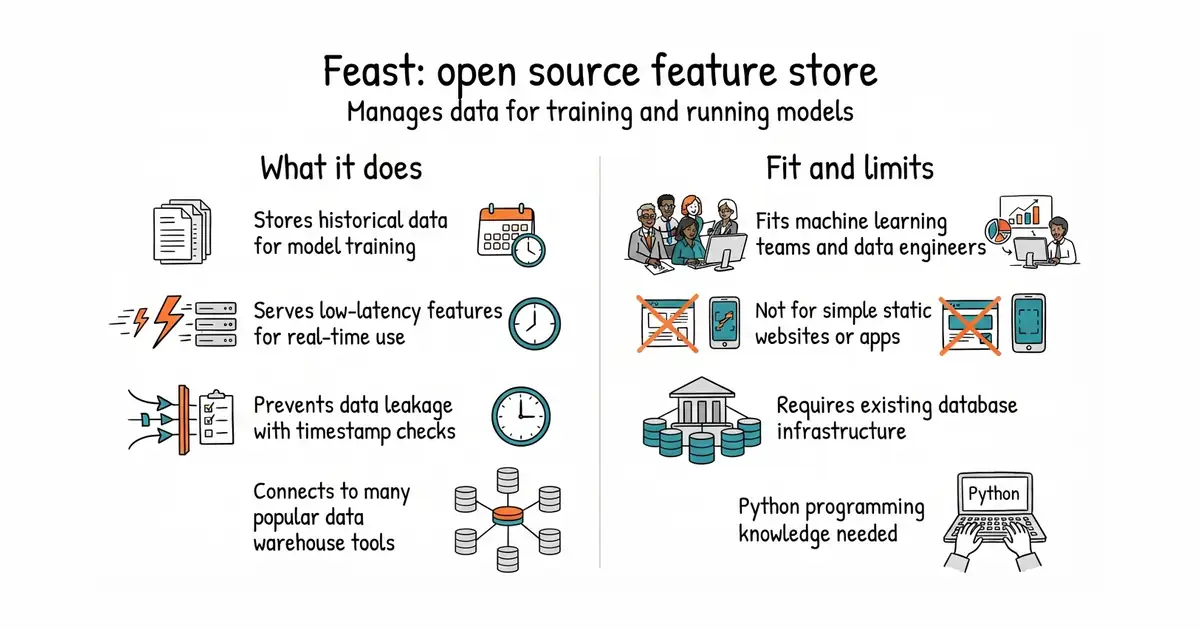
When you build an artificial intelligence model, it needs clean numbers to learn from and quick answers when it runs. Doing this by hand often leads to messy code and mistakes. This tool acts as a shared cupboard for all those numbers. It keeps your training records aligned with real-time predictions so your model does not cheat by seeing the future. You do not pay anything to download it, but you need a server and some database storage to run it in production.
What it is
Feast is an open-source feature store (a central database system for managing and serving pre-calculated data features for machine learning). It provides a single data access layer that connects your raw data storage to your machine learning models.
What it is good for
Data scientists and engineers who want to stop writing custom joining logic every time they train a new model or deploy one to production.
- Keeps training and production data identical to prevent model errors.
- Connects with many popular databases like PostgreSQL, Snowflake, and Redis.
- Includes a Python command-line tool and SDK for easy integration.
- Requires existing data infrastructure and databases to function properly.
- Complex setup for developers who are new to machine learning pipelines.
- Heavy maintenance overhead when managing multiple data sources and servers.
custom SQL join scripts and manual feature lookup code
Redis
- zenml-io/zenml5.6k stars
A machine learning pipeline framework that can coordinate feature stores and model training.

- tobymao/sqlglot9.7k stars
Reads, rewrites and translates SQL between more than twenty database dialects, without a database.
- patroni/patroni8.8k stars
Watches a group of PostgreSQL copies and promotes a new leader when the leader fails.
- pgEdge/spock758 stars
An add-on that lets several PostgreSQL databases all accept changes and keep each other in step.
pip install feast
feast init my_feature_repo
cd my_feature_repo/feature_repo
feast apply