16.2k stars · Apache-2.0 · @electric-sql/pglite-pgmq@0.0.8 (2026-10-14) · Track this in Rising ↗
PostgreSQL compiled so it runs inside a JavaScript program or inside a web page.
Radar check
What we found when we opened it. Every bar is one fact, with its date.
Last code pushed 25 Oct 2026, 2 days before this check.
Latest release @electric-sql/pglite-prepopulatedfs@0.5.11 on 21 Oct 2026.
Public since February 2024, a little over 2 years.
16,190 stars and 465 forks.
43 commits and 24 new issues in the last 90 days.
83 contributors. 40 pull requests merged in 90 days.
No security policy file says how to report a problem. No published security advisories.
How the bars are scored
- Alive. Days since the last code push: a week or less 100, a month 90, three months 70, six months 50, a year 30, eighteen months 15, older 0.
- Releases. Age of the latest GitHub release, on a similar scale; no bar when the project publishes no releases.
- Maturity. Age of the project: eight years 100, five 90, three 70, two 55, one 40, six months 25, younger 10.
- Adoption. Stars on a log scale: 100,000 stars is 100, 10,000 is 80, 1,000 is 60, 100 is 40.
- Activity. Commits in the last 90 days: 300 or more 100, 100 85, 30 65, 10 45, any 25.
- Community. People who have contributed: 100 or more 100, 30 80, 10 60, 5 40, 2 25, one 10.
- Security. A published security policy 80, none 40; published advisories are listed, not scored.
Checked by Repo Radar on 26 Oct 2026 from the repository on GitHub. Covered in Edition 17.
▶Repo detailsthe review · specs · pros & cons · install
What it does
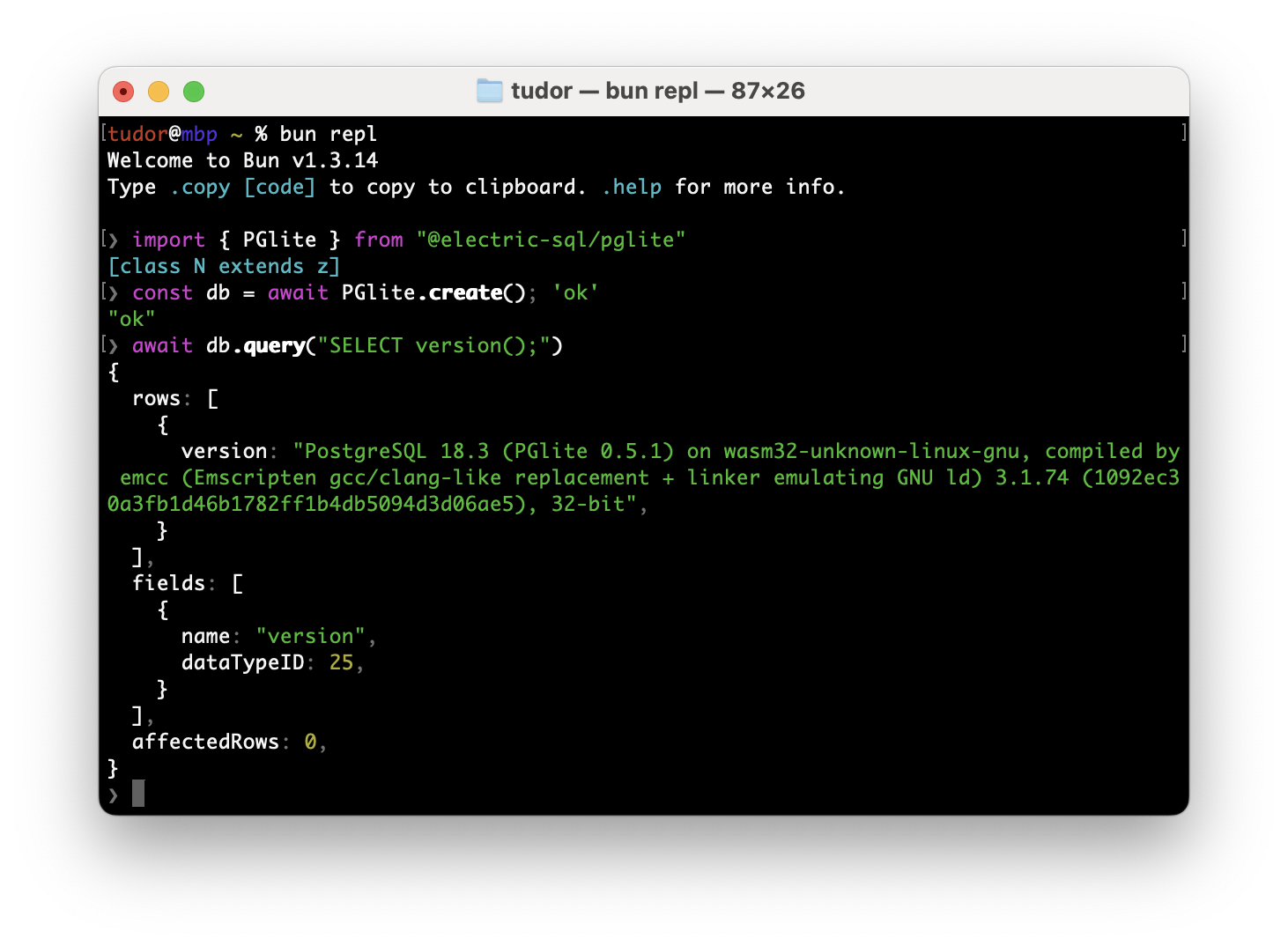
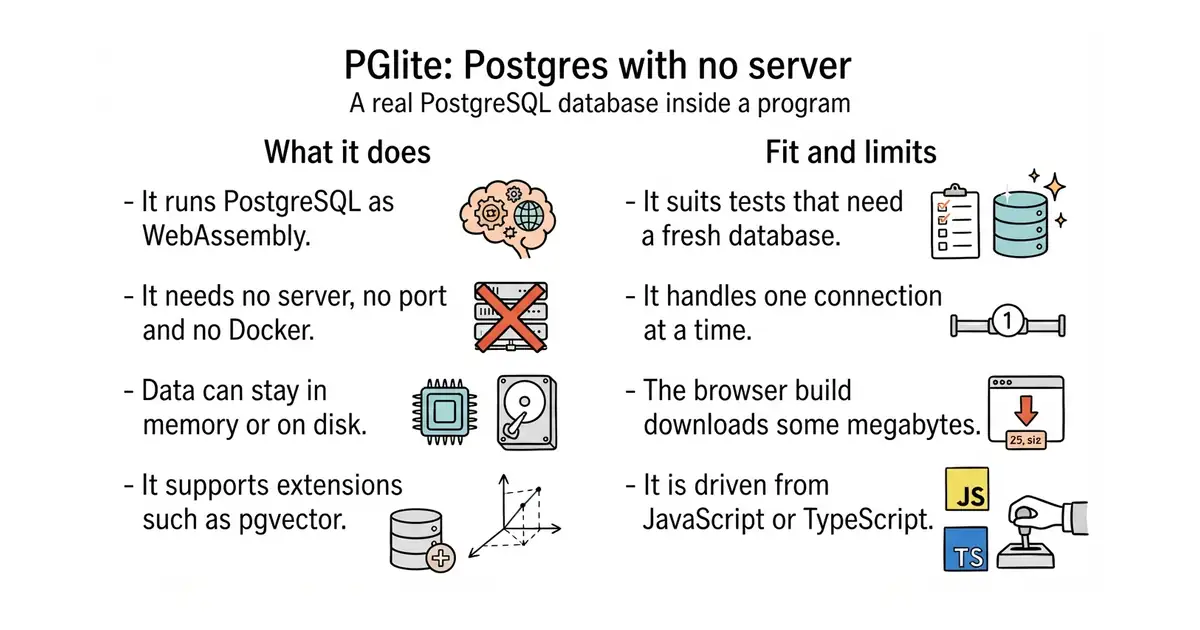
It is the real PostgreSQL engine, built as WebAssembly, a format that lets a program written in another language run inside JavaScript. It runs in Node.js, in Bun, in Deno and in a browser tab. Data can stay in memory, or be written to a folder on disk, or be kept in the browser's own storage. It supports a growing list of Postgres extensions, pgvector for similarity search among them. Version 0.5.10 is the current npm release, and code landed on 28 July 2026; a companion package in the same repository was released on 14 October 2026. It handles one connection at a time, so it is not a replacement for a production database server.
Why it matters
Who it suits. Two groups, and both cases are real. First, anybody whose tests need a database: each test gets its own empty database in milliseconds, and no test can leave dirt behind for the next one. Second, anybody building a demonstration that should work with no account and no backend, because the whole thing can run in the visitor's browser. Skip it if the plan is to serve many users at once, because that is not what it is.
Verdict. The best hour or two you can spend on a test suite that currently starts a database container. Two things to watch: the browser build downloads a few megabytes of WebAssembly on the first visit, and it is driven from JavaScript or TypeScript, so a Python service cannot call it directly. duckdb/duckdb-wasm is the equivalent for analytical queries, and sqlite/sqlite-wasm is the lighter choice when the SQL does not have to be Postgres SQL.
Summary (Key Points)from the README
Key features
- Runs anywhere JavaScript does: Works in the browser, Node.js, Bun and Deno with no other dependencies to install.
- Small footprint: The package is only 3mb gzipped.
- Extension support: Supports many Postgres extensions, including pgvector and PostGIS.
- Flexible storage: Runs as an ephemeral in-memory database, or persists to the file system (Node/Bun/Deno) or indexedDB (browser).
- No virtual machine: Unlike earlier "Postgres in the browser" projects, it runs Postgres compiled to WASM directly rather than inside a Linux VM.
- Single-user mode approach: It uses PostgreSQL's single user mode, with an input/output path added so JavaScript can talk to the WASM build.
- Two-part build: The Postgres WASM module is built separately from the TypeScript client library and packages.
- Prebuilt binaries: Interim build files are generated automatically after each merged PR, so you can skip building the WASM module yourself.
Ways to install
| Platform or method | What it needs | Effort |
|---|---|---|
| Browser, via package manager | A project using a package manager | Low |
| Browser, via CDN (JSDeliver) | Access to the CDN | Low |
| Node.js | Install into your project | Low |
| Bun | Install into your project | Low |
| Deno | Install into your project | Low |
Important
- Single connection: PGlite is single user and single connection, so it does not serve multiple concurrent clients.
- Docker for source builds: Building the Postgres WASM module from scratch requires Docker; contributors also need Node v20 or above and pnpm.
- Prebuilt file placement: If you use the prebuilt binaries instead, you must extract them into packages/pglite/release in your local copy.
- Changesets for contributions: Contributions that touch code must include a changeset.
- Dual license: PGlite is licensed under Apache License 2.0 or the PostgreSQL License, at your choice; changes to Postgres source are under the PostgreSQL License.
Written by an AI model from the project’s README; not part of the review, and it can be wrong.
- A fresh database in milliseconds, so tests stop sharing state.
- It is real PostgreSQL, not an imitation, so the same SQL works in production.
- It supports extensions, including pgvector for similarity search.
- One connection at a time. This does not replace a production server.
- The browser build downloads a few megabytes of WebAssembly on first visit. Plan for that on a slow connection.
- It is driven from JavaScript or TypeScript, so a Python service cannot use it directly.
npm install @electric-sql/pglite