Radar check
What we found when we opened it. Every bar is one fact, with its date.
Last code pushed 5 Aug 2026, 2 months before this check.
Latest release v2.0.1 on 13 Oct 2025.
Public since May 2024, a little over 2 years.
8,303 stars and 1,219 forks.
5 commits and 1 new issues in the last 90 days.
14 contributors. No pull requests merged in 90 days; changes go in directly.
No security policy file says how to report a problem. No published security advisories.
How the bars are scored
- Alive. Days since the last code push: a week or less 100, a month 90, three months 70, six months 50, a year 30, eighteen months 15, older 0.
- Releases. Age of the latest GitHub release, on a similar scale; no bar when the project publishes no releases.
- Maturity. Age of the project: eight years 100, five 90, three 70, two 55, one 40, six months 25, younger 10.
- Adoption. Stars on a log scale: 100,000 stars is 100, 10,000 is 80, 1,000 is 60, 100 is 40.
- Activity. Commits in the last 90 days: 300 or more 100, 100 85, 30 65, 10 45, any 25.
- Community. People who have contributed: 100 or more 100, 30 80, 10 60, 5 40, 2 25, one 10.
- Security. A published security policy 80, none 40; published advisories are listed, not scored.
Checked by Repo Radar on 28 Oct 2026 from the repository on GitHub.
In simple English
This tool lets you put a talking digital person inside a mobile phone app. The animated face moves its lips in time with spoken words and reacts instantly. It runs directly on the phone processor without needing a heavy cloud server to do the graphics. You can connect your own speech recognition, artificial intelligence brain, and voice generator. It costs nothing for the software, but you will need mobile app programming skills to hook it up.
What it is
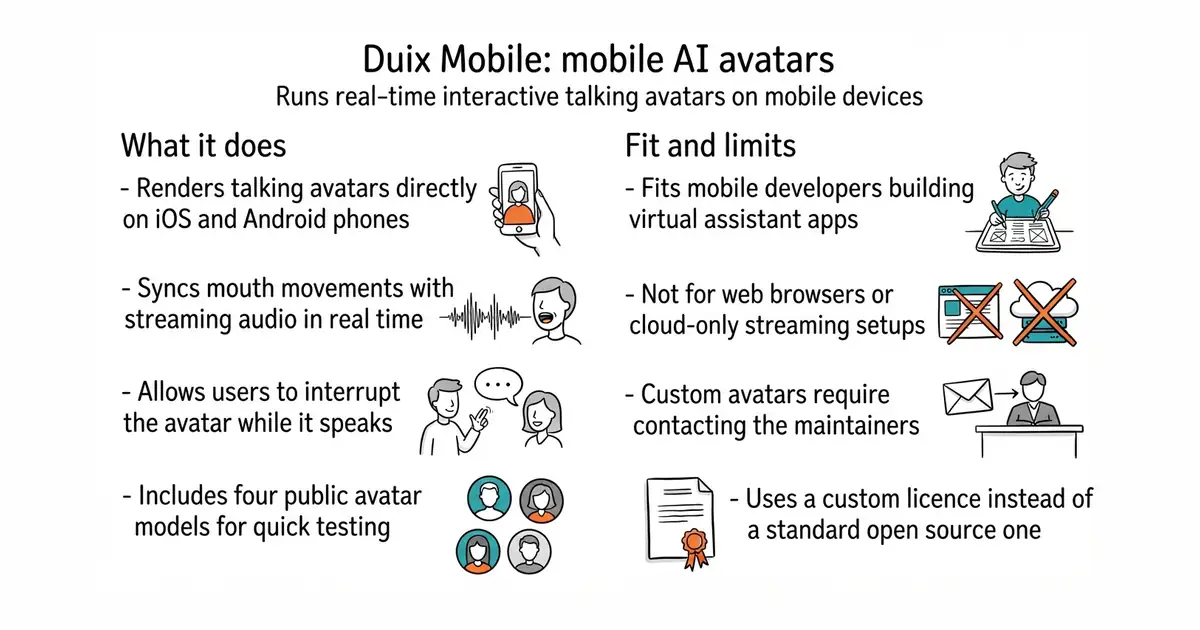
Duix Mobile is an open-source software kit for iOS and Android that renders real-time interactive AI avatars on user devices. It handles face animation, streaming audio, and lip synchronization with low latency.
What it is good for
Solo builders and developers who want to add a talking virtual assistant, tutor, or companion character to a mobile app without paying for expensive cloud video streaming.
Summary (Key Points)from the README
Key features
- On-device operation: Core functions run locally without cloud servers, which the README says makes the SDK lightweight, private and responsive.
- Bring your own AI services: You can plug in your own or third-party LLM, ASR and TTS services to build conversational avatars.
- Streaming audio with barge-in: The avatar can speak while synthesizing and handle user interruptions, available from the July 17, 2025 release.
- Low latency: Avatar response latency is under 120ms, measured on a Snapdragon® 8 Gen 2 SoC.
- Voice event callbacks: Callback events for voice start and end are documented.
- Multilingual subtitles and lip sync: The FAQ says both are supported.
- Public avatars: Four ready-made avatars (Leo, Oliver, Sofia, Lily) are available for download.
- Custom avatars: The README says a 15-second to 2-minute video is usually enough for a custom avatar, with requests sent by email.
- Modular design: The README describes modularity as a way to customize industry-specific avatar solutions.
Ways to install
| Platform or method | What it needs | Effort |
|---|---|---|
| Android | Duix Mobile SDK for Android, with its own README (linked in the repository) | Not stated in this README |
| iOS | Duix Mobile SDK for iOS, with its own README (linked in the repository) | Not stated in this README |
Important
- Hardware benchmark: The latency figure was measured on one chipset only; the README gives no results for other devices.
- Services not included: The README says you integrate LLM, ASR and TTS services yourself, but it does not name which services are bundled.
- Custom avatars need contact: Private avatars require an email request to support@duix.com, so there is no self-service path described.
- Download link mismatch: The avatar download links point to a repository named Duix.mobile, while this project is Duix-Mobile; check that the links resolve before relying on them.
- Platform claims: The README lists automotive, VR, IoT and large-screen support, but only Android and iOS have SDK documentation linked.
- Performance claims are self-reported: Claims such as "stable in poor networks" are not backed by figures in the README.
Written by an AI model from the project’s README; not part of the review, and it can be wrong.
- Runs locally on mobile hardware with very low response delay.
- Supports user interruption so people can speak while the avatar is talking.
- Includes four ready-to-use public avatar models to test with immediately.
- Custom avatar creation requires emailing the maintainers and cannot be done independently.
- Uses a custom license which may restrict commercial use.
- Requires advanced mobile development knowledge to build into an iOS or Android app.
expensive cloud video streaming services for digital human rendering
OpenAI API
- spotify/pedalboard6.4k stars
Applies audio effects to recordings from Python, including studio plug-ins, without calling another program.
- iver56/audiomentations2.3k stars
Spoils sound recordings on purpose, 39 ways, so a model trained on them copes with real rooms.
- shaka-project/shaka-packager2.6k stars
Cuts a video file into the pieces and index files that a browser needs in order to stream it.
Download the iOS or Android demo projects and public avatar zip files directly from the GitHub releases page, then open them in Xcode or Android Studio.