Radar check
What we found when we opened it. Every bar is one fact, with its date.
Last code pushed 25 Oct 2026, the same day before this check.
Latest release 7.17.0 on 22 Oct 2026.
Public since June 2018, a little over 8 years.
3,424 stars and 549 forks.
161 commits and 33 new issues in the last 90 days.
231 contributors. 47 pull requests merged in 90 days.
A security policy says how to report a problem. No published security advisories.
How the bars are scored
- Alive. Days since the last code push: a week or less 100, a month 90, three months 70, six months 50, a year 30, eighteen months 15, older 0.
- Releases. Age of the latest GitHub release, on a similar scale; no bar when the project publishes no releases.
- Maturity. Age of the project: eight years 100, five 90, three 70, two 55, one 40, six months 25, younger 10.
- Adoption. Stars on a log scale: 100,000 stars is 100, 10,000 is 80, 1,000 is 60, 100 is 40.
- Activity. Commits in the last 90 days: 300 or more 100, 100 85, 30 65, 10 45, any 25.
- Community. People who have contributed: 100 or more 100, 30 80, 10 60, 5 40, 2 25, one 10.
- Security. A published security policy 80, none 40; published advisories are listed, not scored.
Checked by Repo Radar on 26 Oct 2026 from the repository on GitHub.
In simple English
When you write tests for your code, you want to know if every line actually runs. This tool checks your code while your tests run. It tells you which lines were tested and which ones were left out. It is free to use and works inside your normal development flow. It takes minutes to set up and runs automatically.
What it is
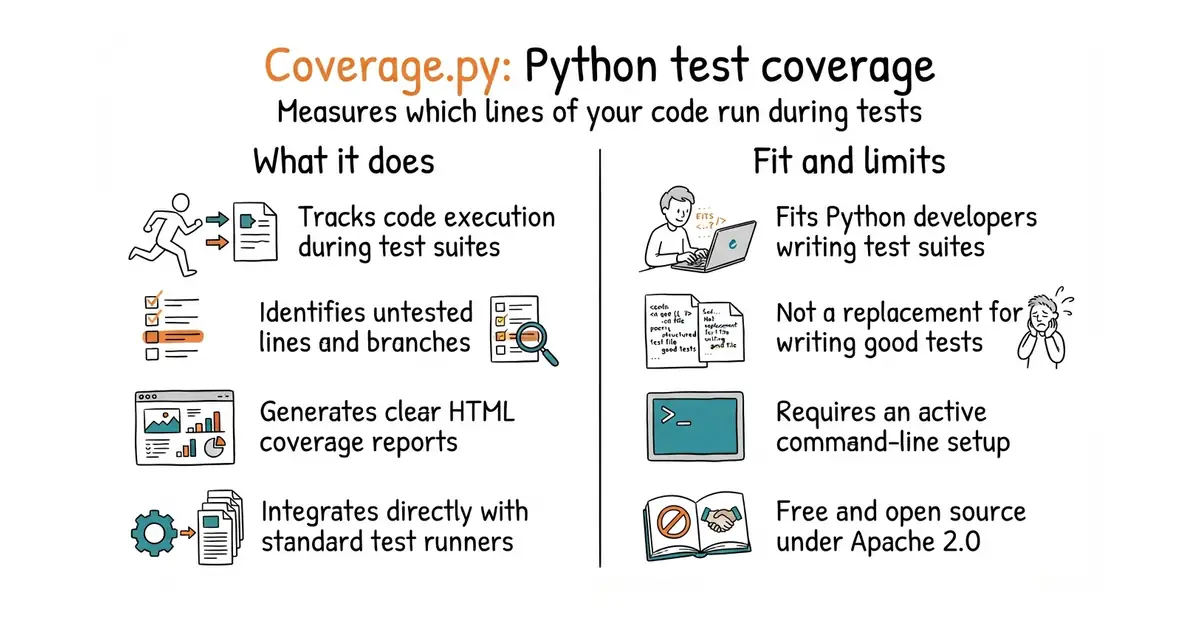
Coverage.py is a command-line tool (a program you run in your terminal by typing text commands) that measures code coverage for Python programs. It monitors your test suite to report which lines of code executed and which ones did not.
What it is good for
Solo builders who write Python tests and want to find untested code blocks before releasing bugs to users.
- Shows exact lines of code that your tests missed.
- Integrates easily with pytest and other test runners.
- Generates clean HTML reports you can open in a browser.
- Requires you to write and maintain a test suite first.
- Can slow down test execution when tracing complex code paths.
- Reports raw numbers that do not measure actual test quality.
Manual code inspection during debugging
pytest


- evanw/esbuild40k stars
Joins many JavaScript, TypeScript and CSS files into one, in well under a second.
- Textualize/textual38k stars
Lets a Python program draw a real interface inside a terminal, and serve the same thing to a browser.
- python-attrs/cattrs1.1k stars
Turns loose data into declared Python objects, and declared objects back into loose data.
source venv/bin/activate
pip install coverage