In simple English
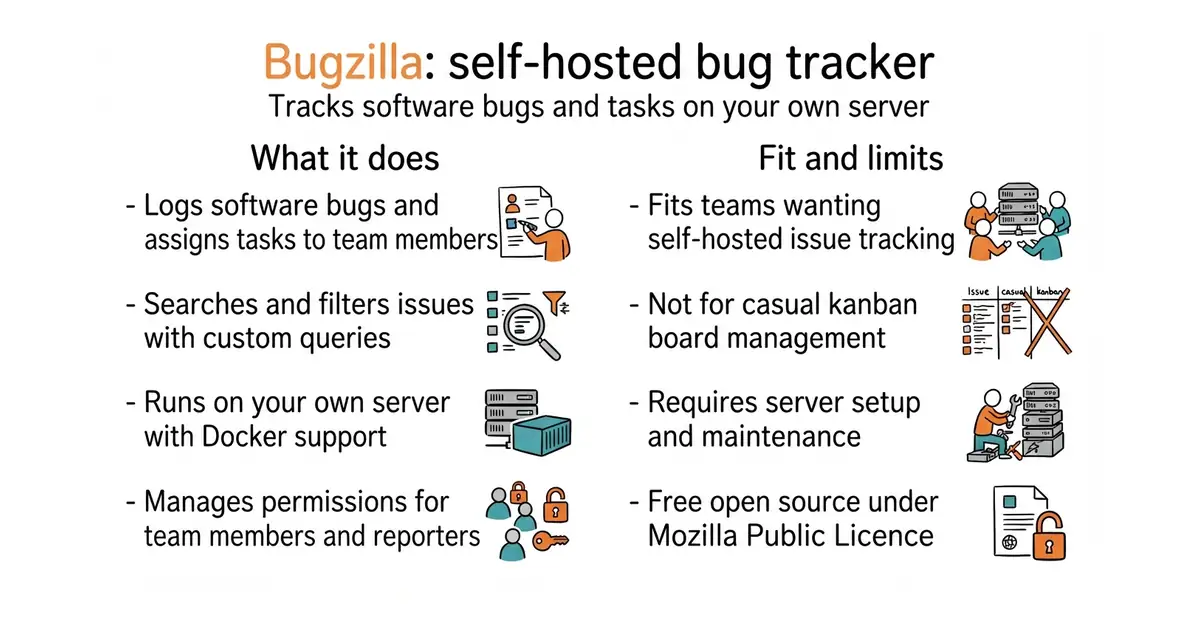
Bugzilla is a classic web tool for tracking software bugs and tasks. Teams use it to record what went wrong, assign it to someone, and track when it gets fixed. It runs on your own server, so your data stays in your hands. Setting it up takes some technical work, and you need a server to host it. It is free to use under the Mozilla Public License 2.0.
What it is
Bugzilla is a web-based issue tracking system written in the Perl programming language. It provides a database-backed web interface for reporting, searching, and managing software defects and feature requests.
What it is good for
Solo builders and teams who want a proven, self-hosted bug tracker without paying for a cloud service or sharing data with third-party platforms.
- Keeps all your bug reports and user feedback on your own server.
- Supports Docker (a way to run a program inside its own sealed box, so it cannot break anything else on your server) for a faster setup.
- Free and open source software with decades of development history.
- Requires setting up a web server, a database, and Perl dependencies if not using Docker.
- The interface feels dated compared to modern project management tools.
- Mainly built for bug tracking, so it lacks broader project management views like kanban boards.
Paid cloud issue trackers like Jira or GitHub Issues when self-hosting is required.
Docker (a way to run a program inside its own sealed box, so it cannot break anything else on your server) or a Linux server.


- HypothesisWorks/hypothesis9.1k stars
A Python library that generates test inputs and reduces any failure to the smallest example that still fails.
- wntrblm/nox1.6k stars
Runs your tests and other jobs in fresh isolated environments, described in an ordinary Python file.
git clone https://github.com/bugzilla/bugzilla.git
cd bugzilla
docker compose up