In simple English
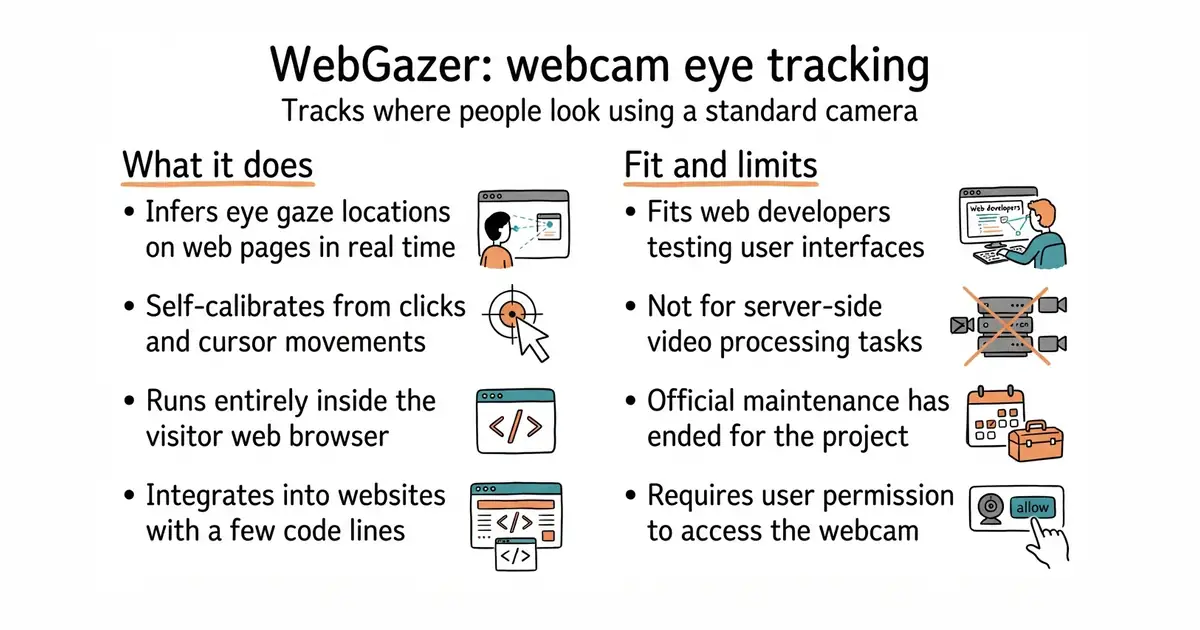
This library watches a visitor through their computer camera. It figures out where they look on your web page. It learns by watching them click and move their mouse. No video leaves the visitor browser. You need permission from the user before it can see them.
What it is
WebGazer is a JavaScript (a programming language for the web) library that performs eye tracking inside a web browser. It runs client-side (running entirely on the user computer rather than a remote server) without needing special hardware.
What it is good for
Solo builders who want to test user interfaces, study reading patterns or build gaze-controlled web experiments without buying expensive eye tracking equipment.
- Runs entirely in the user browser so no video stream needs to be saved on your server.
- Calibrates itself automatically as users click and move their mouse across the page.
- Works with standard webcams found on laptops and phones without special hardware.
- Official maintenance has ended, so future bug fixes depend entirely on the community.
- Licensing rules require caution for commercial projects above one million dollars in valuation.
- Lighting changes and head movements can reduce accuracy during tracking sessions.
expensive hardware eye trackers
React
- GoogleChromeLabs/squoosh26k stars
A web page that compresses images in the browser and shows you the result before you save it.
- simple-icons/simple-icons26k stars
More than 3,400 brand logos as single-colour SVG files, released into the public domain.
- phosphor-icons/core394 stars
The raw SVG files and the catalogue for the Phosphor icon family, with no framework package attached.
git clone https://github.com/brownhci/WebGazer.git
cd WebGazer
npm install
npm run build