Radar check
What we found when we opened it. Every bar is one fact, with its date.
Last code pushed 26 Oct 2026, the same day before this check.
Latest release golden-suite-v0.5.10 on 26 Sep 2026.
Public since March 2026, 7 months.
134 stars and 16 forks.
822 commits and 69 new issues in the last 90 days.
4 contributors. 806 pull requests merged in 90 days. A small team carries it.
A security policy says how to report a problem. No published security advisories.
How the bars are scored
- Alive. Days since the last code push: a week or less 100, a month 90, three months 70, six months 50, a year 30, eighteen months 15, older 0.
- Releases. Age of the latest GitHub release, on a similar scale; no bar when the project publishes no releases.
- Maturity. Age of the project: eight years 100, five 90, three 70, two 55, one 40, six months 25, younger 10.
- Adoption. Stars on a log scale: 100,000 stars is 100, 10,000 is 80, 1,000 is 60, 100 is 40.
- Activity. Commits in the last 90 days: 300 or more 100, 100 85, 30 65, 10 45, any 25.
- Community. People who have contributed: 100 or more 100, 30 80, 10 60, 5 40, 2 25, one 10.
- Security. A published security policy 80, none 40; published advisories are listed, not scored.
Checked by Repo Radar on 26 Oct 2026 from the repository on GitHub.
In simple English
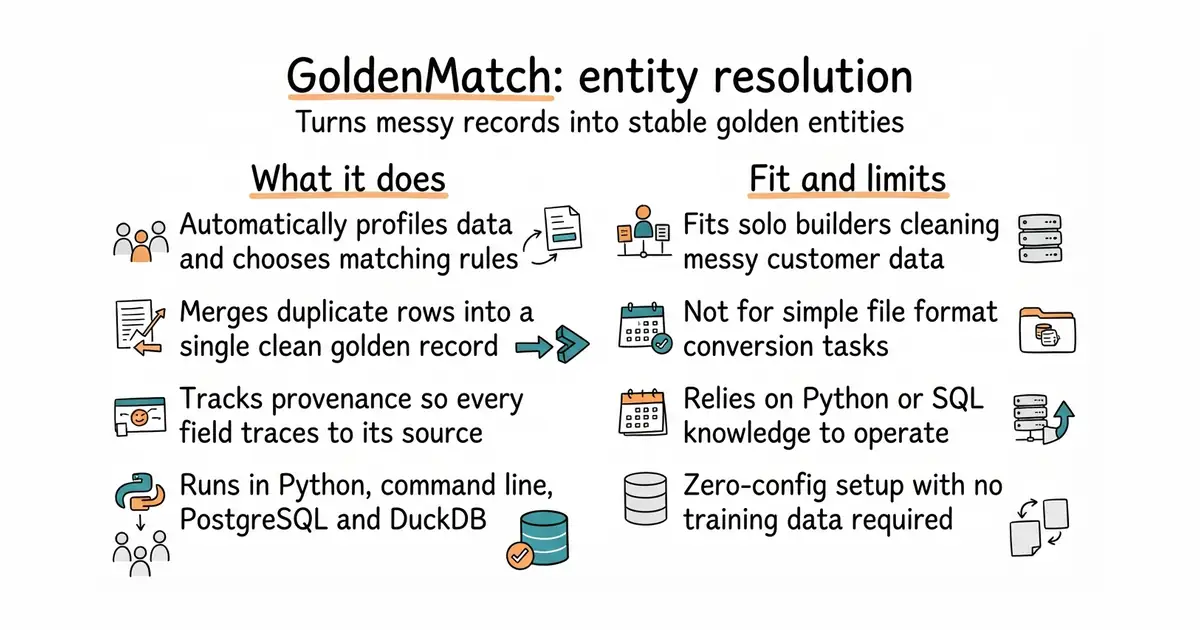
Spreadsheets and databases often store the same person, company or product under different names, spellings and formats. This tool inspects your messy records and figures out which rows belong to the same real-world entity. It groups duplicates together and merges them into a single clean record without making you write matching rules. You can run it from the command line, use it in Python, or let it run inside your SQL database. It saves hours of manual data cleaning and helps you find out how many unique customers you actually have.
What it is
An Arrow-native and Rust-accelerated entity resolution engine that matches records across files, databases and streaming sources. It combines a zero-config matching system with a durable identity layer that preserves field-level provenance, handles merges and splits, and outputs a tamper-evident audit log.
What it is good for
Solo builders and data workers who need to clean up messy customer lists, merge disparate CRM data, or deduplicate database tables without spending days tuning complex matching rules.
- Zero-config setup automatically chooses matching rules for your data.
- Runs locally via CLI, Python library, or directly inside PostgreSQL and DuckDB.
- Retains full provenance so you can trace every merged value back to its source record.
- Requires familiarity with Python or the command line for local usage.
- Advanced distributed backends like Ray or Spark add operational complexity.
- Cross-language string matching between Python and TypeScript can occasionally show minor decimal divergence.
manual spreadsheet deduplication and hand-tuned Splink matching scripts
duckdb
- moj-analytical-services/splink2.5k stars
Splink provides probabilistic record linkage, but requires manual rule tuning compared to this tool's zero-config approach.
- dedupeio/dedupe4.5k stars
Dedupe learns matching rules from active user feedback, whereas this tool automates profiling and matching out of the box.


- tobymao/sqlglot9.7k stars
Reads, rewrites and translates SQL between more than twenty database dialects, without a database.
- patroni/patroni8.8k stars
Watches a group of PostgreSQL copies and promotes a new leader when the leader fails.
- pgEdge/spock758 stars
An add-on that lets several PostgreSQL databases all accept changes and keep each other in step.
pip install goldenmatch
goldenmatch dedupe customers.csv