Radar check
What we found when we opened it. Every bar is one fact, with its date.
Last code pushed 11 Sep 2026, 45 days before this check.
Latest release v1.31.0 on 14 May 2024.
Public since September 2017, about 9 years.
7,688 stars and 915 forks.
0 commits and 1 new issues in the last 90 days.
75 contributors. No pull requests merged in 90 days; changes go in directly.
No security policy file says how to report a problem. No published security advisories.
How the bars are scored
- Alive. Days since the last code push: a week or less 100, a month 90, three months 70, six months 50, a year 30, eighteen months 15, older 0.
- Releases. Age of the latest GitHub release, on a similar scale; no bar when the project publishes no releases.
- Maturity. Age of the project: eight years 100, five 90, three 70, two 55, one 40, six months 25, younger 10.
- Adoption. Stars on a log scale: 100,000 stars is 100, 10,000 is 80, 1,000 is 60, 100 is 40.
- Activity. Commits in the last 90 days: 300 or more 100, 100 85, 30 65, 10 45, any 25.
- Community. People who have contributed: 100 or more 100, 30 80, 10 60, 5 40, 2 25, one 10.
- Security. A published security policy 80, none 40; published advisories are listed, not scored.
Checked by Repo Radar on 26 Oct 2026 from the repository on GitHub.
In simple English
Data tables often spread across many files, such as customer orders and payment logs. Preparing this data for machine learning takes days of manual coding and merging. This Python library automates that entire process for you. It scans your tables and writes out hundreds of statistical features in seconds. You get clean training data without writing tedious join queries by hand.
What it is
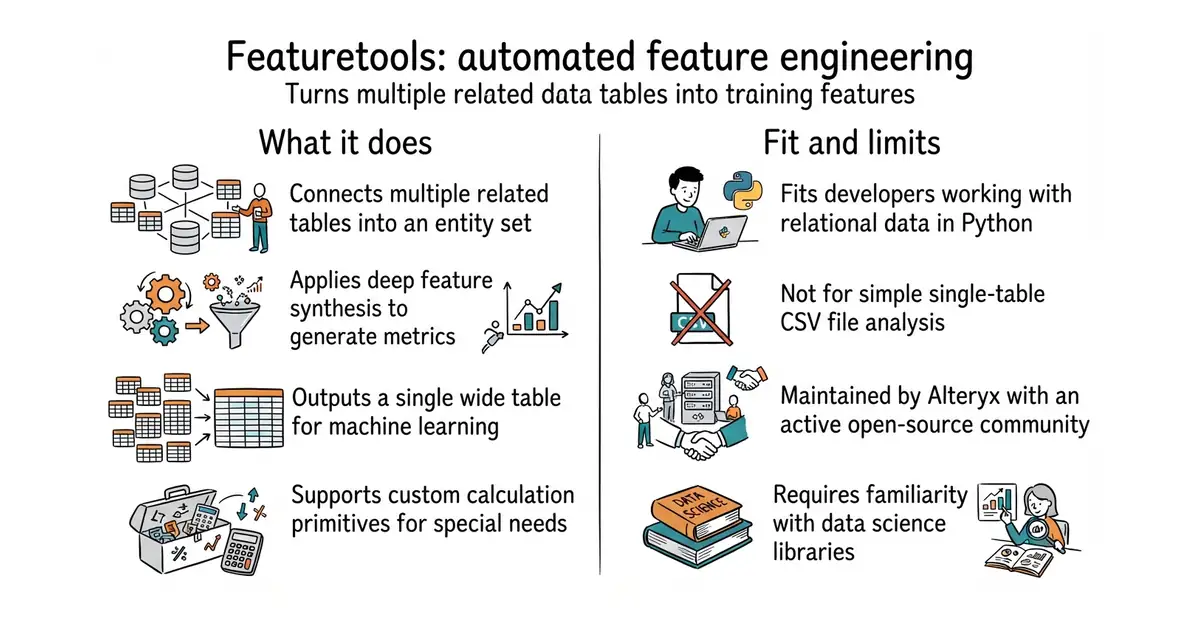
Featuretools is an open-source Python library for automated feature engineering using an algorithm called Deep Feature Synthesis. It connects multiple related data tables and turns them into a single wide table suitable for machine learning algorithms.
What it is good for
Solo builders and data scientists who want to speed up exploratory data analysis and train machine learning models faster on relational datasets.
- Saves hours of writing manual SQL join and aggregation queries.
- Automatically discovers complex patterns across related tables.
- Works seamlessly with popular machine learning libraries like scikit-learn.
- Requires Python programming knowledge to set up and run.
- Can generate huge tables with thousands of columns if not restricted.
- Large datasets need extra memory and optional tools like Dask to run smoothly.
Writing manual SQL join and aggregation queries for machine learning datasets.
scikit-learn
- pycaret/pycaret9.9k stars
An open-source machine learning library that automates model training workflows in Python.
- autogluon/autogluon11k stars
An automated machine learning toolkit that handles data preparation and model training for various data types.


- basicmachines-co/basic-memory4.3k stars
Gives an AI assistant a memory that is stored as plain text files you can read.
- deepset-ai/haystack27k stars
A Python framework for joining language models, document search and tools into one working pipeline.
- Giskard-AI/giskard-oss5.9k stars
A Python library that writes tests for language-model programs and tries to break them on purpose.
python -m venv venv
source venv/bin/activate
pip install featuretools