Radar check
What we found when we opened it. Every bar is one fact, with its date.
Last code pushed 24 Jan 2026, 9 months before this check.
No releases published on GitHub; the code date above is the one to trust.
Public since January 2026, 9 months.
0 stars and 0 forks.
0 commits and 0 new issues in the last 90 days.
1 contributor. No pull requests merged in 90 days; changes go in directly. A small team carries it.
No security policy file says how to report a problem. No published security advisories.
How the bars are scored
- Alive. Days since the last code push: a week or less 100, a month 90, three months 70, six months 50, a year 30, eighteen months 15, older 0.
- Releases. Age of the latest GitHub release, on a similar scale; no bar when the project publishes no releases.
- Maturity. Age of the project: eight years 100, five 90, three 70, two 55, one 40, six months 25, younger 10.
- Adoption. Stars on a log scale: 100,000 stars is 100, 10,000 is 80, 1,000 is 60, 100 is 40.
- Activity. Commits in the last 90 days: 300 or more 100, 100 85, 30 65, 10 45, any 25.
- Community. People who have contributed: 100 or more 100, 30 80, 10 60, 5 40, 2 25, one 10.
- Security. A published security policy 80, none 40; published advisories are listed, not scored.
Checked by Repo Radar on 26 Oct 2026 from the repository on GitHub.
In simple English
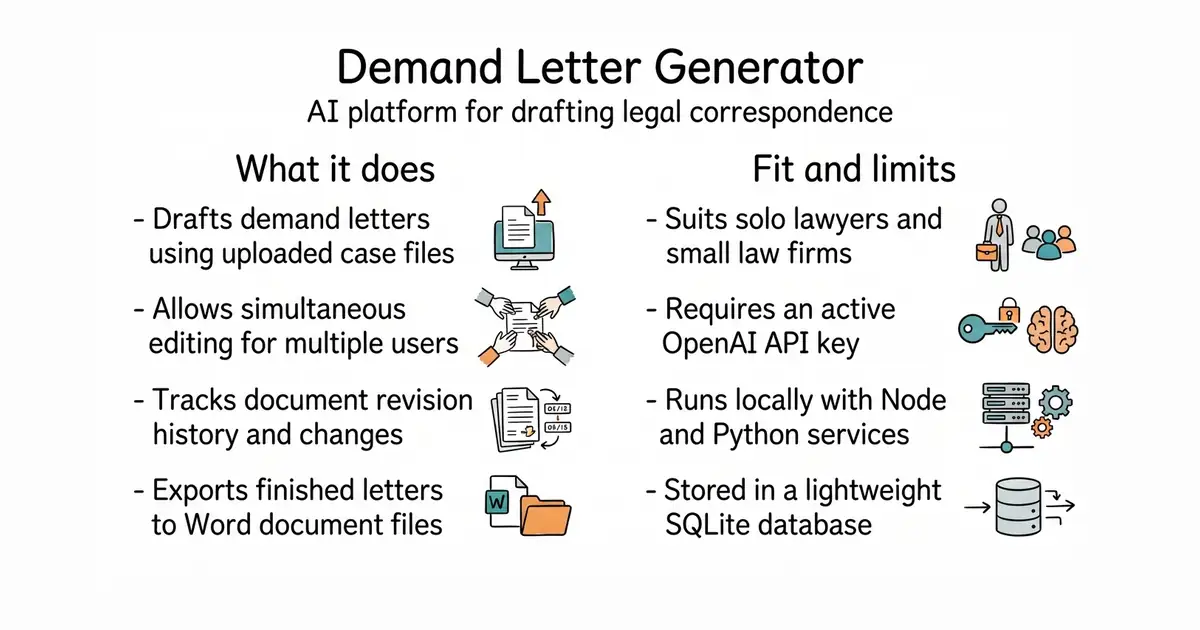
This tool helps lawyers write demand letters using artificial intelligence. You upload source files like case notes or PDFs, and the system drafts a formal legal letter for you. It includes a shared text editor so multiple people can work on the same document at once. You run it on your own computer or server using Node.js and Python. It costs money for the artificial intelligence credits you use while generating letters.
What it is
Demand Letter Generator is an open-source platform that combines a React frontend, a Node.js backend, and a Python artificial intelligence service. It uses SQLite (a lightweight database stored in a single file) to keep track of user accounts, document uploads, and letter versions.
What it is good for
Solo lawyers and small law firms who want to speed up document drafting by letting artificial intelligence read case files and write initial correspondence.
- Drafts formal demand letters automatically using uploaded case files and artificial intelligence.
- Allows multiple team members to edit documents at the same time with live cursors.
- Exports finished correspondence to styled Word documents.
- Requires running both a Node.js server and a Python artificial intelligence service at the same time.
- Needs an active paid subscription or API key from OpenAI to function.
- Setup requires running multiple configuration steps across separate directories.
manual drafting of legal demand letters from scratch
OpenAI API
- langchain-ai/langchain148k stars
A framework for building applications with large language models, similar to the artificial intelligence backend used here.

- basicmachines-co/basic-memory4.3k stars
Gives an AI assistant a memory that is stored as plain text files you can read.
- deepset-ai/haystack27k stars
A Python framework for joining language models, document search and tools into one working pipeline.
- Giskard-AI/giskard-oss5.9k stars
A Python library that writes tests for language-model programs and tries to break them on purpose.
npm run install:all
cd ai-service
python3 -m venv venv
source venv/bin/activate
pip install -r requirements.txt