Radar check
What we found when we opened it. Every bar is one fact, with its date.
Last code pushed 26 Oct 2026, the same day before this check.
Latest release v7.26.0 on 6 Oct 2026.
Public since May 2018, a little over 8 years.
26,827 stars and 7,735 forks.
523 commits and 222 new issues in the last 90 days.
3,932 contributors. 508 pull requests merged in 90 days.
No security policy file says how to report a problem. 4 published security advisories.
How the bars are scored
- Alive. Days since the last code push: a week or less 100, a month 90, three months 70, six months 50, a year 30, eighteen months 15, older 0.
- Releases. Age of the latest GitHub release, on a similar scale; no bar when the project publishes no releases.
- Maturity. Age of the project: eight years 100, five 90, three 70, two 55, one 40, six months 25, younger 10.
- Adoption. Stars on a log scale: 100,000 stars is 100, 10,000 is 80, 1,000 is 60, 100 is 40.
- Activity. Commits in the last 90 days: 300 or more 100, 100 85, 30 65, 10 45, any 25.
- Community. People who have contributed: 100 or more 100, 30 80, 10 60, 5 40, 2 25, one 10.
- Security. A published security policy 80, none 40; published advisories are listed, not scored.
Checked by Repo Radar on 26 Oct 2026 from the repository on GitHub.
In simple English
When you design an API, you write a blueprint file that describes every endpoint, input, and output. Writing the code to talk to that API in Python, Go, TypeScript, or Java takes days of repetitive work. This tool reads your blueprint file and writes all that code for you in seconds. It saves you from writing boring boilerplate code by hand. You can run it on your own computer or inside your continuous integration pipeline for free.
What it is
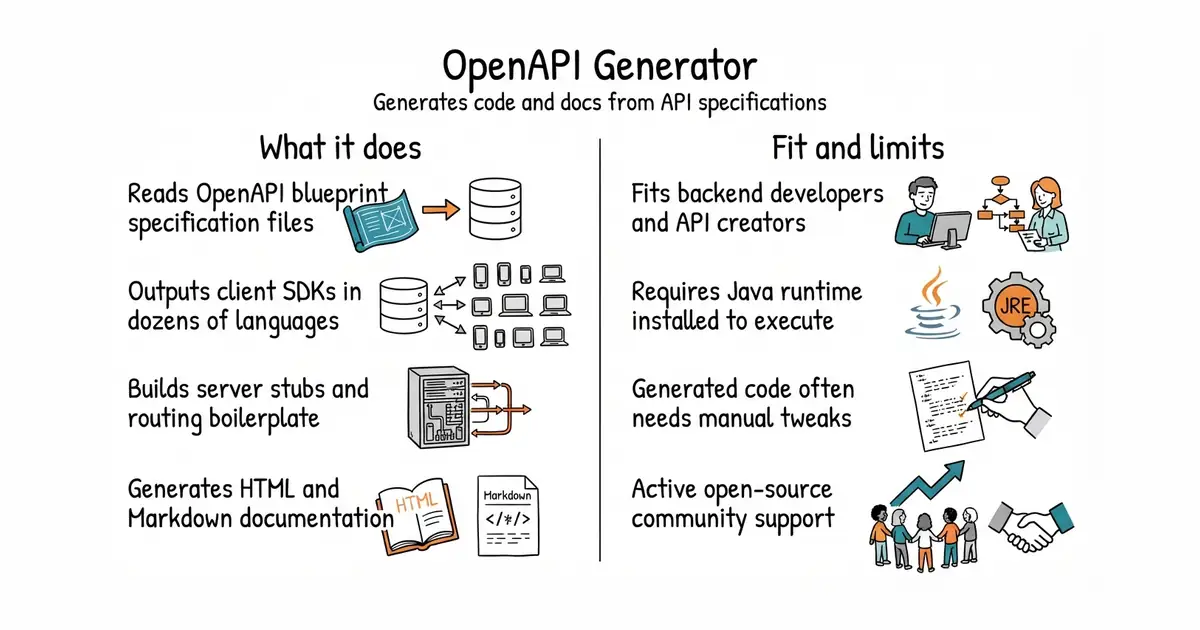
OpenAPI Generator is a command-line utility that reads an OpenAPI specification file and outputs ready-to-compile client libraries, server skeletons, and documentation. It supports dozens of programming languages and frameworks out of the box.
What it is good for
Solo developers building or consuming web APIs who want to skip writing manual client SDKs and server routing code.
- Supports dozens of programming languages and frameworks.
- Generates both client libraries and server stubs from one file.
- Integrates easily into build scripts and continuous integration pipelines.
- Requires Java (a runtime environment used to run programs written in the Java language) to be installed on your machine.
- Generated code often requires manual fine-tuning for edge cases.
- Large codebase with thousands of open issues can make troubleshooting hard.
Writing API client libraries and server route stubs by hand
Swagger Editor
- swagger-api/swagger-codegen18k stars
The older upstream project that OpenAPI Generator was originally forked from.

- evanw/esbuild40k stars
Joins many JavaScript, TypeScript and CSS files into one, in well under a second.
- Textualize/textual38k stars
Lets a Python program draw a real interface inside a terminal, and serve the same thing to a browser.
- python-attrs/cattrs1.1k stars
Turns loose data into declared Python objects, and declared objects back into loose data.
npm install @openapitools/openapi-generator-cli -g
openapi-generator-cli version