2.2k stars · MIT · v0.9.0 (2026-08-12) · Track this in Rising ↗
Distills sentence-transformers into static embeddings ~15x smaller and hundreds of times faster on plain CPU.
Radar check
What we found when we opened it. Every bar is one fact, with its date.
Last code pushed 19 Oct 2026, 8 days before this check.
Latest release v0.10.0 on 11 Oct 2026.
Public since July 2024, a little over 2 years.
2,257 stars and 128 forks.
57 commits and 3 new issues in the last 90 days.
12 contributors. 57 pull requests merged in 90 days.
No security policy file says how to report a problem. No published security advisories.
How the bars are scored
- Alive. Days since the last code push: a week or less 100, a month 90, three months 70, six months 50, a year 30, eighteen months 15, older 0.
- Releases. Age of the latest GitHub release, on a similar scale; no bar when the project publishes no releases.
- Maturity. Age of the project: eight years 100, five 90, three 70, two 55, one 40, six months 25, younger 10.
- Adoption. Stars on a log scale: 100,000 stars is 100, 10,000 is 80, 1,000 is 60, 100 is 40.
- Activity. Commits in the last 90 days: 300 or more 100, 100 85, 30 65, 10 45, any 25.
- Community. People who have contributed: 100 or more 100, 30 80, 10 60, 5 40, 2 25, one 10.
- Security. A published security policy 80, none 40; published advisories are listed, not scored.
Checked by Repo Radar on 25 Oct 2026 from the repository on GitHub. Covered in Edition 1.
▶Repo detailsthe review · specs · pros & cons · install
What it does
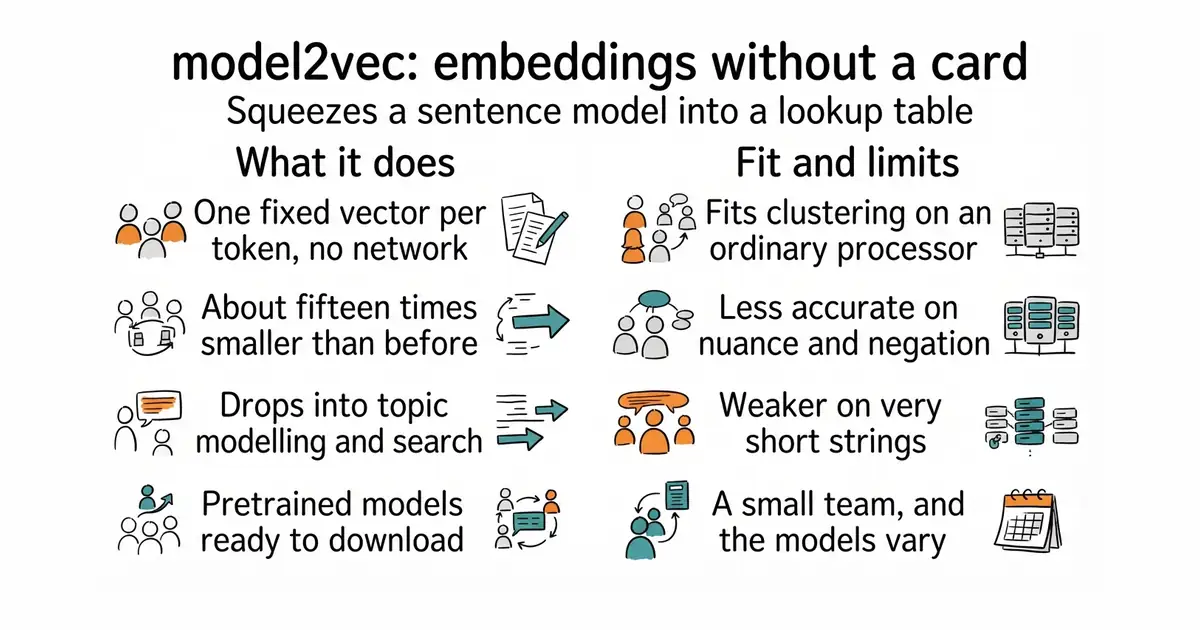
It takes a sentence-transformer model, which is a neural network that turns text into numbers, and distils it into a static model: one fixed vector per token, with no network to run at query time. You can use the pretrained models the project publishes or distil your own. The result loads in a few lines and replaces the original model in the places that expect one, including topic modelling libraries and vector search. It supports several languages and ships models of different sizes. What it does not do is match the original for accuracy: static vectors lose context, so nuance, negation and word order are handled worse than by the network they came from.
Why it matters
Who it suits. Anyone doing clustering, search by meaning or topic modelling on a machine with no graphics card, where the embedding step is what makes the whole idea feel too expensive. It also suits anything that has to embed text while a person waits, because a lookup is fast enough to do in a request. Skip it where accuracy decides the outcome, such as ranking legal or medical results, because the loss is real. Test it on your own language before committing, because the gap varies by language.
Verdict. Worth ten minutes, and the most useful small project in this edition. The reason is narrow and practical: it removes the step that makes a whole class of features look unaffordable, and it does so without a graphics card or a model provider. pip install model2vec and three lines of Python is the entire trial, so there is nothing to commit to. At 2,195 stars it is small, version 0.10.0 landed on 11 October 2026 and code on 5 September 2026, so it is active. Three honest limits. Static vectors are less accurate than the network they were distilled from, especially on short strings and on negation. The quality depends heavily on which distilled model you choose, and the published models differ. And the team behind it is small, which matters more here than usual because the pretrained models are part of the product.
Summary (Key Points)from the README
Key features
- Small size: Model2Vec reduces a Sentence Transformer model by a factor of up to 50; the best model is about 30 MB on disk and the smallest about 8 MB.
- Fast inference: Inference is up to 500 times faster on CPU than the original model.
- Fast distillation: A model can be distilled in about 30 seconds on a CPU, without a dataset, needing only a vocabulary and a model.
- Minimal dependencies: The base package's only major dependency is numpy.
- Fine-tuning: Models can be fine-tuned for classification, similarity, regression, or pair similarity, and run without torch.
- Library integrations: Model2Vec is integrated into Sentence Transformers and LangChain.
- HuggingFace hub support: Models can be shared and loaded with from_pretrained and push_to_hub.
- Model list: Five pre-trained models are offered, covering English general, English retrieval, multilingual, and code use cases.
Important
- Performance trade-off: The README says the size and speed gains come with a small drop in performance compared with the original model.
- Benchmark claims: The "most performant static embedding model in the world" and "smallest model on MTEB" claims are the authors' own statements; the README points to its results folder for supporting evidence.
- Optional extras: Distillation requires the distill extra and fine-tuning requires the train extras; the base install alone does not include them.
- Model base dependence: The flagship models are distilled from specific Sentence Transformer models (for example bge-base-en-v1.5, bge-m3 and CodeRankEmbed), so their behaviour inherits those sources.
- Language scope: Most listed models are English-only; only potion-multilingual-128M is multilingual and only potion-code-16M-v2 targets code.
Written by an AI model from the project’s README; not part of the review, and it can be wrong.
- No graphics card and no neural network at query time, so it runs comfortably on an ordinary processor.
- A direct replacement for sentence-transformers in topic modelling and vector search, so existing code barely changes.
- Plain MIT licence, actively released, with pretrained models published and ready to download.
- Static vectors lose accuracy against the network they came from, particularly on nuance and negation.
- Weaker on very short strings and on some languages, so test before committing to it.
- A small team, and the quality depends on which published model you pick.
You can embed a full transcript in seconds and keep clustering affordable, which quietly makes several features on your roadmap possible instead of theoretical.
python3 -m venv venv
source venv/bin/activate
pip install model2vec