4.8k stars · MIT | [jabref.org](https://www.jabref.org) · v5.15 (2024-07-10) · Track this in Scout
A desktop citation and reference manager that stores its library as a plain BibTeX file.
▶Repo detailsthe review · specs · pros & cons · install
What it does
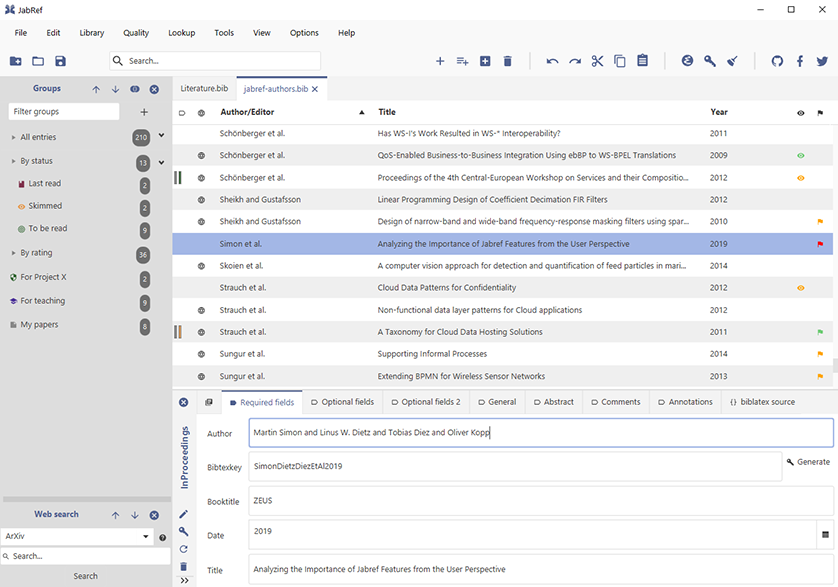
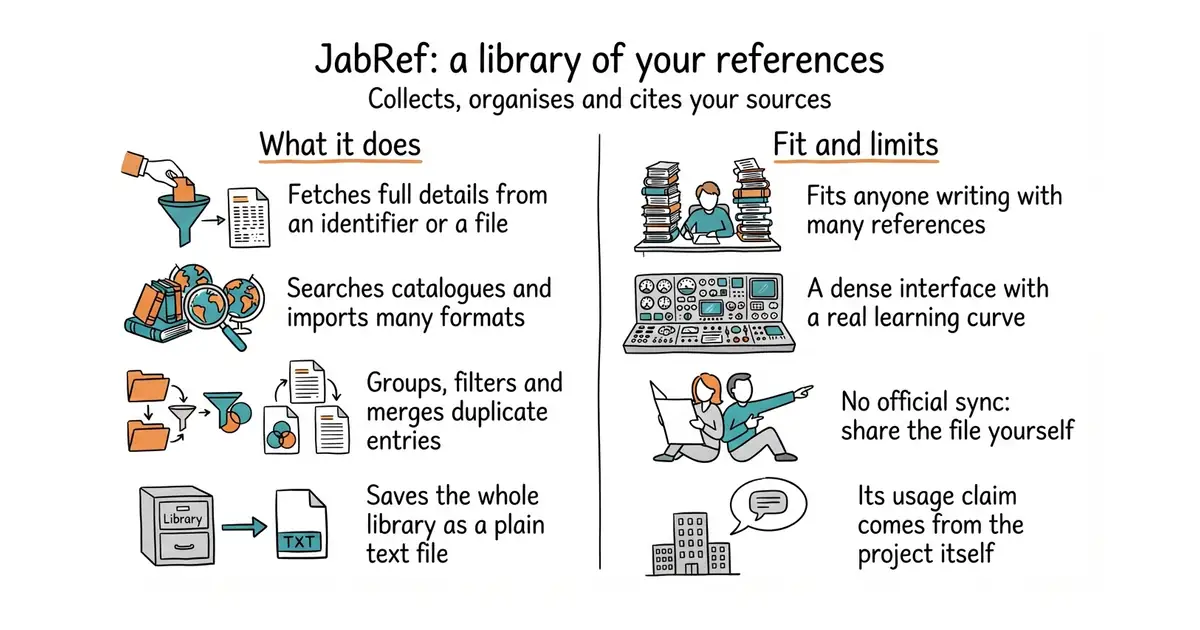
JabRef collects references four ways: searching online catalogues including CrossRef, Google Scholar, IEEEXplore, arXiv and PubMed; importing from more than 15 reference file formats; fetching full details from an ISBN, DOI, PubMed identifier or arXiv identifier; and pulling metadata out of a PDF already on your disk. Browser extensions for Firefox, Chrome, Edge and Vivaldi send a page straight into the library. Once collected, references sit in hierarchical groups with search, filtering, duplicate merging and a customisable citation-key generator, and attached files — 20 document kinds are supported — can be renamed and moved automatically by rule. For writing, it supports BibTeX and BibLaTeX natively, cite-as-you-write in several editors, thousands of citation styles, and Word and LibreOffice. A library saves as a plain text file, and a team can share one through a SQL database. There is also a command-line tool, JabKit. What it is not: a PDF reader, a note-taking system or a writing program. It manages the references and hands them to whatever you write in.
Why it matters
Who it suits. Anyone writing with references who wants the library to be a file rather than an account: a thesis, a paper, a book, a long report with sources. It is the natural companion to a text-based writing setup, because the library it produces is exactly what LaTeX and Pandoc expect. Skip it if you want your references synced to a phone and shared through a service, where a hosted product fits better, and skip it if you have fewer than twenty references, which a plain list handles.
Verdict. Worth an hour, and the reason to choose it over the better-known alternative is the file format. A BibTeX file is text: readable, searchable, sensible in version control, and accepted by every typesetting tool that matters. Two cautions. The interface is a dense desktop application and the first hour is spent finding things. And the project's own claim that "tens of thousands of researchers" use it daily is its claim, not a measurement — treat it as marketing. On currency: release v5.15 is dated 10 July 2026 against 24,690 commits, and ungh.cc refused this repository today, so that release is the proof rather than a code date. If you want something lighter and newer, Future-Scholars/paperlib does less with a cleaner interface.
- Fetches full reference details from a DOI, ISBN, arXiv or PubMed identifier, or straight out of a PDF.
- The library is a plain text BibTeX file: portable, version-controllable, and what typesetting tools already read.
- MIT licensed, with browser extensions, a command-line tool and optional sharing through a SQL database.
- A dense desktop interface with a real learning curve, and no system requirements published on the repository page.
- No official hosted sync; sharing a library means running a SQL database or passing the file around.
- The headline usage claim comes from the project itself, with nothing behind it that a reader can check.
 zotero/zotero
The best-known alternative: collecting, organising, annotating and citing sources, with hosted sync and a stronger browser capture.
Track this in Scout- Future-Scholars/paperlib
A smaller, newer academic paper manager that imports papers, scrapes metadata and exports citations, with far less to learn.
Track this in Scout
docker run ghcr.io/jabref/jabkit:edge --help