46.1k stars · AGPL-3.0 · no tagged releases; 17,418 commits on master · Track this in Rising ↗
Turns almost any page into an RSS feed — Reddit searches, YouTube channels, Hacker News — so competitor and keyword monitoring becomes a notification.
Radar check
What we found when we opened it. Every bar is one fact, with its date.
Last code pushed 27 Oct 2026, the same day before this check.
Latest release v2026.10.27-8486.1d73c7c on 27 Oct 2026.
Public since April 2018, a little over 8 years.
46,687 stars and 10,291 forks.
2,791 commits and 66 new issues in the last 90 days.
1,745 contributors. 594 pull requests merged in 90 days.
A security policy says how to report a problem. 7 published security advisories.
How the bars are scored
- Alive. Days since the last code push: a week or less 100, a month 90, three months 70, six months 50, a year 30, eighteen months 15, older 0.
- Releases. Age of the latest GitHub release, on a similar scale; no bar when the project publishes no releases.
- Maturity. Age of the project: eight years 100, five 90, three 70, two 55, one 40, six months 25, younger 10.
- Adoption. Stars on a log scale: 100,000 stars is 100, 10,000 is 80, 1,000 is 60, 100 is 40.
- Activity. Commits in the last 90 days: 300 or more 100, 100 85, 30 65, 10 45, any 25.
- Community. People who have contributed: 100 or more 100, 30 80, 10 60, 5 40, 2 25, one 10.
- Security. A published security policy 80, none 40; published advisories are listed, not scored.
Checked by Repo Radar on 28 Oct 2026 from the repository on GitHub. Covered in Edition 4.
▶Repo detailsthe review · specs · pros & cons · install
What it does
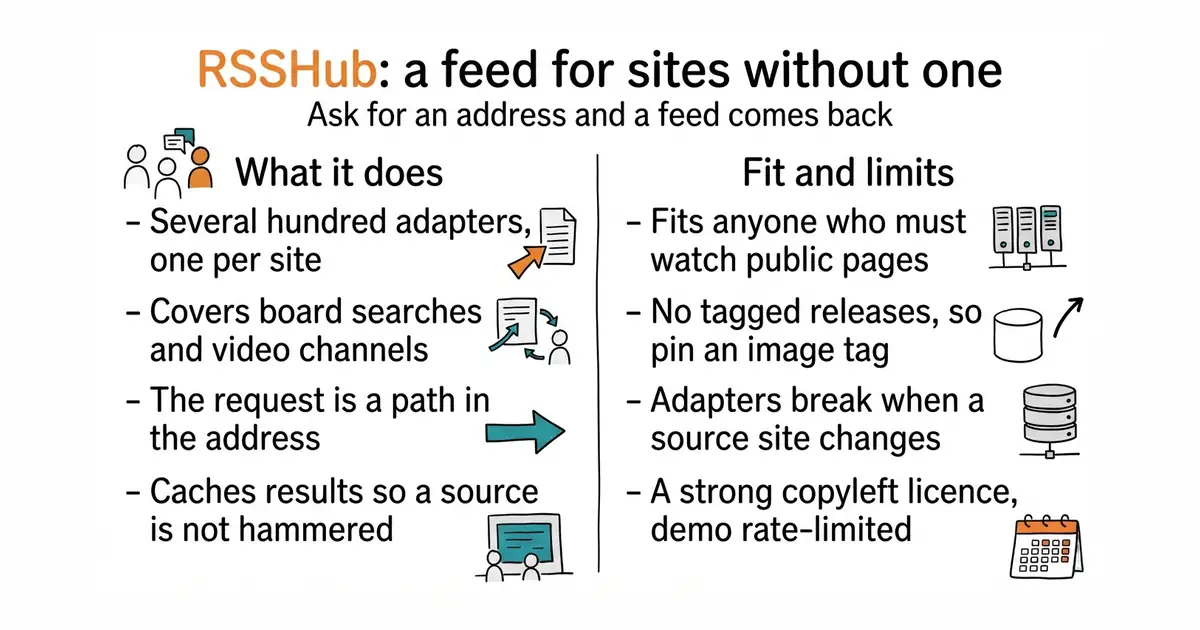
It generates a feed for websites that publish none of their own. Several hundred adapters are included, each one covering a particular site or a particular kind of page. Discussion-board searches, video channels, news aggregators, job boards and shop listings are all among them. The request is made as a path in the web address, so no configuration file is written per source. It runs as one server, with published Docker images and a public demonstration instance. Results are cached, so a source site is not hit repeatedly. It does not read or store feeds; that is a feed reader's job. It publishes no tagged releases, so there is no version number to pin, only a container image.
Why it matters
Who it suits. Anyone who needs to know when a specific question gets asked in public, or when a competitor publishes something, and cannot sit watching the sites all day. Feeds are also the easiest thing to hand to an automation tool, which turns watching into a notification that arrives. Skip it if the sites in question already publish feeds, which more of them do than people assume.
Verdict. Worth an hour, and among the most reliably maintained projects of its kind. Code was pushed on the same day this refresh was written. Three cautions. There are no tagged releases, so pin a specific container image or a rebuild will quietly change behaviour. Individual adapters break when a source site changes its pages, and an empty feed looks exactly like a quiet week, so the feeds need checking. And the licence is AGPL-3.0 with the public demonstration instance rate-limited, so run a private copy.
Summary (Key Points)from the README
Key features
- Large content coverage: RSSHub aggregates millions of contents from all kinds of sources.
- Global instance network: The README describes it as the world's largest RSS network, with over 5,000 global instances.
- Active open source community: Contributors deliver new routes, new features and bug fixes.
- Folo integration: Folo is an AI RSS reader that the README says works especially well with RSSHub.
- Feed discovery in the browser: RSSHub Radar helps users find and subscribe to RSS and RSSHub feeds on the sites they visit.
- Mobile companions: RSSBud covers iOS and RSSAid covers Android, the latter built with Flutter.
- Raycast search: DocSearch Link brings RSSHub documentation search into Raycast.
- Curated route list: Awesome RSSHub Routes collects RSS feeds and RSSHub routes.
Ways to install
| Platform or method | What it needs | Effort |
|---|---|---|
| Hostinger one-click deployment | Not stated in the README | Single click, per the README |
| Deployment guide | Not stated in the README; the README points to a separate Deployment page | Not stated in the README |
Important
- Setup details are elsewhere: The README gives no installation steps, requirements or hosting specs. It only links to Quick Start and Deployment pages.
- Promotions appear in the README: A RapidProxy ad (residential proxies from $0.55/GB) and a Hostinger one-click deploy offer are included. Neither is part of RSSHub itself.
- Headline figures are self-reported: The "5,000 global instances" and "millions of contents" claims come from the README and are not verified here.
- License: RSSHub is released under AGPL-3.0. The README does not explain what that means for users who run or modify it.
Written by an AI model from the project’s README; not part of the review, and it can be wrong.
- Several hundred adapters already written, including board searches and video channels
- Feeds are the ideal input for an automation tool, which turns watching into a notification
- Among the most actively maintained projects in this area
- No tagged releases, so pin a container image or a rebuild will surprise you
- Adapters break when a source site changes, and a silently empty feed looks like a quiet week
- AGPL-3.0, and the public demonstration instance is rate-limited
Point RSSHub at a handful of searches and your competitors' YouTube channels, wire the feeds into n8n from Edition 1, and the questions arrive in your inbox instead of you hunting for them.
n8n subscribes to the feeds and emails you the matches.
docker run -d --name rsshub -p 1200:1200 diygod/rsshub