Radar check
What we found when we opened it. Every bar is one fact, with its date.
Last code pushed 23 Oct 2026, 2 days before this check.
Latest release v0.9.3 on 21 Feb 2025.
Public since March 2021, a little over 5 years.
1,715 stars and 335 forks.
6 commits and 1 new issues in the last 90 days.
223 contributors. 6 pull requests merged in 90 days.
No security policy file says how to report a problem. No published security advisories.
How the bars are scored
- Alive. Days since the last code push: a week or less 100, a month 90, three months 70, six months 50, a year 30, eighteen months 15, older 0.
- Releases. Age of the latest GitHub release, on a similar scale; no bar when the project publishes no releases.
- Maturity. Age of the project: eight years 100, five 90, three 70, two 55, one 40, six months 25, younger 10.
- Adoption. Stars on a log scale: 100,000 stars is 100, 10,000 is 80, 1,000 is 60, 100 is 40.
- Activity. Commits in the last 90 days: 300 or more 100, 100 85, 30 65, 10 45, any 25.
- Community. People who have contributed: 100 or more 100, 30 80, 10 60, 5 40, 2 25, one 10.
- Security. A published security policy 80, none 40; published advisories are listed, not scored.
Checked by Repo Radar on 26 Oct 2026 from the repository on GitHub.
In simple English
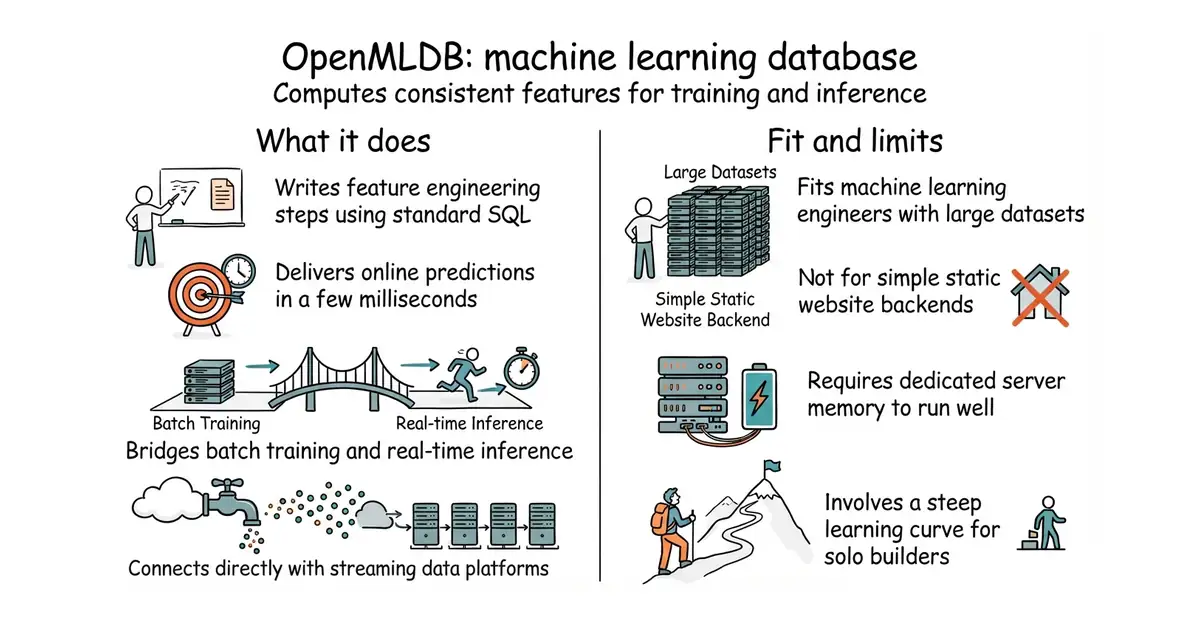
Building machine learning models requires preparing data in exact ways for training and live use. Doing this twice using different tools often leads to silent errors and mismatched results. This database lets you write feature extraction steps once using SQL. It runs those steps for offline training and online predictions without changes. It is free to use under an open source licence, but requires significant setup and server resources.
What it is
OpenMLDB is an open-source machine learning database and feature platform built to compute consistent features for both model training and online inference. It provides a real-time SQL engine optimized for time-series data and a batch engine to process large datasets.
What it is good for
Data scientists and engineers who need to deploy complex time-series feature engineering pipelines into production without rewriting Python scripts into C++.
- Produces consistent features for both offline training and online inference.
- Processes real-time queries in a few milliseconds for low-latency predictions.
- Uses standard SQL syntax extended specifically for machine learning tasks.
- Complex distributed architecture requires significant setup effort for non-programmers.
- Demands substantial RAM and server resources to run in-memory computations.
- Maintained primarily by enterprise contributors with a steep learning curve.
custom python feature scripts and manual c++ production rewrites
Apache Kafka
- feast-dev/feast7.3k stars
An open source feature store for machine learning that helps manage and serve features.

- basicmachines-co/basic-memory4.3k stars
Gives an AI assistant a memory that is stored as plain text files you can read.
- deepset-ai/haystack27k stars
A Python framework for joining language models, document search and tools into one working pipeline.
- Giskard-AI/giskard-oss5.9k stars
A Python library that writes tests for language-model programs and tries to break them on purpose.
docker run -d --name openmldb -p 8080:8080 4pdosc/openmldb:latest